


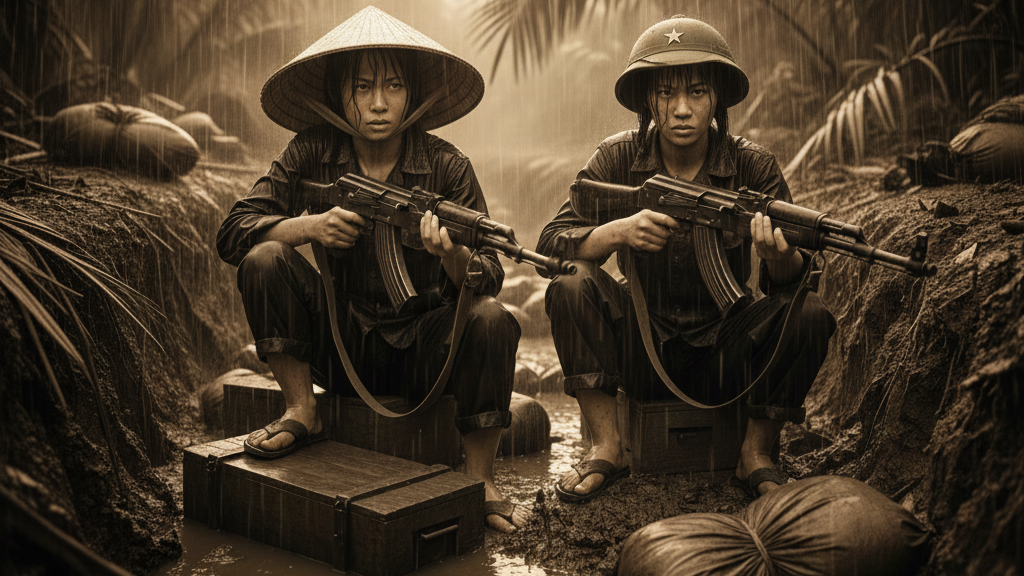
When images of the Vietnamese wars circulate in popular memory, they often focus on male guerrillas or uniformed soldiers facing overwhelming firepower. Yet woven through every phase of Vietnam’s long struggle against colonial rule and foreign intervention was a vast, determined, and often decisive female presence. Vietnamese women were not marginal helpers or symbolic figures. They were fighters, spies, logisticians, political organizers, medics, and enforcers of revolutionary discipline, forming a backbone of resistance during the wars against both France and the United States.
Women’s participation drew on a deep historical narrative. Vietnamese revolutionary leaders consciously invoked legendary heroines such as the Trưng Sisters and Lady Triệu, figures taught in schools and celebrated in folklore as proof that women had always defended the nation. During the war against French colonial rule from 1946 to 1954, women were formally integrated into the Viet Minh, operating in rural villages and contested zones where revolutionary control depended on constant civilian involvement. Women hid cadres, transported weapons, acted as couriers and intelligence gatherers, and in many cases joined armed village militias. Their labor sustained guerrilla warfare in areas where formal armies could not operate openly.
This role expanded dramatically during the war against the United States and the South Vietnamese government. Within the Viet Cong, women were everywhere. Historians estimate that women made up roughly one-third of local guerrilla forces, and in some village militias they formed the majority. They carried rifles, laid booby traps, served as snipers, and defended hamlets during raids. Equally crucial was their ability to blend into civilian life. Women moved through markets, towns, and checkpoints with less suspicion, making them ideal intelligence operatives and couriers in urban and semi-urban areas.
Perhaps the most punishing work fell on women assigned to logistics. Along the Ho Chi Minh Trail, an immense supply network threading through jungles and mountains, women cleared paths, repaired bombed roads, carried ammunition and food, and evacuated the wounded under constant aerial bombardment. Many were barely out of their teens. They worked with rudimentary tools, slept in makeshift shelters, and endured malaria, malnutrition, and exhaustion. Survival itself became an act of resistance.
The revolutionary state framed this participation through slogans such as the “three-ready women,” celebrating those ready to fight, to produce, and to support the revolution. Propaganda posters and photographs showed young women in black pajamas, rifles slung over their shoulders, calm and resolute. These images were meant to signal both national unity and socialist modernity, suggesting that women’s emancipation was inseparable from national liberation.
Reality, however, was more complicated. Wartime necessity pushed women into roles that challenged traditional gender norms, but it did not erase them. Female fighters faced the same dangers as men while also navigating expectations of modesty, sexual restraint, and eventual return to domestic life. After victory, many women veterans found their sacrifices quietly sidelined as society reasserted conventional roles of wifehood and motherhood. Recognition, pensions, and public honor often flowed more readily to male counterparts.
Still, participation in the war transformed women’s lives in lasting ways. It expanded literacy, political awareness, and social mobility, particularly for rural women who had previously been confined to household labor. It also left a deep imprint on Vietnam’s collective memory. Museums, textbooks, and memorials continue to depict women as integral to victory, complicating simplistic narratives of the Vietnam War as a clash between armies alone.
The story of Vietnamese female fighters is ultimately a story of mass mobilization. Against technologically superior enemies, the revolution relied on society itself becoming the battlefield. Women made that possible. They sustained supply lines, gathered intelligence, fought when necessary, and ensured continuity when units were destroyed or displaced. Without them, the long war of attrition that defined Vietnam’s path to independence would have been impossible. Their legacy is not merely symbolic. It is structural, written into the very mechanics of how a small, resource-poor country sustained decades of resistance and reshaped its own social order in the process.
People love to say the Vietnam War was fought by men with guns and helicopters. Cute story. Convenient story. Partially false.
Vietnam was fought also by women, who carried rice baskets that hid grenades, by teenage girls repairing bombed roads at night, by mothers who smiled at checkpoints and passed intelligence an hour later, by grandmothers who hid wounded fighters under the floorboards. If you remove women from Vietnam’s wars of liberation, the whole heroic masculine war movie collapses like a cheap bamboo chair.
Let’s be very clear: Vietnamese women were not “supporting” the revolution. They were the revolution. They made guerrilla warfare possible. They made long wars survivable. They turned kitchens, villages, tunnels, markets, and even their own bodies into infrastructure. And they did it while being underestimated, sexualised, dismissed, or completely ignored by enemy forces who could not imagine that the woman selling vegetables might also be the one mapping their patrol routes.
This is what patriarchy does best: it blinds itself.
The revolutionary slogans loved to talk about equality. Posters showed young women with rifles and perfect posture. But after the war? Oh, after the war, the same women were often quietly told to put the gun down, pick up the baby, and stop making noise. Liberation, it turns out, has a gender expiry date.
And yet—this is the part that really gets me—those women knew the deal. Many of them understood perfectly well that the revolution might not fully love them back. They fought anyway. Not because they were naïve, but because survival, dignity, and autonomy sometimes demand dirty compromises. War is not a feminist utopia. It is a brutal negotiation with reality.
Western narratives still struggle with this. They want Vietnamese women to be victims only, or symbols only, or background scenery in someone else’s trauma. What they don’t like is agency. A woman with a gun who knows exactly why she’s holding it makes people uncomfortable—especially when she’s not asking for permission or applause.
So no, don’t romanticise them. Don’t turn them into soft-focus heroines or tragic footnotes. Respect them as strategists, labourers, fighters, and political actors. Respect the contradiction: they broke gender roles to win a war, and then were pushed back into them once the war was won.
History didn’t forget Vietnamese women. History was taught to look away.
And Spicy Auntie? I’m not looking away.