


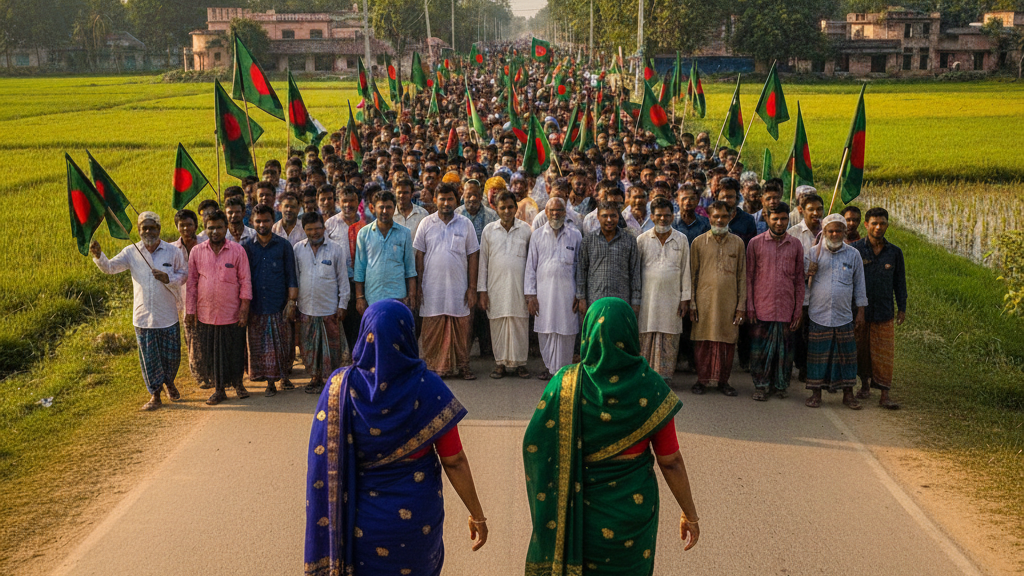
For more than three decades, Bangladesh lived under what commentators came to call the “Age of the Begums,” a political era defined by the rivalry between Begum Khaleda Zia and Sheikh Hasina. Few countries anywhere in the world were governed so consistently by women, and fewer still in South Asia or the Muslim-majority world. Yet this period also produced one of modern politics’ sharpest paradoxes: a nation ruled by women while remaining stubbornly patriarchal for most women who lived in it.
Both leaders entered politics through national tragedy and dynastic inheritance. Khaleda Zia stepped into public life after the assassination of her husband, President Ziaur Rahman; Sheikh Hasina emerged as the sole surviving political heir of Sheikh Mujibur Rahman after the 1975 massacre of her family. Their personal histories endowed them with moral authority and emotional resonance that male rivals struggled to match. Over time, politics hardened into a binary struggle, with the country oscillating between the two camps and interpreting almost every election, protest, or reform through their antagonism.
At the very top, this created the image of a country that had broken the glass ceiling. At almost every level below, the ceiling remained firmly in place. Parliament continued to be dominated by men, with women largely confined to reserved seats rather than competitive constituencies. Party hierarchies stayed deeply masculine, hostile to independent female leaders who lacked dynastic protection. The implicit lesson was clear: women could rule, but only as exceptional figures, not as a normal outcome of political participation.
Legal reforms affecting women followed the same cautious pattern. During the Begums era, laws addressing acid attacks, domestic violence, and trafficking were introduced or strengthened, often under pressure from activists and international partners. These measures mattered, and they saved lives. Yet the foundations of gender inequality were rarely touched. Family law governing marriage, divorce, custody, and inheritance remained largely unchanged, continuing to disadvantage women through religious and customary norms. Neither leader was willing to spend political capital on reforms that might provoke conservative backlash, preferring incremental change to confrontation.
The gap between rhetoric and reality was especially visible in the persistence of gender-based violence. Acid attacks, dowry-related abuse, child marriage, and sexual harassment were publicly condemned by successive governments, sometimes with dramatic speeches delivered by women prime ministers themselves. But enforcement lagged. Police inaction, informal mediation, and pressure on victims to reconcile with abusers remained widespread. For many women, the presence of a female leader at the top did little to alter their experience with the justice system on the ground.
Economically, the paradox deepened. Women became central to Bangladesh’s growth story through their mass participation in the garment industry, which expanded rapidly during the Begums era and turned the country into a global manufacturing hub. Millions of women gained wages, mobility, and a measure of independence. At the same time, they labored under low pay, unsafe conditions, and weak labor protections, with unionization discouraged and workplace rights framed as economic rather than gender issues. Women powered national development while remaining largely invisible in political decision-making.
Socially, female rule did not soften public morality. If anything, discourse around women’s behavior and respectability grew more restrictive. Female journalists, students, and activists were increasingly scrutinized for their dress and conduct, while feminism was often portrayed as foreign, elitist, or culturally corrosive. The ruling parties themselves relied heavily on respectability politics, shielding their leaders from misogyny by emphasizing their roles as widows and mothers rather than confronting patriarchal attitudes head-on.
This may be the most enduring contradiction of the Age of the Begums. The dominance of two women allowed society to claim progress while avoiding structural change. “Women already rule here,” critics of gender reform could say, dismissing demands for bodily autonomy, labor rights, or legal equality as unnecessary or excessive. Female leadership became a symbol that substituted for gender justice rather than a vehicle for it.
With Khaleda Zia’s death and Sheikh Hasina’s removal from office, Bangladesh has finally stepped out of this long shadow. The end of the Begums era is not only a political transition but a conceptual one. It forces a reckoning with the limits of representation without transformation, and with the uncomfortable truth that women in power do not automatically produce feminist states. Whether the next chapter moves beyond personality-driven politics toward institutional gender justice remains an open question. What is clear is that the paradox of the Age of the Begums will continue to shape how Bangladesh understands power, gender, and the difference between seeing women rule and seeing women truly free.
Everyone loves the photo-op of a woman at the very top of power. A woman sworn in. A woman saluted. A woman behind the big desk. It makes for irresistible headlines: Look! Progress! And yet, if you’ve lived long enough, or paid close enough attention, you know this truth is deeply uncomfortable for liberal democrats and authoritarian nostalgists alike: women in power do not automatically deliver women’s rights.
Bangladesh just gave us a textbook case. For decades, the country was ruled by two formidable women. Strong personalities, iron wills, historic legacies. And yet, ordinary Bangladeshi women continued to face child marriage, domestic violence, unequal divorce laws, workplace exploitation, and a justice system that too often told them to reconcile, endure, or stay silent. Female leadership at the top became a convenient alibi: what more do you want? Women already rule.
I’ve seen this movie before. India watched it under Indira Gandhi, the only woman “strong enough to be prime minister,” who also suspended civil liberties and never made women’s rights a central political project. Pakistan lived it with Benazir Bhutto, courageous and brilliant, yet constrained by dynastic politics, military power, and conservative compromises that left most Pakistani women exactly where they were. Indonesia experienced it with Megawati Sukarnoputri, elevated more by lineage than ideology, presiding over stability but not transformation for women’s bodies, labor, or political representation.
These women mattered. They broke ceilings. They survived systems designed to crush them. But let’s be honest: they governed as exceptions, not as feminists. Their power was personal, not structural. Their legitimacy came from fathers, husbands, martyrs, bloodlines. And once you enter power that way, you don’t burn the house down — you carefully redecorate one room and call it reform.
Patriarchy is perfectly capable of tolerating a few exceptional women, as long as the rules remain intact. In fact, it prefers them. They are useful symbols. They silence critique. They allow men to say, “See? Gender equality achieved,” while women at the bottom keep stitching garments, bearing sons, swallowing abuse, and navigating laws written without them in mind.
This is the hard lesson feminism in Asia keeps relearning: representation is not liberation. A woman leader can be conservative. She can be authoritarian. She can be indifferent to other women’s lives. And sometimes, she must be — to survive.
So yes, celebrate women who reach the summit. But don’t confuse the view from the top with the condition of the ground below. Until laws change, institutions shift, and ordinary women gain power over their own lives, a woman on the throne is just that: a woman on a throne. And patriarchy, darling, is very comfortable bowing to queens.