


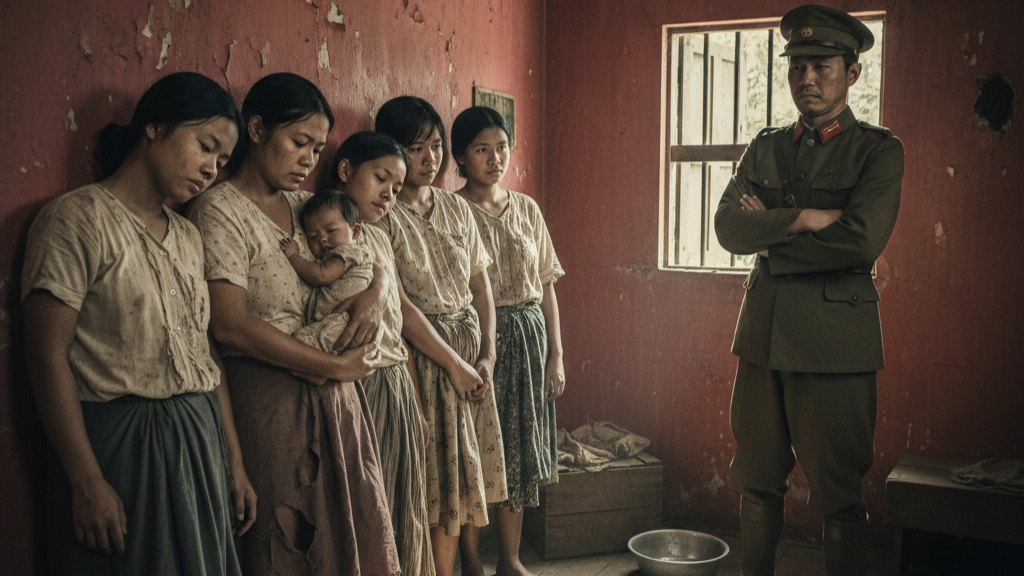
The crumbling walls of Bahay na Pula—the Red House in Bulacan—stand at the center of one of the Philippines’ most painful memory wars, where preservation, trauma, justice, and forgetting collide. Once a graceful prewar residence, the house has become a contested symbol of Japanese wartime sexual violence, raising urgent questions: should places of extreme suffering be restored as memorials, or allowed to fade away in deference to survivors who want to move on? As climate threats, real estate pressure, and the passage of time converge, the debate has grown sharper, more emotional, and increasingly political.
Built in 1929 and seized by Japanese troops in the final year of World War II, Bahay na Pula was used as a detention and rape site for women and girls from nearby villages, particularly Mapaniqui in Pampanga, after a brutal anti-guerrilla raid in November 1944. Survivors recount how men were tortured and executed, while women were imprisoned and repeatedly abused—a crime now internationally recognized as wartime sexual slavery. In Filipino collective memory, this falls under karahasang seksuwal sa digmaan (sexual violence in war), a chapter long marginalized by postwar silence and Cold War geopolitics.
Today, the house is close to collapse. Conservationists warn that a strong typhoon could erase it entirely within a year. Architects and heritage advocates argue that losing the structure would mean losing a rare, tangible witness to atrocities often dismissed as “he said, she said.” For them, preserving the house is an act of pag-alala (remembrance) and katarungan (justice), especially as survivors age and oral testimony risks being lost. They envision a memorial or small museum that tells the story soberly, without sensationalism, and possibly even without the house’s original red color, which many associate with fear and blood.
But not all survivors agree—and this is where the debate becomes deeply uncomfortable. Members of the Malaya Lolas (Free Grandmothers), a group of Filipina survivors of Japanese military sexual violence, have voiced strong opposition to restoring the site. For them, the house is not a neutral historical artifact but a living wound. Seeing it again means reliving the trauma. One survivor has said that no building is needed as long as people continue to listen to their stories. This stance reflects pagpapagaling (healing) through distance rather than preservation, and a belief that memory can—and perhaps should—live in testimony rather than bricks and mortar.
This tension highlights a recurring dilemma in post-conflict societies: who owns memory? Conservationists often frame preservation as future-oriented, arguing that memorials are for the next generations, not just the present one. Survivors who oppose restoration insist that their lived pain should not be overridden by abstract ideals of heritage. Both positions are rooted in legitimate claims, and neither fits neatly into activist slogans.
The Philippine government has so far struggled to respond decisively. Local officials have expressed interest in acquiring the property and converting it into a memorial space, but funding constraints, private ownership, and bureaucratic inertia have stalled progress. At the national level, cultural and historical agencies have remained largely silent. This hesitancy contrasts with growing international pressure: in 2023, a United Nations women’s rights body urged the Philippines to preserve the site or establish another form of memorialization to honor victims of wartime sexual slavery.
The debate around Bahay na Pula also unfolds in the shadow of Philippine–Japan relations, now framed by economic cooperation, aid, and strategic alignment. Advocates for preservation stress that remembering atrocities does not equal hostility, invoking pakikipagkasundo (reconciliation) rather than revenge. Critics fear, however, that memorialization without survivor consensus risks instrumentalizing trauma for political or symbolic gain.
As the Red House continues to decay, the real danger may be indecision itself. If nothing is done, nature and neglect will decide, quietly erasing a site that embodies both unbearable pain and unresolved history. Whether through preservation, alternative memorials, or intensified documentation of survivor testimonies, the debate forces the Philippines to confront how it remembers violence against women in war—not as distant history, but as a moral reckoning still unfinished.
I have sat in too many rooms with too many women who survived war, occupation, “peace,” and silence to believe there is a single correct way to remember. So when people ask me whose side I’m on in the Bahay na Pula debate, my answer is: I am on the side of women—and women are not a monolith.
Let’s be very clear. What happened in that house was not “history.” It was karahasang seksuwal (sexual violence), systematic, racialized, militarized. Girls were raped. Mothers were imprisoned. Fathers and brothers were tortured and killed. That truth does not soften with time, nor does it become less obscene because eighty years have passed. Anyone suggesting we should “move on” without acknowledging that is asking women to perform emotional labor for the comfort of others. Again.
And yet. I also understand the women who cannot bear to see that house restored. Trauma is not an archive. Memory does not sit politely on museum walls. For some survivors, healing looks like distance, not preservation. Asking an elderly woman to relive her worst memories for the sake of national pedagogy can feel like a second violation. That matters. Deeply.
What troubles me is not disagreement among survivors. What troubles me is how quickly institutions fall silent when women disagree. Suddenly, nothing moves. No funding. No decision. No urgency. The house collapses, conveniently, and everyone can sigh with relief: Ay, wala na (it’s gone). No fight needed. No accountability required.
Letting Bahay na Pula rot is not neutrality. It is a choice. A very familiar one.
Here is the uncomfortable feminist truth: preserving a site of violence is not about honoring pain—it is about refusing denial. Physical places matter because states forget on purpose. Buildings testify when governments hedge. Ruins speak when diplomatic language smooths everything over. This is not about hating Japan; it is about refusing pagbubura (erasure).
But preservation without consent is also violence. Turning trauma into a tourist stop or a nationalist talking point would be grotesque. Any memorial must be survivor-led, trauma-informed, and explicit about sexual violence—not sanitized into vague “wartime suffering.” No heroic plaques. No red paint. No false reconciliation.
If the house is saved, it must be saved carefully. If it is not, then the stories must be preserved fiercely—taught, archived, translated, repeated until denial becomes impossible.
What I will not accept is this slow-motion disappearance disguised as respect. Silence is not healing. Forgetting is not peace. And women’s suffering is not something to be negotiated away because it makes people uncomfortable.
We can remember without hating. But we cannot heal by pretending nothing happened.