


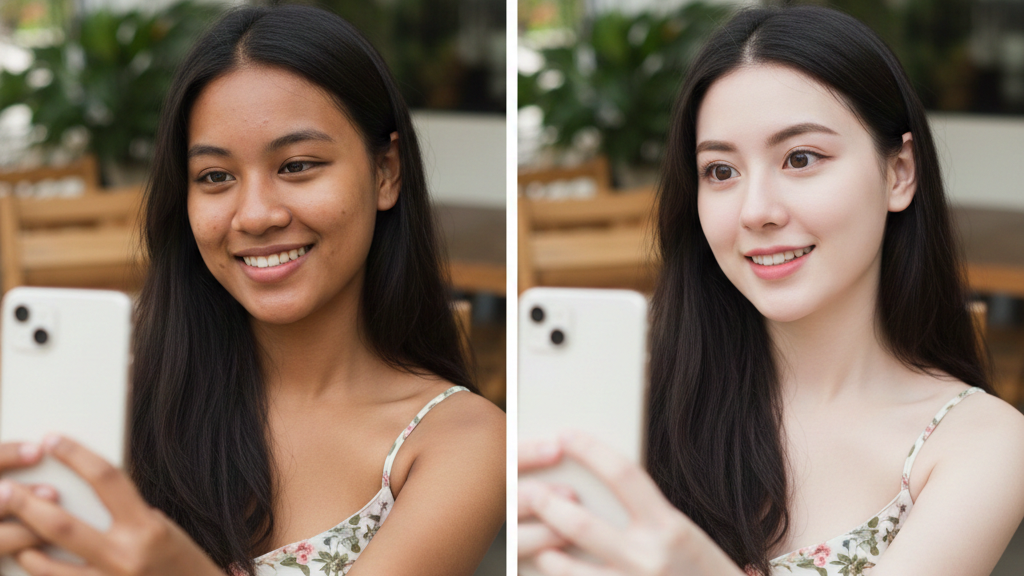
In Southeast Asia, beauty filters are no longer a playful add-on to selfies. They have quietly become a baseline—the visual minimum many women feel expected to meet before posting a photo, joining a video call, or even updating a profile picture. Open TikTok, Instagram, or Snapchat anywhere from Manila to Jakarta, Ho Chi Minh City to Bangkok, and the faces that fill the screen tend to share the same digital polish: smooth, poreless skin, lighter and brighter tones, slimmed cheeks, larger eyes, softened jawlines. The transformation is subtle enough to pass as “natural,” yet powerful enough to reshape what ordinary beauty now looks like.
This is not only about vanity. It is about digital colorism, a long-standing regional hierarchy—lighter skin equals higher status—reborn through algorithms. On most popular apps, the default “beautify” preset still nudges skin toward brightness, sometimes explicitly labeled “whitening” or “brightening,” sometimes quietly embedded in smoothing and lighting adjustments. The effect echoes colonial-era aesthetics, advertising tropes, and class-coded beauty standards that have circulated in Southeast Asia for generations. Filters simply compress those histories into a single tap.
The ecosystem is vast. Inside global platforms like TikTok, Instagram, and Snapchat, built-in effects offer instant face slimming, eye enlargement, and complexion correction. Alongside them sits a thriving parallel world of dedicated beauty-camera apps. SNOW and SODA, originally popularized in East Asia, are widely used across Southeast Asia for selfies that promise “natural” enhancement. Chinese-origin apps such as Meitu and BeautyPlus remain staples, especially among younger users, offering high-powered editing tools that can dramatically reshape facial features while preserving photographic realism. Photos edited in these apps are then uploaded back onto mainstream platforms, blending seamlessly into everyday feeds.
What makes this moment different from earlier photo-editing trends is how invisible the edits have become. Earlier filters were obvious—dog ears, flower crowns, cartoon blush. Today’s AI-driven beautification is harder to detect. Faces move naturally, lighting adapts, skin texture appears intact even when it has been digitally perfected. As a result, viewers are not just comparing themselves to celebrities or influencers; they are comparing themselves to what looks like a plausible, achievable version of their peers. Often, they are comparing themselves to an improved version of their own face.
This is where “beauty baseline pressure” sets in. In many Southeast Asian social circles, especially among urban youth and young professionals, posting an unfiltered photo can feel like breaking an unspoken rule. Filters become equivalent to grooming—like combing your hair or ironing your clothes—except the grooming quietly alters bone structure and skin tone. Once most people edit, not editing becomes noticeable. The standard shifts.
Colorism intensifies this pressure. In multicultural societies like the Philippines, Indonesia, Thailand, and Vietnam, lighter skin has long been associated with urban privilege, education, and upward mobility. Digital filters reinforce these associations by making brightness the visual default. Even when users insist they are only “fixing lighting,” the cumulative effect is a feed that narrows acceptable skin tones and subtly marginalizes darker complexions. This is particularly striking in Southeast Asia, where real-world diversity is enormous but digital representation grows increasingly uniform.
The emotional impact varies. Many women describe filters as confidence-boosting, playful, or protective—a way to control how they are seen in fast-moving online spaces that can be cruel. At the same time, regional research and clinical commentary increasingly point to a downside: heightened self-surveillance, constant comparison, and dissatisfaction triggered not by strangers but by one’s own edited images. Teenagers and young adults appear especially vulnerable, growing up in an environment where their first online face is rarely their real one.
Platforms are beginning to acknowledge the issue. TikTok has announced restrictions on certain appearance-altering filters for users under 18, targeting effects that slim faces, enlarge lips, or dramatically smooth skin. But regulation moves slowly, while beauty technology evolves fast. In Southeast Asia—where TikTok penetration is massive and beauty apps are normalized early—policy changes often lag behind everyday practice.
The result is a paradox. Filters promise empowerment, yet quietly enforce conformity. They offer creativity, yet reproduce old hierarchies of skin tone and facial structure. In Southeast Asia, the question is no longer whether women use beautifying filters. It is whether opting out is still socially possible—and what it means for a region whose real beauty has always been far more varied than the faces scrolling past our screens.
Oh sweetheart, let’s stop pretending this is just about “fun filters.” Auntie has lived long enough—and scrolled long enough—to know when a harmless toy quietly turns into a social rule.
In Southeast Asia today, beauty filters are not optional anymore. They are etiquette. They are the digital equivalent of being told, gently but firmly, “Maybe fix yourself a little before showing up.” And guess what we’re fixing? Not bad lighting. Not tired eyes. We’re fixing skin tone. We’re fixing cheekbones. We’re fixing noses, jaws, lips—whole ethnic histories, erased with one tap and a promise of looking “natural.”
Natural for whom, darling?
What makes me itch is how sneaky it’s become. In my time, whitening creams were loud. They shouted their prejudice from billboards and pharmacy shelves. Today, colorism whispers. It hides inside words like “brighten,” “clean,” “fresh,” “soft glow.” You slide the bar just a little—because everyone else does—and suddenly your brown, gold, sun-kissed Southeast Asian skin has been politely escorted out of the frame.
And then comes the real trick: once everyone edits, not editing feels rebellious. Risky. Almost rude. Posting your real face starts to feel like turning up to a wedding in flip-flops—not illegal, but socially uncomfortable. So young women learn early that their real face is a draft, and the edited one is the final version.
Auntie finds that cruel.
I hear the defense all the time: “It boosts confidence.” Sure. So does wearing heels. So does makeup. But heels come off. Filters don’t. Filters follow you into mirrors, into dates, into job interviews, into that tiny voice that asks why you don’t look like yourself anymore. And unlike makeup, filters don’t just decorate—they replace. They quietly teach you that your natural skin tone is a problem to solve.
Let me be clear: I am not here to shame women for using filters. In a world that grades us visually every second, survival strategies are not moral failures. The problem is not the girls. It’s the system that convinces them they must polish their faces before being seen as worthy of attention, respect, or desire.
So yes, use the filter if you want. Play. Experiment. Have fun. But don’t let an app tell you that Southeast Asian beauty needs correcting. Our faces are not “before” photos. They are the whole damn story.
And Auntie will keep saying it, filtered or not.