


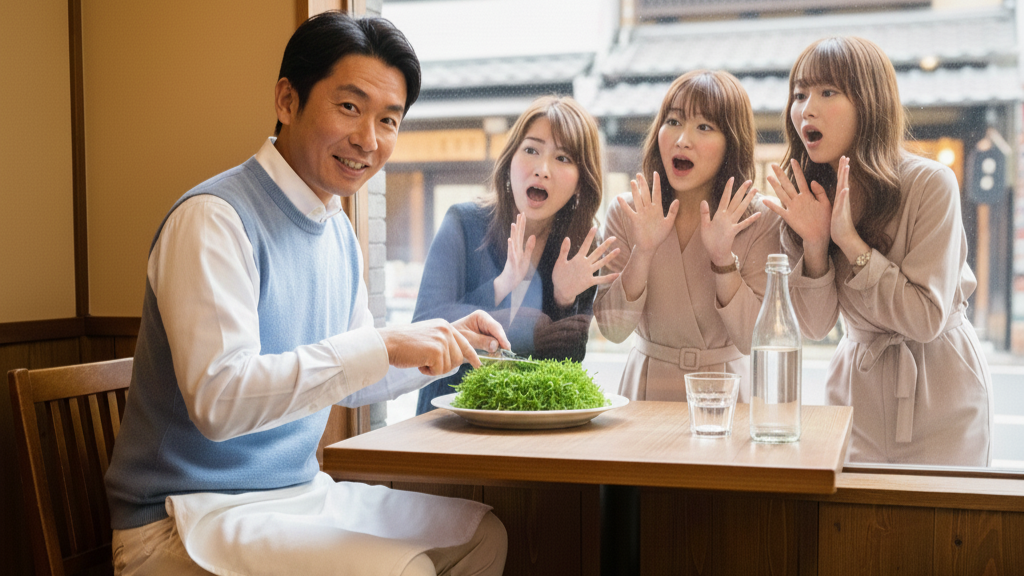
In Japan’s ongoing conversation about love, masculinity, and demographic decline, few labels have travelled as far or sparked as much debate as the “Herbivore Man.” Coined nearly two decades ago, the term 草食系男子 (sōshoku-kei danshi, literally “grass-eating men”) has become shorthand for a generation of Japanese men who appear indifferent to sex, romance, marriage, and traditional male ambition. In an era of falling birth rates, delayed marriages, and economic uncertainty, the herbivore man has been alternately blamed, pitied, mocked, and quietly admired — often all at once.
The expression was first popularised in the mid-2000s by Japanese writer and social commentator Maki Fukasawa, who used it to describe men who did not aggressively pursue women or measure masculinity through conquest, dominance, or corporate success. In contrast to 肉食系男子 (nikushoku-kei danshi, “meat-eating men”), herbivore men were portrayed as gentle, emotionally reserved, risk-averse, and content with a low-pressure lifestyle. They might enjoy fashion, hobbies, friendships, or solo leisure more than dating apps or marriage interviews, and they often reject the expectation that men must be assertive breadwinners.
Japanese media quickly turned the term into a cultural lightning rod. By the late 2000s and early 2010s, headlines linked herbivore men to 少子化 (shōshika, declining birth rates), 晩婚化 (bankonka, late marriage), and even national economic stagnation. Government surveys showed rising numbers of young men reporting little interest in dating or sexual relationships, while a growing share of men in their twenties and thirties had never been on a date. For conservative commentators, the herbivore man became a convenient explanation for Japan’s demographic anxiety — a symbol of lost virility in a society already worried about ageing and decline.
Yet sociologists and gender scholars have long argued that this framing misses the deeper context. The rise of herbivore men coincided with decades of economic insecurity following the collapse of Japan’s asset bubble. Stable lifetime employment, once central to masculine identity, gave way to 非正規雇用 (hiseiki koyō, non-regular work), stagnant wages, and long working hours with diminishing rewards. For many men, opting out of marriage or intense career competition is less about laziness than rational self-protection. Raising a family in urban Japan is expensive, time-consuming, and still shaped by rigid gender roles that assume men must be primary earners. Choosing a quieter life can feel like the only realistic option.
Culturally, the herbivore man also reflects changing attitudes toward intimacy and autonomy. Younger generations place greater value on personal space, emotional safety, and consent, and are less inclined to view romance as an obligation. The Japanese concept of 自分らしさ (jibun-rashisa, being true to oneself) has gained prominence, encouraging individuals to resist social scripts that no longer fit their circumstances. From this perspective, herbivore men are not anti-romance but anti-pressure — unwilling to perform masculinity on terms defined by previous generations.
In recent years, the term itself has begun to feel dated. Some men once labelled herbivores are now in long-term relationships, while others reject the label altogether, seeing it as media caricature rather than lived identity. Meanwhile, public discourse has shifted toward broader questions about mental health, work-life balance, and the unequal burden marriage still places on women. Feminist commentators increasingly note that Japan’s low marriage and fertility rates cannot be solved by urging men to be more “meat-eating” without addressing structural inequality, workplace reform, and women’s unpaid labour.
Still, the herbivore man endures as a cultural mirror. He embodies Japan’s tension between tradition and adaptation, between demographic panic and individual choice. Whether seen as a problem or a pioneer, the herbivore man challenges the assumption that masculinity must be loud, dominant, and relentlessly reproductive. In a society slowly renegotiating what adulthood, intimacy, and success look like, his quiet refusal to play along may be less a crisis than an uncomfortable, necessary evolution.
Spicy Auntie has a confession to make: she rather likes Japan’s so-called Herbivore Men. Not because they are shy, or soft, or allergic to flirting, but because they make an entire society deeply uncomfortable simply by not performing masculinity on demand. And that, my dears, is delicious.
For years, the poor 草食系男子 (sōshoku-kei danshi) have been blamed for everything from Japan’s declining birth rate to the collective heartbreak of aunties who just want to see a wedding photo before they die. “Why don’t these men chase women anymore?” people wail. “Why don’t they want marriage? Sex? Babies?” Spicy Auntie would like to gently ask back: why were they ever obligated to?
Let’s be honest. For decades, Japanese masculinity was a brutal contract. Work insane hours. Earn enough to support a family. Be emotionally silent. Drink with your boss. Come home late. Repeat until death or early retirement, whichever comes first. Romance was transactional, marriage was compulsory, and exhaustion was a badge of honour. Now some men look at that script and say, いや、結構です (iya, kekkō desu — no thanks). And suddenly they’re a national crisis.
The herbivore man doesn’t roar, conquer, or “lead.” He hesitates. He reflects. He opts out. He values peace over pressure and sanity over status. That terrifies people who built their identity on suffering being meaningful. When men stop competing, chasing, and consuming — especially women — the entire gender order starts wobbling like a badly stacked bento box.
Of course, critics love to sneer. Herbivore men are lazy, childish, unambitious, sexless. Spicy Auntie has heard this tune before. Funny how gentleness is praised in women but pathologised in men. Funny how opting out of a rigged system is framed as moral failure instead of self-preservation. Funny how no one asks whether women actually want to marry men who are burnt out, emotionally unavailable, and permanently asleep on the sofa.
Here’s the inconvenient truth: herbivore men didn’t kill romance. Economic precarity did. Gender inequality did. A work culture that eats people alive did. The idea that marriage means unpaid labour for women and financial death for men did. Herbivore men are not the cause; they are the symptom — and perhaps the early warning sign.
Spicy Auntie suspects that behind all the panic lies a deeper fear: if men can choose softness, slowness, and solitude, then masculinity is no longer compulsory theatre. And if masculinity can be renegotiated, then so can power. So chew slowly, herbivores. Auntie is watching — and quietly rooting for you.