


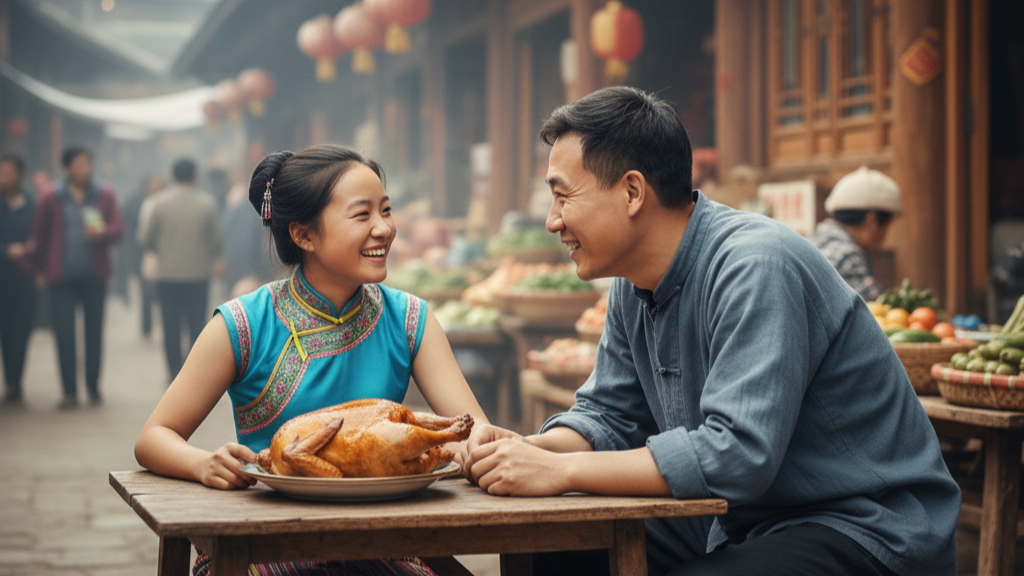
In the emerald rice-fields and riverine towns of Xishuangbanna, Yunnan, where the scent of simmering herbs and blooming jasmine wafts through bustling markets, love takes a deliciously literal form: in the hands of young Dai women holding cooked chickens as invitations to romance. In this corner of China’s southwest, the Dai ethnic group (傣族, Dǎi zú) turns courtship into a vibrant, sensory tradition during the Dai New Year, using “chicken as a matchmaker” in a ritual that blends flirtation, food and cultural expression. Here, a cluck or exchange of price isn’t just commerce — it’s a playful negotiation of desire and consent, a local reminder that love, like lunch, is best shared.
For the Dai — an ethnic minority of roughly 1.3 million people inhabiting western Yunnan — young singles enjoy remarkable freedom in choosing their partners, with fewer constraints from familial matchmaking than in some other Chinese cultures. During the New Year festivities, known locally as Yuesao, women dress in their most beautiful traditional attire and bring cooked chickens to market stalls. But these aren’t just for sale: they are symbols of invitation and interest.
The ritual – as described by the South China Morning Post – unfolds like an improv romance. A young man approaches, eyes fixed on the gleaming poultry, and asks about the price with a nod and a grin. If the woman does want his company, she quotes a price and invites him to sit beside her, sharing shade and the beginning of a conversation over food. If she is not interested, she simply refuses to “sell” it — the Dai equivalent of a gentle but firm “no thanks,” and done with grace and clarity amidst the day’s festive energy.
In one charming exchange reported from recent Dai New Year markets, a would-be suitor approached a stall with a chicken between woman and sunlit path and declared, “Food is better to share, the burden is lighter if you carry it together, and the chicken will feel better if we eat it together.” This playful sentiment encapsulates the ethos of the tradition: partnership as shared nourishment. The woman, radiant in her traditional costume, responded with equal warmth: “It’s more delicious and more comfortable to eat freely.” She added, with a laugh at the bustle around them, “It’s too noisy here, so take it to the forest and eat it.” So they packed a chair and chicken and strolled toward the quiet woodland, where conversations could deepen and feelings be confessed away from the laughter and splashing of the busy market.
These exchanges aren’t just quaint sayings; they are part of a cultural logic that prizes mutual choice and respect. The ceremonial act of asking the price of the chicken becomes a ritual of courtship — a chance for both parties to express interest or decline without embarrassment. A refusal isn’t shameful; it’s part of the dance, clear and free from pressure, leaving both sides space to navigate their emotions.
Once the invitation is accepted and the chair is set, couples often depart the marketplace’s cacophony, stepping into shaded groves where the scent of damp earth and blossoms offers a softer backdrop. There, sharing the meal becomes an act of intimacy — a moment when young lovers can talk more freely, laugh easily, and explore whether their spark might lead to partnership. In this way, the chicken — edible, symbolic and utterly delightful — becomes a conduit for connection.
While modernity has transformed many aspects of life in southwest China, these courtship traditions have endured, especially around New Year when youth are encouraged to mingle, sing love songs and enjoy the season’s festivities. Activities like stringing together embroidered love bags or participating in open-air dances weave together community, identity and romance in ways that feel both joyful and rooted in centuries-old heritage.
In a world where digital dating apps now mediate many romantic encounters, the Dai’s chicken-centred courtship rituals remind us that connection can still be tactile, candid and communal. Here, love isn’t just announced with a swipe — it’s offered with a chicken, shared with a smile, and savoured beneath the open sky, echoing with laughter and the promise of shared meals ahead.
Spicy Auntie here, somewhere between admiration and mild envy, watching Dai girls in Yunnan flirt with actual chickens and thinking: honestly, why is this not a global dating standard already?
Let’s recap. In Dai culture, a woman sits proudly at a New Year market with a cooked chicken. A man approaches. He asks the price. If she likes him, she sells it and invites him to sit, eat, talk, maybe wander off into the forest. If she doesn’t like him, she simply refuses to sell. No explanations. No awkward apologies. No “let’s stay friends.” Just… no chicken for you, sir. Clear. Elegant. Feminist as hell.
Now compare that to modern dating apps, where women must politely endure men who open conversations with “hey sexy” or unsolicited philosophical essays about why rejection hurts their inner child. The Dai system cuts straight through that nonsense. Interest is mutual, embodied, and public. The chicken does the talking. Consent is baked into the ritual. Boundaries are respected. And somehow, no one writes angry Reddit posts about being “ghosted by poultry.”
What really delights Auntie is how female agency is front and centre. The woman controls the interaction. She sets the price. She decides who sits beside her. She chooses whether the chicken is eaten together or not eaten at all. The suitor performs interest; she grants access. Patriarchy is politely told to wait outside the market.
And let’s appreciate the poetry of the exchanges. “Food is better shared.” “The chicken will feel better if we eat it together.” My loves, this is flirting with metaphor, not emojis. This is romance that acknowledges something fundamental: partnership is about sharing weight, space, meals, silence. Not about impressive profiles or curated vulnerability.
Also, may I point out how environmentally sustainable this is? No rings, no roses, no carbon-heavy grand gestures. Just a chair, a chicken, and a walk into the forest. Try doing that on Valentine’s Day in Bangkok or Shanghai.
Of course, Auntie knows this isn’t a fairytale untouched by reality. These rituals exist within broader social norms, agricultural calendars, and community expectations. But still — compared to forced marriages, algorithmic dating despair, or the exhausting emotional labour women perform everywhere else, the Dai approach feels refreshingly sane.
So here’s Auntie’s modest proposal: bring back tangible courtship. Replace “wyd” texts with shared food. Replace endless talking stages with clear rituals. And above all, let women say no without consequences, explanations, or backlash.
If love must be negotiated, let it be done with dignity — and preferably something delicious on the table.