


China’s social media landscape has been set ablaze not with mourning but with sharp criticism and emotional reckonings after the death of Peng Peiyun (彭珮云 Péng Pèiyún), one of the principal architects of the nation’s decades-long one-child policy. The news that Peng died in Beijing on December 21, 2025, at the age of 95 has stirred a potent blend of anger, grief, and historical reflection on platforms like Weibo and Douyin — where netizens (网民 wǎngmín) are revisiting one of the most controversial social policies in People’s Republic of China history through a deeply personal lens.
Official state media commemorated Peng as an “outstanding leader in China’s population and health work, women and children’s affairs, and socialist rule of law construction,” highlighting her long leadership of the National Family Planning Commission from 1988 to 1998. Yet, the tone online could not have been more different. Her passing triggered a wave of comments on Weibo (微博) that tied her legacy directly to the harsh implementation of coercive population controls — and to long-standing social wounds that many feel were never adequately acknowledged.
On Weibo, posts denouncing Peng’s role have been widespread and visceral. One widely shared comment read, “那些失去的孩子,赤身裸体,正在另一边等着你” — “Those lost children, naked and exposed, are waiting for you on the other side,” invoking imagery and emotion around the estimated millions of forced abortions and sterilizations carried out under the policy. Other users lamented: “If the one-child policy had been implemented ten fewer years, China’s population wouldn’t be collapsing like it is today.”
On Douyin (抖音), China’s short-video platform analogue to TikTok, users have not only criticized Peng’s legacy but expressed raw personal testimonies. One Douyin poster claimed to have survived a forced induction injection, while tacitly mourning a peer who did not. Angry slogans like “党性=无人性” — “Party loyalty equals no humanity” — have circulated widely, encapsulating a sentiment that the policy’s enforcement dehumanized families in the name of state-level population control.
The historical backdrop to this online response stretches back to 1979–80, when China introduced the one-child policy as a central plank of 计划生育 Jìhuà Shēngyù (family planning), aimed at curbing rapid population growth that leadership feared would outstrip economic development and resources. In practice, this meant stringent limits on births, heavy fines for “违规 wéiguī” (violators), and in many rural areas, direct state intervention in reproductive decisions.
Although the policy was relaxed in 2015 in favor of a two-child and later a three-child policy, its long shadow has shaped Chinese society in profound ways. One of the most enduring societal impacts remains 性别比失调 xìngbié bǐ shītiáo — a skewed male-to-female birth ratio rooted in traditional son preference combined with strict birth limits. The result has been a generation with fewer siblings and, in many families, life-long psychological and economic pressures.
Beyond that, the policy’s demographic effects now form the backdrop for another national concern: a shrinking and aging population that has led to three consecutive years of population decline — a stark contrast to the overpopulation fears of the 1980s. Many Chinese online commentators explicitly connect Peng’s legacy to China’s current demographic challenges, arguing that the tight grip of 一胎化 yītāihuà (one-child enforcement) sowed the seeds of today’s birthrate crisis.
The social media backlash also reflects broader shifts in Chinese public discourse. In an era where platforms capture generations’ worth of personal narratives and collective memory, Peng’s death has become more than an obituary; it is a trigger for public debate about state power and individual suffering. Terms like 失独 shīdú — referring to parents who have lost their only child — have resurfaced in discussions as reminders of the human cost for families who continue to carry the psychological legacy of policies that once dictated the size of their households.
While official channels continue to frame Peng’s contributions within a narrative of public service, the darker undercurrents on Chinese social media signal an emotional reckoning with a policy that, for many, was a defining and divisive moment in modern Chinese life. What is emerging online is not just criticism of a single figure but a broader reflection on how state policy and personal histories intertwine — in comments, memories, and the collective reckoning of a generation still grappling with the echoes of its past.
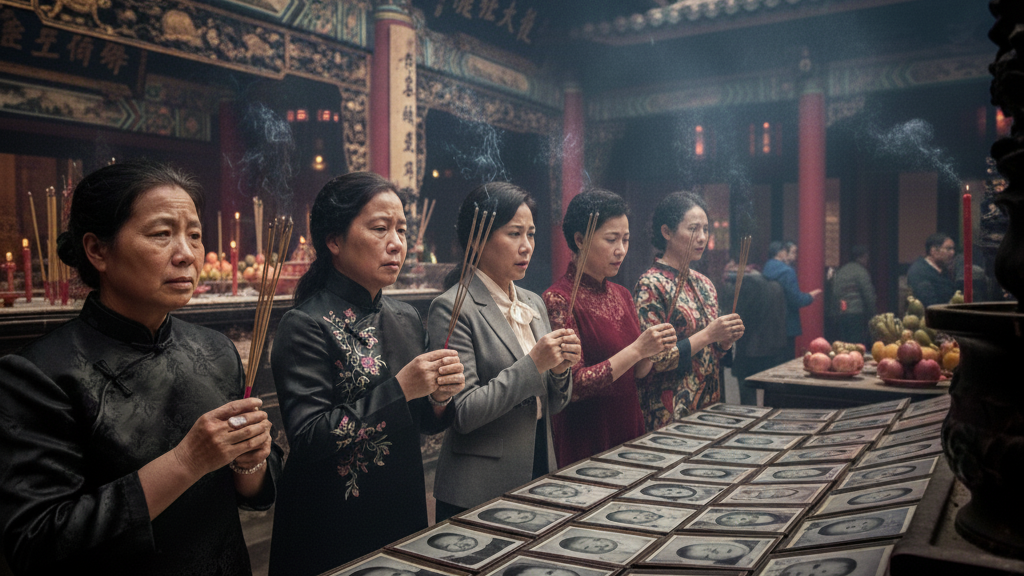
“The children we lost are waiting for you.” Spicy Auntie is not lighting incense today. She is lighting memory. And memory, unlike official obituaries, does not obey instructions.
When Peng Peiyun died, state media reached immediately for the velvet language of “service,” “stability,” and “historical necessity.” But on Weibo, the tone was different. Brutally different. And frankly, thank goddess for that. Because if there is one thing China has mastered, it is embalming trauma with euphemisms. And the internet — bless its unruly soul — occasionally rips the bandages off.
The one-child policy was never just a policy. It was a regime of fear that entered women’s bodies uninvited. It was cadres knocking at doors, registers of wombs, forced abortions framed as “collective good.” It was mothers bleeding in silence and fathers learning to look away. And now, decades later, it is a country wringing its hands over empty kindergartens and lonely sons, asking, “Why won’t people have children anymore?”
Oh sweetheart. Really?
What struck Auntie most about the online backlash was not the anger — anger is obvious, overdue, and frankly restrained. What struck me was the grief. Deep, unprocessed grief that had nowhere to go for years because grief was not patriotic. Grief was inconvenient. Grief did not fit into slogans like 计划生育. So people swallowed it. Until someone died. And suddenly the words came out sideways, sharp, and unforgiving.
“The children we lost are waiting for you.” That line is not cruelty. It is unresolved mourning dressed as accusation. It is the voice of parents who were told their suffering was necessary, then told to move on, then told to produce grandchildren they no longer physically or emotionally could.
And no, this is not about one woman alone. Spicy Auntie is not interested in cheap scapegoats. This is about a system that demanded obedience over humanity and then pretended it never crossed lines. It crossed bodies. It crossed bedrooms. It crossed graves.
Now the same state wants women to reproduce “for the nation.” Same bodies, new orders. Forgive me if I don’t hear enthusiasm. You cannot terrorize reproduction for decades and expect trust to grow back like a houseplant.
The internet backlash is not disrespect. It is historical muscle memory. It is society saying: we remember what you want us to forget. And until that memory is acknowledged — honestly, painfully, publicly — no amount of baby bonuses or propaganda will fix the demographic hole dug by fear.
Spicy Auntie will say this gently, once: a nation that never apologizes to women should not be surprised when women stop believing in its future.