


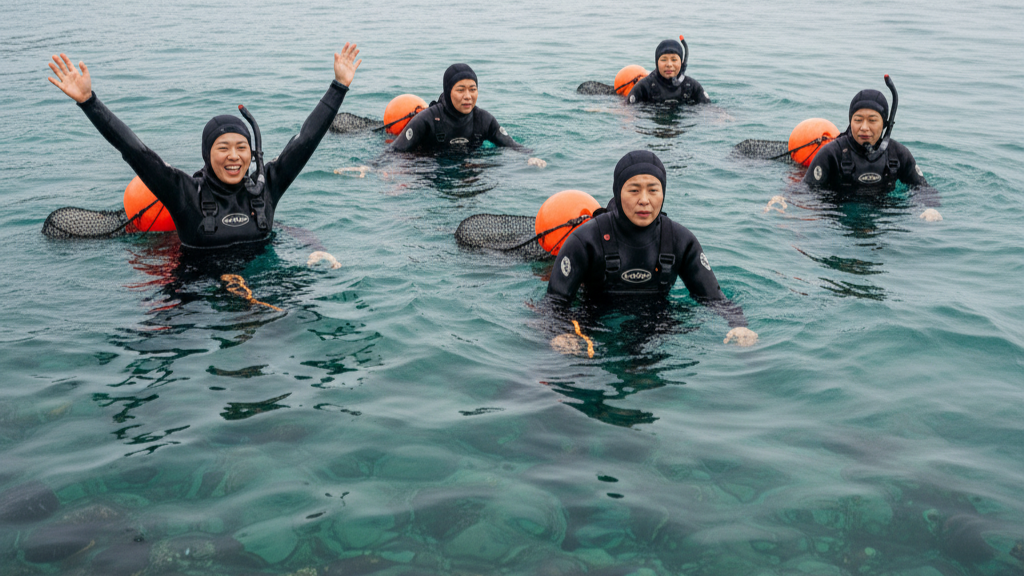
Type “Women of the Sea” into any search bar and you’ll land on the same magnetic image: older Korean women in black rubber suits, orange buoys bobbing beside them, slipping under cold waves on a single breath to bring up abalone and sea urchins. These are the haenyeo (해녀), South Korea’s legendary female free-divers, celebrated in documentaries and K-dramas, but still rooted in a hard, wet routine where the ocean is workplace, pantry, and fate. And while Jeju Island is their most famous home, you can feel the tradition alive on the mainland too—at Daebyeon-ri (대변리) in Busan’s Gijang County (기장군), where a “haenyeo village” has turned a working shoreline into a living, edible story of women, labor, and sea-salt pride.
UNESCO’s description of Jeju haenyeo culture is blunt about the difficulty: women—some in their 80s—dive around 10 meters to gather shellfish “without the help of oxygen masks,” harvesting for up to seven hours a day during the season, repeating short, breath-held plunges again and again. Between dives they surface with a distinctive exhale, often described as sumbi-sori (숨비소리), a huffing, whistling release that is as much physiology as identity—proof you came back up. Haenyeo work has long been wrapped in communal rules and shared knowledge—reading currents, tides, and species cycles, deciding when to take and when to leave, and caring for one another through systems built over generations. Even in modern retellings, what endures is the sense that these are not lone heroines but a disciplined group with its own ethics, skills, and hierarchies.
That collective spirit is easy to romanticize from afar, and some haenyeo are pushing back against the glossy version. In a 2025 Guardian feature, Jeju haenyeo and citizen scientist Myeonghyo Go voices frustration with how outsiders strip out the hard parts. “I feel uncomfortable when stories about the haenyeo are shared,” she says, arguing that people “take everything that is really important out and only show certain aspects of our lives.” Her discomfort isn’t only about pride—it’s about survival. She points to ecological decline with the clarity of someone who watches the seabed for a living: “The seaweeds here are disappearing… Because we don’t have the seaweeds, we don’t have abalone.” In the same piece, she insists the job is not just extraction but stewardship: “We survive on collecting and selling the seafood, but we are also protecting them. We show how humans and nature can coexist.” She even describes halmeoni bada (할머니 바다, “grandma ocean”), a designated shallows area for the oldest divers—an everyday policy of respect embedded into the geography of work.
If Jeju is the emblem, Daebyeon-ri is a reminder that the haenyeo story is also commerce, taste, and coastal improvisation. On Busan’s eastern edge, past the bright spines of Haeundae and Songjeong, Daebyeon-ri’s port holds a haenyeo village said to have carried on for about half a century—less a museum than a strip of seafood restaurants and stalls hugging Daebyeon Port. The origin story is wonderfully unglamorous: it began with red plastic basins. Divers would come in, rinse off by the pier, and lay out abalone, sea cucumbers, and sea squirts in tubs—until passersby started asking to buy on the spot. Veteran haenyeo Im Mal-sook, 78, remembers the casual beginning in a line that captures how traditions often become “institutions” by accident: “Back then, people would say, ‘Give me some of that,’ when they saw us wash up with our catch… That’s how it all started here.”
Today the Daebyeon-ri experience is a direct line from sea to table: platters piled with what the Gijang coast gives—abalone, octopus, conches, clams—alongside dishes that feel like coastal comfort food with an edge of bravado, such as abalone porridge enriched with deep-green innards.
It’s tourism, yes, but it’s also continuity: an economy built around women whose expertise is physical and precise, and whose authority comes from repetition—one minute of breath, one more dive, one more return to the surface. In Daebyeon-ri, you don’t just “learn about haenyeo.” You taste the outcome of their judgment: what was worth taking today, what was left for tomorrow, and what the sea still allows.
Spicy Auntie is sitting by the sea while writing this, watching women who are older than most revolutions walk into cold water like they own it. The haenyeo do not “empower” themselves, they do not “find their inner strength,” and they definitely do not pose for inspirational posters. They just work. They breathe, dive, harvest, surface, exhale that sharp 숨비소리 (sumbi-sori), and do it again. Repeat until the tide says stop. Repeat until the body says enough. Repeat for decades.
Let me be very clear, dear readers: patriarchy did not allow the haenyeo to exist. It simply failed to stop them.
Long before gender panels, leadership workshops, or corporate feminism discovered the word “resilience,” these women were feeding families by outswimming men, outlasting storms, and outthinking the sea. While respectable society liked its women quiet, dry, and obedient, the haenyeo were wet, loud, muscular, and economically indispensable. If that makes some people uncomfortable, good. Discomfort is the first crack in denial.
And yet, here comes the modern world, camera in hand, trying to turn them into postcards. UNESCO label here, Netflix aesthetics there, a touch of nostalgia, a dash of “vanishing tradition.” Auntie rolls her eyes so hard she nearly sprains something. The haenyeo are not a dying poem. They are living labor. When haenyeo women say the sea is changing, that abalone is disappearing, that seaweed forests are thinning, they are not being poetic. They are issuing a data-driven warning from inside the ecosystem.
I particularly like how the Daebyeon-ri haenyeo did not wait for cultural grants or curators. They laid out their catch in plastic basins, people asked to buy it, and an economy happened. No branding workshop. No strategic plan. Just women saying: “This is what we pulled from the sea today. Eat or don’t.” Capitalism, but make it saltwater and matriarchal.
What also deserves respect is their internal ethics. The halmeoni bada (할머니 바다), the “grandmother sea,” reserved for the oldest divers, is more than sentiment. It is social design. It says age has value. It says slowing down does not mean being pushed out. Imagine if modern workplaces understood that.
Spicy Auntie does not romanticize aching joints, scarred hands, or lungs trained by necessity rather than wellness apps. But I do romanticize competence. I romanticize women whose authority comes from mastery, not permission. The haenyeo remind us that feminism does not always shout. Sometimes it breathes once, dives deep, and comes back up with dinner.
Now excuse me. Auntie smells abalone porridge nearby, and theory is best digested with something warm and earned.