


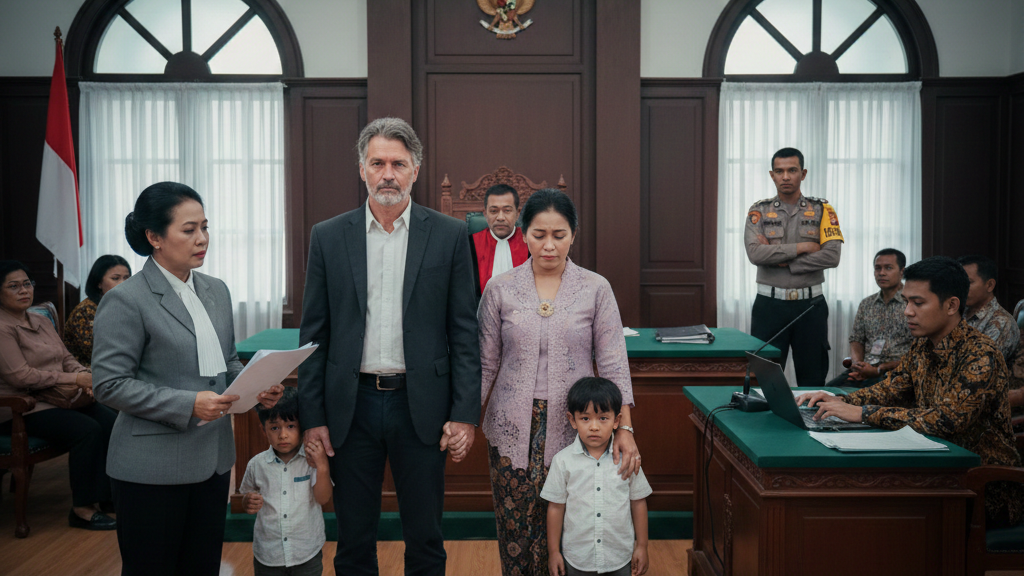
Mixed marriages are increasingly common in Indonesia, especially in urban centres, tourist regions, and among globally mobile professionals. Yet few legal topics generate as much confusion, anxiety, and misinformation as marriage between an Indonesian citizen and a foreign national—and, even more so, the status of their children. Indonesian law is neither fully restrictive nor fully liberal. It is precise, bureaucratic, and unforgiving of mistakes. For mixed families, understanding the basics early can make the difference between security and long-term legal headaches.
In legal terms, Indonesia defines a “mixed marriage” strictly by nationality. If one spouse is an Indonesian citizen (WNI) and the other is a foreign national (WNA), the marriage automatically falls under a special legal category, regardless of ethnicity, race, or place of birth. This distinction triggers specific rules on marriage registration, property ownership, immigration, and citizenship.
Indonesia does recognise mixed marriages—but only if they are properly registered and religiously valid. There is no purely civil marriage in Indonesia. Every marriage must be conducted under a recognised religion and registered with the authorities. Muslim couples register through the Office of Religious Affairs (KUA); non-Muslim couples register through the Civil Registry (Disdukcapil). A religious ceremony alone is not enough. Without registration, the marriage has no legal standing, which can later affect inheritance, child legitimacy, and immigration rights.
Marriage to an Indonesian citizen does not grant the foreign spouse citizenship. This point cannot be overstated. At most, marriage provides a pathway to residency through spouse-sponsored visas and permits. Indonesian citizenship may only be obtained through naturalisation after long-term residence, and approval is discretionary. Marriage is a factor, not a guarantee.
Property law is where many mixed couples encounter their first major shock. Indonesian land law prohibits foreigners from owning freehold property. If an Indonesian marries a foreigner without a prenuptial agreement separating assets, joint marital property rules apply—and the Indonesian spouse may lose the legal ability to hold land in their own name. This has led to countless disputes, forced sales, and legal restructurings. Since a Constitutional Court ruling in 2015, post-nuptial agreements are allowed, but prevention remains far easier than repair.
Children of mixed marriages are treated more generously than spouses under Indonesian law. A child born to one Indonesian parent is entitled to Indonesian citizenship, regardless of where the child is born. Indonesia allows children from mixed marriages to hold dual citizenship—but only temporarily. Dual nationality is permitted until the child turns 18, with a final deadline at 21 to formally choose one nationality. After that point, Indonesian citizenship is lost automatically if no choice is declared.
This system makes early documentation critical. Children should be registered promptly with the Indonesian civil registry, issued an Indonesian birth certificate and passport, and, if applicable, registered with the foreign parent’s embassy. Immigration affidavits confirming dual nationality status are essential. Delays or inconsistent paperwork—especially for children born abroad—are one of the most common causes of future legal problems.
While holding Indonesian citizenship, children of mixed couples enjoy the same rights as other Indonesian children. They can attend public schools, access national health insurance, and reside in the country without immigration restrictions. Once a child opts for foreign nationality after adulthood, however, their legal status changes significantly. They become subject to visa rules, higher education fees, and foreigner restrictions on property and inheritance.
Many mixed families stumble not because the law is hostile, but because it is complex and rigid. Parents often assume dual citizenship is permanent. Others miss nationality deadlines, misunderstand embassy advice, or overlook property implications at the time of marriage. Conflicts between Indonesian law and the foreign parent’s nationality law—especially in countries that prohibit dual citizenship—can further complicate matters. Becoming members of the few associations of mixed couples, can help get timely information on policy and laws’ changes. The most active among them is PerCa Indonesia (Perkumpulan Masyarakat Perkawinan Campuran Indonesia)
The Indonesian system ultimately reflects a clear hierarchy. The state is cautious toward foreign spouses, protective but conditional toward children, and deeply procedural in how rights are granted and maintained. For mixed families, the most important decisions are rarely romantic ones. They are administrative: registering correctly, planning property ownership, and preparing early for a child’s nationality choice.
In Indonesia, love may cross borders easily—but the law never does without paperwork.
Spicy Auntie speaking. I am holding a cup of coffee that has gone cold because I’ve been on WhatsApp with three different mixed-marriage couples at once, all panicking about passports, land titles, and a mysterious deadline nobody warned them about. Romance is wonderful, my dears, but in Indonesia romance must always bow politely before paperwork.
Let’s start with the basics. Indonesia does not hate love. It simply loves forms more. Love may be blind, but the state has excellent eyesight and a long memory. You can fall in love across borders, accents, and continents—but the moment you say “I do,” the government clears its throat and asks: Have you registered this properly? Under which religion? With which office? And do you have a stamp?
I’ve seen couples cry over missing stamps. Grown adults. Educated. Multilingual. Reduced to tears by Disdukcapil.
Foreign spouses, listen carefully: marriage will not save you. It will not magically turn you Indonesian. It will give you a visa, a stack of renewals, and a front-row seat to the slow ballet of bureaucracy. Citizenship remains a distant mountain, visible but hard to climb, and no amount of wedding photos on Bali beaches will change that.
Now, children. Ah, the children. Indonesia is kinder to children than to lovers, which is refreshingly maternal for a state. Mixed-marriage kids get dual citizenship—temporarily. It’s like a long engagement with a brutal ultimatum. “You may belong to two countries,” Indonesia says sweetly, “but only until you’re grown. After that, choose.”
Choose at 18. Confirm by 21. Miss the deadline and—poof—one passport disappears like a bad ex. I have met parents who thought dual citizenship was forever. I have met twenty-year-olds who discovered their nationality problem on TikTok. Nobody wants to learn about citizenship law through panic.
And then there is land. Oh, land. If I had a rupiah for every Indonesian woman who lost sleep over a house bought without a prenuptial agreement, I would own several villas that I am legally allowed to own. Mixed marriage plus no prenup equals heartbreak with a notary stamp. Love is joint, property must not be.
So here is Auntie’s advice, free and slightly judgmental. Love bravely, but plan boringly. Register everything early. Ask stupid questions before the wedding, not after the baby is born. Assume nothing. Especially not dual citizenship, land ownership, or “my friend said it’s fine.”
Indonesia welcomes mixed families. It just wants them organised, documented, and extremely punctual. Love crosses borders. Bureaucracy guards them.