


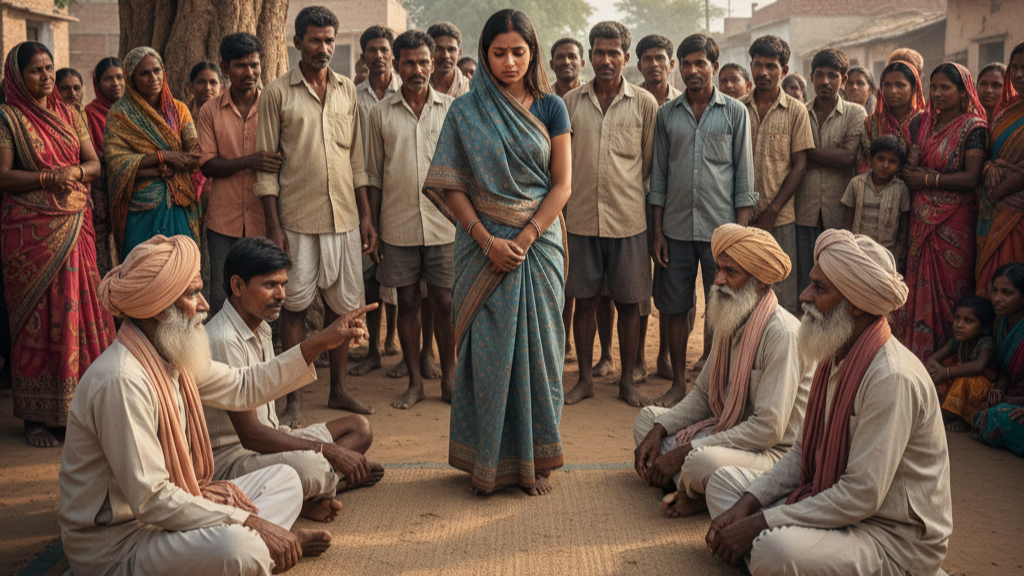
In India, gang rape is a crime that shocks the conscience, sparks national outrage, and fills news cycles with promises of justice. Yet beyond the glare of television studios and courtroom steps, another story often unfolds quietly and brutally: the societal forcing of “reconciliation” between a rape survivor and her assailants. Known locally as समझौता (samjhauta), or compromise, this practice treats sexual violence not as a grave violation of a woman’s bodily autonomy, but as a disturbance of social order that must be quickly patched up and buried.
In many rural areas and small towns, particularly where caste hierarchies and kinship networks dominate daily life, rape is handled not primarily by police or courts, but by informal power structures such as village councils, caste assemblies, or खाप पंचायत (khap panchayat). These bodies have no legal authority, yet they wield immense influence. Their priority is not justice for the survivor, but the restoration of “peace,” इज़्ज़त (izzat, honor), and social balance. The survivor’s suffering becomes secondary to the fear of scandal, police intervention, or prolonged court cases that might stain the community’s reputation.
The mechanics of forced reconciliation are grimly consistent. Families are pressured to accept money as “compensation,” sometimes framed as help for medical costs or future marriage expenses. In other cases, elders impose fines on the accused men and declare the matter resolved, occasionally even using the money for communal purposes, as if the crime were a minor dispute rather than an act of extreme violence. The most chilling version is the push for marriage, where the rapist or one of the perpetrators offers to marry the survivor, and the community presents this as a “solution” that restores her respectability and closes the case.
Language plays a key role in normalising this coercion. Rape is euphemised as a “mistake,” a “fight,” or a “bad incident,” while reconciliation is dressed up as forgiveness, maturity, or pragmatism. Survivors who resist are warned of social boycott, threats, or further violence. Their families are told that pursuing justice will destroy their daughter’s chances of marriage and bring lifelong shame. In such conditions, consent to compromise is often anything but voluntary.
Legally, this practice has no standing. Under Indian law, rape is not a compoundable offence; it cannot be settled privately or withdrawn through agreement. Courts have repeatedly affirmed that sexual violence is a crime against society, not a negotiable family matter. Yet on the ground, the gap between law and lived reality is wide. Police officers may subtly encourage settlement to reduce workload or avoid local pressure. Politicians may look away, especially when accused men belong to dominant castes or influential families. Survivors, exhausted and afraid, are left with the impossible choice between a hostile justice system and an oppressive community.
Cultural notions of female purity and family honor are central to why forced reconciliation persists. In patriarchal logic, a raped woman is seen as “damaged,” and the community’s goal becomes managing that damage. The crime is reframed as something that happened to the family’s reputation rather than to the woman’s body and psyche. Her silence is treated as a public service, her suffering as collateral damage in the preservation of social harmony.
The psychological toll on survivors is devastating. Being compelled to forgive attackers, accept money, or even live near or with them compounds trauma with humiliation. Justice is replaced by enforced coexistence, and healing is sacrificed to convenience. What is presented as reconciliation is, in reality, a continuation of violence by other means.
Despite stronger laws and louder feminist voices, the practice of forced samjhauta reveals how deeply entrenched patriarchal power remains in parts of India. Until communities stop treating rape as a stain to be scrubbed away and start recognising it as an unforgivable crime against women’s autonomy, reconciliation will remain a euphemism for silencing. And for many survivors, the most painful part of the crime will not end with the assault, but with the moment they are told to “move on” for the good of everyone else.
Spicy Auntie is furious today. Not witty-furious, not ironic-furious. Proper, teeth-grinding, blood-boiling furious.
“Marry your rapist.” Say it slowly. Let it sit in your mouth like something rotten. Because that is what parts of society are still telling women after gang rape: that the solution to extreme sexual violence is to bind the victim for life to one of the men who destroyed her body and mind. Not jail. Not accountability. Marriage. As if rape were a misunderstanding, a spilled drink, a social faux pas that can be fixed with a ritual, a red sari, and a fake smile.
This isn’t tradition. This isn’t culture. This is misogyny wrapped in incense and sanctimony.
What really enrages Auntie is the language of “compromise.” समझौता, they say, as if a woman’s trauma were negotiable. As if peace were something extracted from her silence. As if harmony mattered more than her humanity. Communities do not “heal” by forcing survivors to forgive. They protect rapists by outsourcing cruelty to the family, the village, the elders, the so-called moral guardians.
And let’s be clear: this is not about forgiveness. Forgiveness is a choice. This is about coercion. About threatening families with ostracism, violence, ruined marriage prospects, endless harassment. About teaching girls early that their bodies are community property and their pain an inconvenience. About reminding women that even when the law says one thing, patriarchy will enforce another.
Auntie despises the hypocrisy most of all. The same men who speak solemnly of इज़्ज़त (honor) are perfectly comfortable sacrificing a woman’s entire future to preserve their own reputations. The same elders who demand obedience suddenly discover pragmatism when prison looms for “their boys.” And the same society that howls for death penalties on television quietly arranges settlements in the village courtyard.
Do not call this reconciliation. Call it what it is: a second assault. A prolonged one. A socially sanctioned continuation of violence.
If you want reconciliation, start with the survivor’s safety, dignity, and autonomy. Start with prison cells, not wedding halls. Start by teaching boys that rape is not a mistake, not a temptation, not a lapse—it is a crime. Until then, every forced marriage, every coerced compromise, every silenced woman is proof that the real sickness is not individual brutality, but a system that prefers quiet over justice.
Spicy Auntie is not calm. She is not patient. And she is done pretending that this is complicated.