


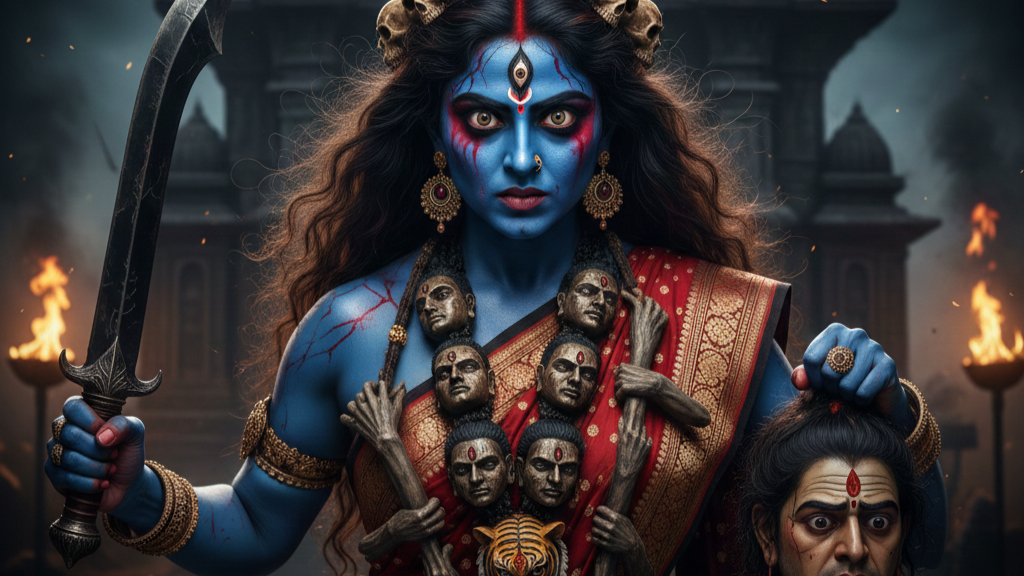
The Indian goddess Kali has always unsettled the polite imagination. Dark-skinned, wild-haired, tongue lolling red, adorned with skulls and severed arms, she looks nothing like the smiling, benevolent “mother goddess” often marketed to the world. Yet for millions of devotees—especially women—Kali is not frightening at all. She is intimate, honest, and liberating. In a religious landscape that has often prized female obedience, sacrifice, and purity, Kali stands apart as the goddess who refuses to behave. That refusal is precisely why her cult endures and why women, across class and caste, remain particularly drawn to her.
Kali emerges in Hindu mythology as the raw force of Shakti (शक्ति, divine feminine energy), unleashed when restraint is no longer enough. She appears in moments of crisis, most famously during battles with demons who cannot be defeated by conventional power. Kali does not negotiate, domesticate, or redeem evil; she annihilates it. Her very name comes from kāla (काल), meaning time or death, reminding devotees that nothing—no body, no authority, no injustice—escapes her reach. This association with time gives Kali a uniquely female resonance: she governs cycles, endings, transformation, and rebirth, realities women know intimately through their bodies and lives.
Kali’s iconography speaks directly to female experience. Her nakedness signals radical freedom from social shame. Her unbound hair defies the discipline imposed on women’s bodies and behavior. The garland of skulls, often said to represent the fifty letters of the Sanskrit alphabet, turns language, knowledge, and memory into ornaments rather than burdens. She stands atop Shiva—pure consciousness rendered inert without her energy—quietly subverting patriarchal cosmology. Without the feminine, even the highest male god is powerless. Kali does not apologize for this truth.
For women devotees, Kali’s greatest power is not destruction but permission. She legitimizes emotions women are trained to suppress: rage, grief, desire, jealousy, defiance. In a society that often praises sahansheelta (सहनशीलता, endurance) as a feminine virtue, Kali sanctifies refusal. She shows that anger can be sacred, that boundaries can be violent if necessary, and that protection sometimes requires ferocity. This is why Kali is called Ma (माँ, mother) even when she is bloodstained: she protects her children not by soothing them, but by removing what threatens them.
Kali worship flourishes especially in Bengal and eastern India, where Kali Puja rivals Diwali in intensity. Here, the goddess is not distant. She is spoken to, argued with, scolded, loved. Women pray to Kali for strength against abusive marriages, for survival amid poverty, for courage to live alone, for protection from social judgment. Unlike many deities, Kali does not demand ritual purity or submissive femininity. Widows, unmarried women, sex workers, lower-caste devotees—those often excluded from respectability—find in her a goddess who accepts them whole.
Tantric traditions deepen this intimacy. In Tantra, Kali is not merely a goddess but ultimate reality itself, beyond moral binaries of pure and impure. Menstruation, sexuality, death, decay—realities often used to stigmatize women—are not pollutants but gateways to truth. This worldview resonates strongly with women whose bodies are constantly regulated, surveilled, and disciplined. Kali offers spiritual dignity without erasure.
In modern India and beyond, Kali has also become a symbol of feminist resistance. Artists, activists, and writers reclaim her as an icon of female autonomy in the face of patriarchy, nationalism, and religious conservatism. Attempts to sanitize or censor Kali—dressing her modestly, muting her violence—are often read by women as efforts to neutralize her power. Kali refuses to be respectable. That refusal keeps her alive.
Kali endures because she mirrors life as women often live it: intense, unjust, cyclical, embodied, and demanding courage. She does not promise safety, only truth. And for many women, that truth—fierce, dark, uncompromising—is the most maternal gift of all.
Spicy Auntie here, stirring the pot as usual—and today I am lighting incense, not candles. Because we have decided to write a long series of posts about Asian goddesses and mythical figures who inspire women, unsettle patriarchy, and refuse to sit nicely with their ankles crossed. And to do so, there is no better place to start than Kali. Frankly, sisters, she is amazing.
Look at her. Really look. Blue-skinned, naked, wild-haired, tongue out, dripping with blood and truth. No demure smile, no apologetic softness, no “don’t worry, I’ll sacrifice myself quietly so everyone else feels comfortable.” Kali does not come to make you feel safe. She comes to make you free. And that distinction matters.
Kali is what happens when feminine power stops asking permission. She is Shakti without filters, without PR, without patriarchal approval. When the situation is so bad that polite gods fail, Kali shows up. She doesn’t negotiate with monsters. She ends them. Tell me that doesn’t resonate with women who have been told for centuries to endure, adapt, forgive, and smile through injustice.
What I love most about Kali—and what so many women instinctively understand—is that she validates emotions we are trained to suppress. Rage? Sacred. Desire? Not sinful. Refusal? Necessary. Kali doesn’t ask women to be pure, obedient, or endlessly nurturing. She asks us to be honest. And honesty, as every woman over 30 knows, is revolutionary.
Kali is called Ma, mother, but she is not the soft-focus, self-erasing mother of greeting cards. She is the mother who will burn the village to protect her children. The mother who chooses survival over reputation. The mother who knows that sometimes love looks like destruction—of lies, of abuse, of silence.
It is no accident that Kali is beloved by women on the margins: widows, unmarried women, working-class women, women whose bodies and lives do not fit respectability politics. Kali does not demand purity tests. She does not ask for your résumé. She takes you as you are—angry, tired, sexual, grieving, unfinished.
And let’s be clear: patriarchy hates Kali. It has tried to tame her, dress her up, tone her down, make her respectable. Good luck with that. Kali cannot be sanitized. The moment you try, she stops being Kali.
So yes, Spicy Auntie is thrilled to begin this journey with her. Asian goddesses are not decorative mythology; they are political, emotional, and deeply relevant. Kali reminds us that feminine power was never meant to be quiet. It was meant to shake the universe—and sometimes, burn it down so something better can grow.