


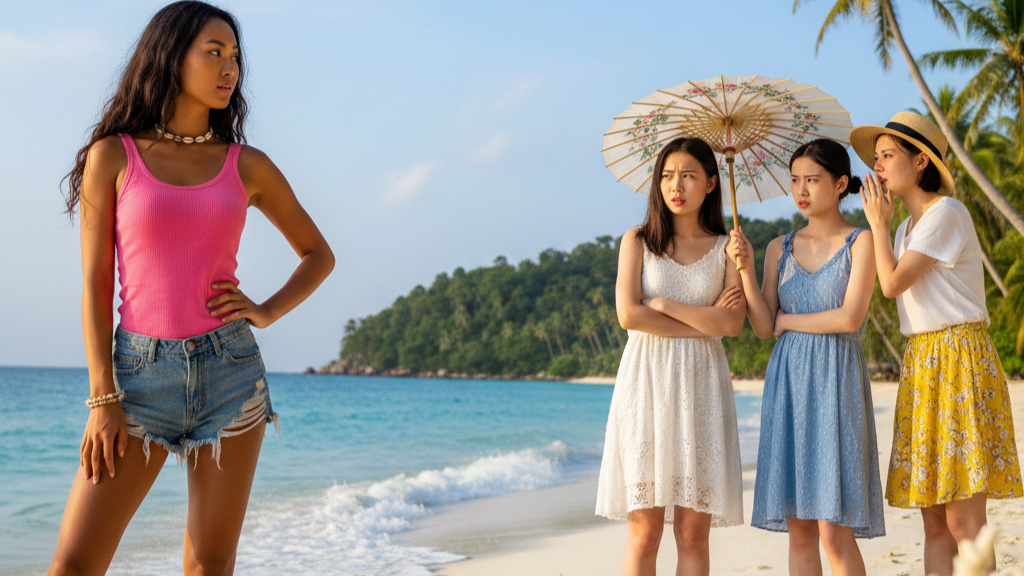
Scroll through expat forums, dating-app bios, or long-stay travel vlogs and the claim pops up again and again: Western men, some say, are drawn to Southeast Asian women with sun-kissed, tan or “morena” skin. It is framed as attraction to a “healthy glow,” a rejection of artificial beauty standards, even as body-positivity. Scratch a little deeper, though, and that preference sits at the crossroads of tourism culture, Western beauty history, and Southeast Asia’s own long struggle with colorism.
In much of the contemporary West, a tan has come to signal leisure, vitality, and time spent outdoors. The pale skin once associated with refinement and indoor wealth gave way, over the twentieth century, to the bronzed body of the beach, the pool, and the summer holiday. When Western men travel to or settle in places like Thailand, Philippines, or Indonesia, that cultural script often travels with them. Tan skin on local women is read through a Western lens as “natural,” “fit,” and “authentic,” especially in tropical settings where the sun is omnipresent and daily life appears more physically active than the office-bound routines back home.
This is where the language of admiration frequently borrows from health and wellness talk. The “healthy glow” becomes a compliment that sounds progressive, even affirming. In the Philippines, the term morena traditionally describes women with brown or tan skin, in contrast to mestiza, associated with lighter, often mixed-heritage complexions. In recent years, morena pride has gained visibility in media and advertising, framed as confidence and self-acceptance in a society long saturated with skin-whitening products. When Western men praise morena beauty, some women interpret it as validation against local colorist hierarchies that have historically devalued darker skin.
Yet this is only part of the story. The same preference can slide easily into exoticism, a way of consuming difference rather than celebrating individuality. Southeast Asian women have long been subject to an Orientalist gaze that casts them as “natural,” “sensual,” and closer to the body than the mind. Tan skin, in this framing, becomes shorthand for a fantasy of tropical femininity—sun, sea, and sexual availability rolled into a single image. The attraction is no longer about a woman’s confidence or health, but about how well she fits a pre-packaged idea of “Asian beauty.”
This tension is sharpened by the region’s own complex relationship with skin tone. Across Southeast Asia, lighter skin has often been associated with class, urbanity, and respectability, while darker skin suggests rural labor and exposure to the sun. In Indonesia, the word putih (white) still dominates beauty marketing, while sawo matang (literally “sapodilla-brown”) is used to describe medium-tan skin in a more neutral or positive way. In Thailand, ผิวแทน (tan skin) is increasingly reclaimed in fashion and social media, even as whitening creams remain ubiquitous. Against this backdrop, Western praise for tan skin can feel refreshing—but also unsettling, because it comes from outside the local system of values and power.
Dating apps and tourism spaces amplify these ambiguities. Profiles that say “I love morena girls” or “prefer tan Asian women” blur the line between appreciation and fetishization. Many Southeast Asian women report that such comments quickly become reductive, focusing obsessively on skin tone as a defining trait rather than one aspect of a whole person. What begins as supposed body-positivity ends up reinforcing racialized desire, where attraction is conditional on fitting a narrow, exoticized look.
There is also a simple contrast effect at work. Western men arriving from societies where tanning is a choice may read Southeast Asian tan skin as effortless and authentic, ignoring the fact that many local women have been taught from childhood to avoid the sun. The compliment lands unevenly: it praises what local norms have often discouraged, but without challenging the deeper structures that produce colorism in the first place.
So do Western men “prefer” Southeast Asian women with tan or morena skin? The more accurate answer is that some do, and they explain it in ways that borrow from Western tanning culture, wellness ideals, and travel fantasies. Whether that preference feels affirming or objectifying depends less on the skin tone itself than on the gaze behind it. Admiration that recognizes context, individuality, and agency can support genuine body confidence. Desire that flattens women into a tropical aesthetic, however sun-lit, remains just another way of consuming difference—warm glow and all.
Ah yes. The tan obsession. Pull up a chair, Auntie’s got thoughts.
Every few months, a Western man somewhere in Southeast Asia announces—often proudly, sometimes drunkenly—that he “just prefers tanned girls.” He says it like it’s a personality trait. Like lactose intolerance. Like he deserves a medal for enlightenment. “I don’t like pale girls,” he insists, gazing meaningfully at the tropical sun. “I like that healthy glow.” Darling, you like a vacation aesthetic.
Let’s be clear: liking tan skin is not revolutionary. It is not feminist. It is not body positivity. It is, at best, a recycled Western beauty trend imported with sunscreen and emotional baggage. At worst, it’s the same old exoticism with a bronzed Instagram filter. The colonial gaze, now with better lighting.
Auntie has heard it all. “Tan women look more natural.” “They look freer.” “They’re more relaxed.” Funny how these compliments always come preloaded with assumptions about personality, sexuality, and availability. Tan skin, in this fantasy, doesn’t just reflect sunlight—it reflects projection. The woman becomes tropical by default: warm, earthy, uncomplicated, conveniently non-threatening. Paradise with eyelashes.
Meanwhile, let’s talk about the local reality you so casually ignore. In much of Southeast Asia, women have spent generations being told to avoid the sun, lighten their skin, cover up, buy creams that promise putih, puti, puti-putihan. Colorism wasn’t invented by Asian mothers—it was fed by class, colonialism, and capitalism. So when you show up applauding “tanned girls,” it lands… oddly. Validation? Maybe. But also confusion. And sometimes, exhaustion.
Because here’s the thing, dear Western admirer: you praise tan skin while enjoying the privilege of choosing it. You tan for pleasure. Many women tan by necessity—working, commuting, living. And when the same tan is mocked at home but fetishized abroad, Auntie calls that what it is: a double standard wearing flip-flops.
And don’t even get Auntie started on the way “I love morena women” sometimes morphs into dating-app archaeology. Filters. Preferences. Entire personalities built around skin tone. That’s not attraction—that’s shopping. Women are not Pantone charts.
So yes, admire beauty. Tan, pale, freckled, scarred, glowing, tired, real. But if your desire needs to announce itself as progressive, if it requires a TED Talk about “healthy glow,” if it turns women into climate zones—pause. Look inward. Hydrate. Reflect.
Auntie’s verdict? Like who you like. Just don’t confuse your holiday fantasies with liberation, and don’t call fetishism body positivity. Tan skin doesn’t need saving. Women don’t need your approval. And paradise, sweetheart, is not a dating preference.