


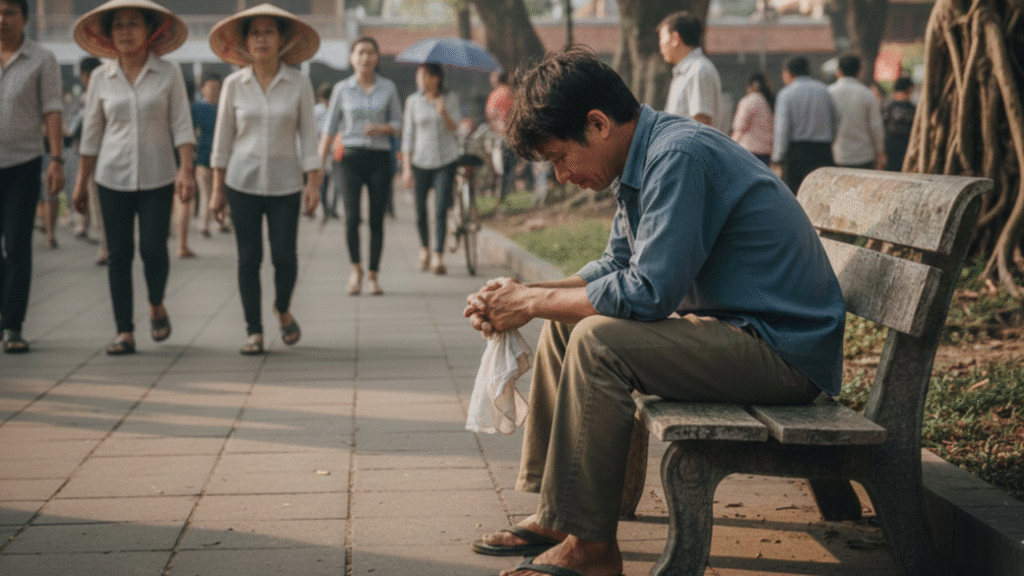
Vietnamese men’s mental health is quietly unraveling under the weight of toxic masculinity, entrenched gender roles, and relentless societal expectations that say a man must be the trụ cột gia đình (family’s backbone) and never show weakness. In a culture where tears are equated with fragility and stress is buried deep beneath a stoic exterior, men are increasingly battling anxiety, isolation, and depression, often in silence until a breaking point is reached. This hidden crisis sits at the crossroads of tradition and modern pressures, reshaping how Vietnam grapples with well-being and identity in the 21st century.
At Hanoi’s Bach Mai Hospital, reports VnExpress International, clinicians like Dr Vu Son Tung and Dr Nguyen Viet Chung are seeing a worrying trend: men presenting with physical symptoms like insomnia, heart palpitations and chronic anxiety that mask more profound emotional distress. One patient, forced to hide financial losses and career setbacks behind a façade of normalcy, eventually attempted suicide after years of immune stress bình thường hóa (normalized) by gendered expectations to “grin and bear it.”
These stories aren’t anomalies. They reflect a broader, culturally reinforced pattern in which boys are taught early that crying is “unmanly” and discussing feelings equates to weakness. Such messaging fosters toxic masculinity — an ideology that praises emotional repression and shames vulnerability. A 2022 survey reported by VnExpress found more than a quarter of male respondents desired professional help for pressures related to work, finance, and family, yet most hesitated due to fear of judgment or stigmatization.
Vietnam’s mental health landscape underscores the gravity of this problem. With an estimated 14 million people living with some form of mental disorder, and very limited access to clinical psychological services — only around 143 trained therapists nationally — the infrastructure to support those in need is woefully inadequate. The World Health Organization notes that mental health disorders like depression and anxiety comprise a significant burden across the Western Pacific, pointing to a systemic issue that transcends borders and cultures.
Pressure to conform to rigid gender norms also deepens emotional isolation. A 2024 VnExpress feature about loneliness among Vietnamese men highlighted how the stereotype of the male as the family’s primary provider discourages emotional expression, weakening interpersonal bonds even within the home. As women increasingly join the workforce and roles evolve, men sometimes find fewer emotional outlets within traditional family structures, compounding feelings of disconnection.
The consequences extend beyond individual suffering. International research has linked adherence to traditional masculine norms with lower rates of help-seeking and greater use of maladaptive coping strategies such as alcohol use — a trend also seen in Vietnam. This isn’t just about sentiment; it’s about life and death. Globally, men die by suicide at higher rates than women, a paradox partly driven by reluctance to seek help until situations are dire — a pattern that mirrors clinical observations in Vietnamese patients.
Yet, amidst this sobering reality, conversations about healthy masculinity are emerging. Mental health professionals encourage redefining strength not as stoicism, but as emotional awareness and resilience, capable of embracing vulnerability. Simple practices — sharing feelings during everyday activities like nấu ăn (cooking) or watching TV with a trusted friend or partner — can begin to chip away at decades of emotional containment.
Redefining masculinity also requires listeners to shift their responses: validating feelings rather than offering immediate solutions fosters trust and makes it easier for men to open up. Community dialogue, education, and accessible support services are crucial to destigmatizing mental health struggles for all genders.
Vietnam stands at a cultural inflection point. As societal norms evolve with globalization, conversations about nam tính lành mạnh (healthy masculinity) and mental health are becoming more visible. Acknowledging the emotional world of men — and dismantling the myth that strength means silence — could unlock profound benefits not only for individuals but for families and communities across the country.
I’m sitting here with my coffee going cold, scrolling through yet another article about Vietnamese men’s mental health, and I can already hear the chorus: đàn ông mà — he’s a man, he’ll manage. That phrase alone deserves to be locked up for crimes against human sanity. Because apparently, having a Y chromosome magically turns stress into muscle and sadness into… silence.
Vietnamese men are taught early that they must be trụ cột gia đình (the family pillar). Pillars don’t cry. Pillars don’t panic at 3 a.m. Pillars don’t admit they’re terrified of layoffs, debt, aging parents, rising school fees, or the quiet fear of not being “enough.” Pillars crack silently, and when they collapse, everyone acts surprised.
What fascinates me — in the dark, anthropological way Auntie has — is how masculinity here is both worshipped and weaponised. Be strong, be successful, be married, provide, don’t complain. But don’t talk about feelings, because feelings are for women, children, or Western podcasts with soft background music. Vietnamese masculinity often feels like a performance staged for parents, neighbours, and Facebook — while the actor inside is exhausted and deeply lonely.
I’ve met these men everywhere: in Hanoi cafés, Saigon gyms, on motorbikes at red lights where their eyes look permanently tired. Good men. Gentle men. Men who listen. Men who cook better than their wives but still feel ashamed if they earn less. Men who support gender equality publicly but privately feel they are failing because they don’t match the old script their fathers memorised.
And here’s the irony that makes Auntie roll her eyes so hard I risk retinal damage: Vietnamese women have been emotionally multitasking since forever. Working, caregiving, managing in-laws, handling children’s feelings, swallowing frustration with a smile. We’ve had no luxury of emotional illiteracy. So when men tell me, “I don’t know how to talk about feelings,” I nod — and then I think: maybe it’s time you learned, darling.
Let me be clear: this is not a competition in suffering. Patriarchy hurts women brutally — but it also strangles men in tailored suits and moral expectations. Toxic masculinity isn’t men’s fault alone; it’s a system lovingly reinforced by families, schools, workplaces, and those well-meaning aunties who ask, “Why aren’t you married yet?” with surgical precision.
So here’s Auntie’s unsolicited advice: vulnerability is not weakness. It’s overdue maintenance. Talk to someone. Cry if you need to. Redefine nam tính (masculinity) before it breaks you. Because strength isn’t silence — it’s survival with your soul intact.