


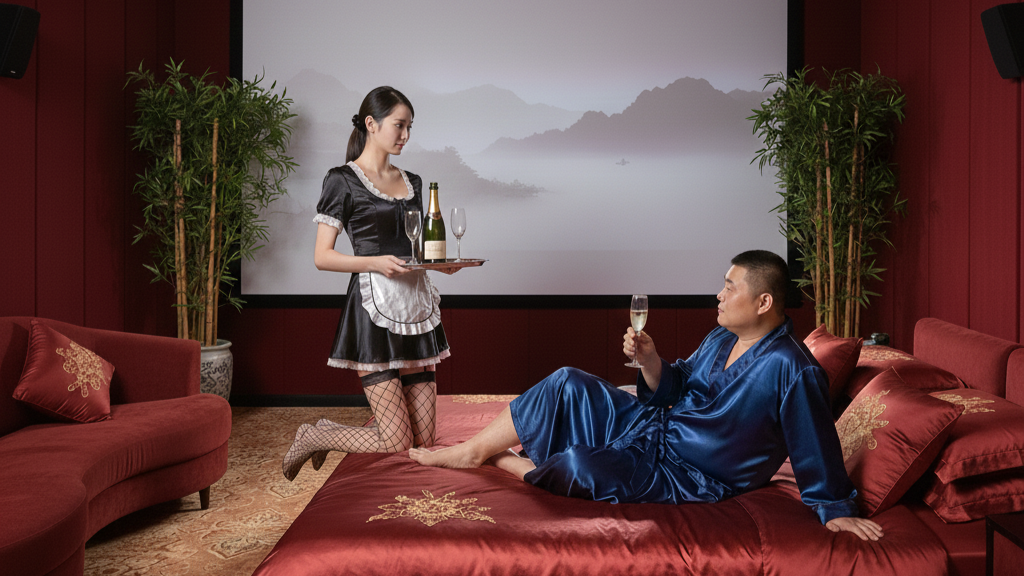
Behind the discreet doors of China’s booming urban entertainment scene, a little-known business model has been quietly thriving: the so-called “private cinema” (私人影院, sīrén yǐngyuàn). Marketed online as intimate, customizable film-viewing spaces for couples or friends, these venues promise privacy, comfort and flexible hours. But over the past year, police crackdowns and investigative media reports have revealed that in several cities, private cinemas have also become fronts for illegal and grey-zone activities ranging from unlicensed overnight accommodation to paid sexual companionship and prostitution-related services. The phenomenon has sparked a wider debate about regulation, urban loneliness, and how China’s underground service economy adapts to tight moral and legal controls.
Private cinemas are typically small venues divided into individual rooms, each equipped with a screen, sofa or bed, sound system and streaming access. Customers book by the hour through platforms such as Meituan or Dianping, often attracted by vague promises of “immersive experience” (沉浸式体验, chénjìn shì tǐyàn) or “private companionship” (陪伴服务, péibàn fúwù). In theory, they fall under entertainment or cultural business regulations. In practice, authorities have found that some operators exploit regulatory loopholes and the privacy of enclosed rooms to run side businesses that violate public security and anti-prostitution laws.
One of the most frequently cited locations in recent police reports is Chengdu, where public security officers conducted undercover inspections of more than 20 private cinemas in 2025. While many were found to be operating normally, several venues were penalized for failing to register overnight guests using real-name systems (实名登记, shímíng dēngjì), a legal requirement in China. At least one cinema was shut down after police confirmed it was providing for-profit “companionship services” in its viewing rooms, a euphemism often used to mask sexualized interactions.
In Xi’an, police went further, criminally detaining operators who had allegedly organized paid escort services under the cover of “movie-watching packages.” According to media reports, customers were initially offered a private screening, then encouraged to upgrade to higher-priced packages involving a female companion. Several individuals involved received administrative penalties, while organizers were investigated for facilitating prostitution (容留卖淫, róngliú màiyín).
Further south, in the resort city of Sanya, authorities detained the owner of a private cinema suspected of pornography-related offenses (涉黄违法, shè huáng wéifǎ). Police statements described the venue as offering services that went far beyond film viewing, with young female employees punished administratively and landlords warned about legal liability for renting property to illegal businesses. The case highlighted how tourist hubs with transient populations can be especially fertile ground for such operations.
Smaller cities have not been immune. In Jingdezhen, known more for porcelain than nightlife, police dismantled a private cinema that advertised online but secretly ran a “private cinema plus playmate” (私人影院+陪玩, péiwán) model. Investigators found that sexual services were provided in closed rooms, leading to arrests and charges linked to prostitution facilitation. Similar media exposés have pointed to cases in Dali, where journalists posing as customers were openly offered overnight stays and companionship at private cinemas operating on the edge of legality.
What unites these cases is not only the business model, but the social context. Analysts quoted in Chinese media note that private cinemas appeal to customers seeking anonymity, intimacy and emotional or physical closeness in cities marked by intense work pressure and isolation. Operators capitalize on this demand while hiding behind the neutral label of “cinema,” adjusting services according to risk and enforcement intensity.
As police across China step up inspections and publicize cases, authorities are signaling that the private cinema sector will no longer be treated as a regulatory blind spot. Yet the persistence of these venues suggests that demand has not disappeared. Instead, it continues to shift shape, reflecting deeper tensions between regulation, urban desire, and the informal economies that flourish wherever privacy meets profit.
Spicy Auntie has seen this movie before — and not in China alone. Call them “private cinemas,” “VIP rooms,” “family KTV,” or “entertainment lounges,” the script barely changes across Asia. Dim lights, thick doors, plush sofas, a screen nobody is really watching, and an unspoken understanding that what’s being sold is not the film, the song, or the karaoke microphone. It’s intimacy. Or at least a rented version of it.
When I read about China’s private cinemas suddenly “discovered” by police, I almost spilled my tea. Discovered? Darling, Auntie walked through versions of these places years ago. In Bangkok, I was taken to KTVs where the girls’ job was not to sing but to sit close, laugh on cue, pour drinks, and quietly negotiate what happened after the song ended. In Phnom Penh, I’ve seen so-called “cinema lounges” with mattresses instead of seats, where the screen was just background noise for something more transactional. In Jakarta and Surabaya, they called them “family karaoke” — very family-oriented, as long as your family consisted of one lonely man with cash.
Asia has perfected the art of euphemism. “陪伴” (péibàn, companionship). “陪玩” (péiwán, playmate). “服务升级” (fúwù shēngjí, service upgrade). Same dance, different language. China’s private cinemas didn’t invent anything new; they simply localized a regional business model that thrives wherever public morality is loudly policed and private desire quietly monetized.
What always strikes me is the hypocrisy. Authorities claim shock when they find escort services hidden behind screens and sofas, yet everyone — landlords, platforms, local officials — knows exactly what kind of “experience” is being sold. These venues survive because they meet a demand nobody wants to talk about: loneliness, sexual frustration, emotional isolation, the need to be touched without the messiness of real relationships.
And let’s be honest: when crackdowns happen, it’s rarely the men who pay the real price. The women — young, replaceable, often migrants — get fined, detained, “educated.” Operators disappear, rebrand, reopen two streets away. Auntie has watched this cycle repeat from Manila to Kuala Lumpur, from Ho Chi Minh City to Osaka’s back-alley lounges. Close one door, another padded door swings open.
The problem isn’t private cinemas. The problem is a system that pretends desire can be regulated into obedience. You can ban rooms, screens, sofas, even words. You cannot ban human need. As long as Asia insists on public virtue and private silence, there will always be dark rooms where the movie doesn’t matter — and everyone knows why they’re really there.