


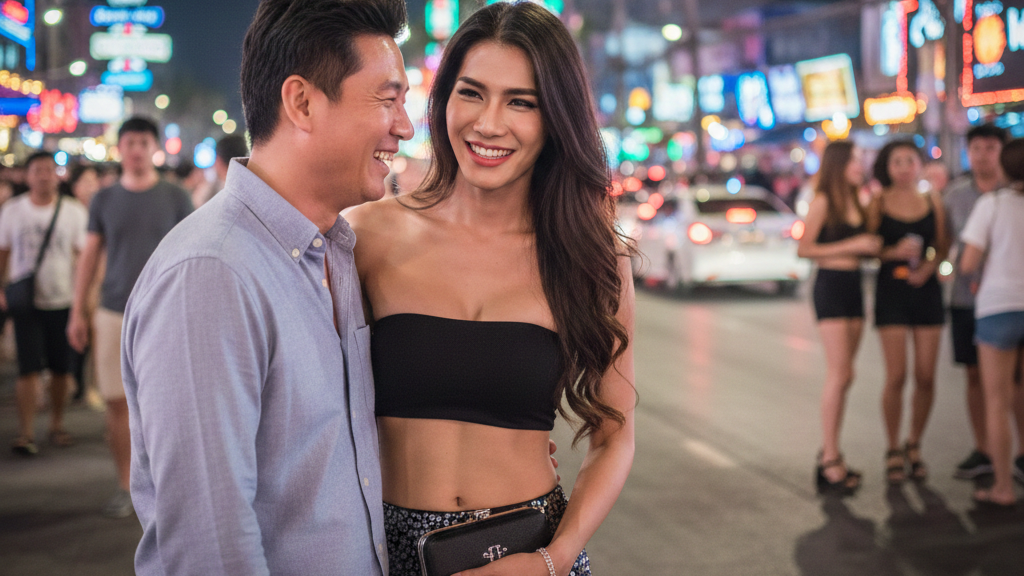
For decades, Thailand has occupied a peculiar place in the global imagination when it comes to sex, gender, and desire. Sun, beaches, nightlife and permissiveness are part of the brand, but so too is the visibility of transgender women—known locally as kathoey (กะเทย). For some foreign men and tourists, this visibility becomes a point of curiosity, attraction, and ultimately sexual pursuit. The reasons behind this phenomenon are complex, uncomfortable at times, and deeply entangled with power, fantasy, and global inequalities.
A first explanation lies in visibility itself. In Thailand, transgender women are far more publicly present than in many societies. They appear in cabaret shows, popular television programs, beauty contests, shopping malls, and nightlife districts. While this visibility does not translate into full legal equality or social safety, it creates an impression—especially for visitors—that gender diversity is widely accepted and celebrated. For tourists arriving from countries where transgender people are marginalized or hidden, this openness can feel liberating, even intoxicating.
Tourism infrastructure reinforces this perception. In Bangkok, Pattaya, Phuket, and Chiang Mai, entertainment districts are carefully shaped around foreign consumption. Bars, clubs, cabarets, and hostess venues openly market transgender performers and companions as part of a distinctive nightlife experience. For some visitors, encountering kathoey in these spaces normalizes desire that might otherwise feel forbidden or risky at home. Thailand becomes a stage where curiosity feels sanctioned by distance and anonymity.
Fantasy also plays a powerful role. Western and East Asian porn industries, online forums, and travel blogs have long fetishized Thai transgender women, packaging them as “exotic,” hyper-feminine, sexually skilled, and emotionally attentive. These narratives flatten real people into consumable archetypes, often erasing their daily struggles, families, and aspirations. Many tourists arrive already carrying these scripts in their heads, primed by years of online imagery and peer storytelling.
Anonymity is another crucial factor. Travel allows people to suspend their usual social identities. Away from spouses, colleagues, religious communities, or national norms, some Western, South Asian and East Asian men feel free to experiment without consequences. For visitors who identify as heterosexual at home, paid sex with a transgender woman may be rationalized as a temporary adventure rather than a challenge to identity. “What happens in Thailand stays in Thailand” becomes a convenient psychological firewall.
Economics cannot be ignored. Thailand’s long-standing sex and entertainment economy—operating in legal gray zones—makes access relatively easy compared with many countries. Prices are lower than in Europe, North America, or Japan, and negotiations are often explicit and ritualized. For some men, this clarity reduces anxiety: roles are defined, expectations are transactional, and emotional risks appear manageable, even if this perception is misleading.
Yet not all encounters are brief or purely transactional. Research and reportage document longer-term relationships between foreign men and Thai transgender women that blend affection, money, aspiration, and inequality. Some evolve into semi-stable partnerships involving remittances, cohabitation, or dreams of migration. These relationships can provide material support and emotional connection, but they also expose deep power imbalances shaped by citizenship, income, race, and age.
Behind the tourist fantasy lies a far harsher reality. Transgender women in Thailand face widespread employment discrimination, limited legal recognition, family rejection, and routine harassment by police. Those working in nightlife or sex work are particularly vulnerable to violence, coercion, and health risks. High-profile cases involving foreign clients have periodically shattered the illusion of harmless adventure, revealing how easily fetishization can slide into dehumanization.
Understanding why foreign men seek sex with Thai kathoey therefore requires looking beyond individual desire. It is a story about how tourism markets difference, how global media eroticizes gender variance, and how economic inequality turns visibility into vulnerability. For some visitors, Thailand offers permission to explore desire; for many transgender women, it offers one of the few viable ways to survive in a society that celebrates them on stage while denying them equality off it.
Auntie has been around long enough to recognize a familiar pattern when she sees one. It starts with curiosity, gets dressed up as “open-mindedness,” and ends—far too often—in entitlement. Foreign men arrive in Thailand telling themselves a flattering story: I’m not like the others. I’m progressive. I admire gender diversity. I respect trans women. And then, five minutes later, they’re negotiating prices, boundaries, bodies, and silence, as if admiration were something you could pay for by the hour.
Let’s be clear. Desire itself is not the crime. Attraction is not immoral. Wanting a transgender woman does not make you a monster. What does is the way that desire gets licensed by tourism, money, and distance. Thailand becomes a moral free zone, a place where men believe they can explore fantasies without consequences—because the consequences don’t follow them home. They stay behind, in rented rooms, police stations, clinics, and memories that never make it into holiday photos.
Auntie has watched how “ladyboy” fascination is sold as charm, humor, and harmless kink. But behind the jokes is a brutal hierarchy. Transgender women are celebrated on stage, mocked on television, fetishized in bed, and erased in law. No legal gender recognition. Limited job options. Routine harassment. And yet tourists keep insisting how “lucky” Thai trans women are—how visible, how accepted, how glamorous. Visibility without protection is not freedom. It’s exposure.
Many foreign men insist these encounters are mutual, even romantic. Sometimes they are. Sometimes affection is real. But let’s not pretend the playing field is level. One side holds a passport, disposable income, and an exit ticket. The other holds hope, rent due, family pressure, and very few alternatives. When romance mixes with survival, power never disappears—it just learns to smile.
What irritates Auntie most is the selective blindness. Men who would never dare approach a transgender woman back home suddenly feel bold in Bangkok or Pattaya. Why? Because here, she is imagined as available, transactional, endlessly feminine, and safely contained within the fantasy of the trip. Not a colleague. Not a neighbor. Not someone who might ask for rights, recognition, or respect beyond the night.
So no, this isn’t a story about Thailand being permissive or exotic. It’s a story about how global inequality eroticizes difference. About how tourism gives men permission to consume what they are unwilling to defend. And until that changes, Auntie will keep saying it plainly: if you desire transgender women, start by respecting their lives—not just their bodies.