


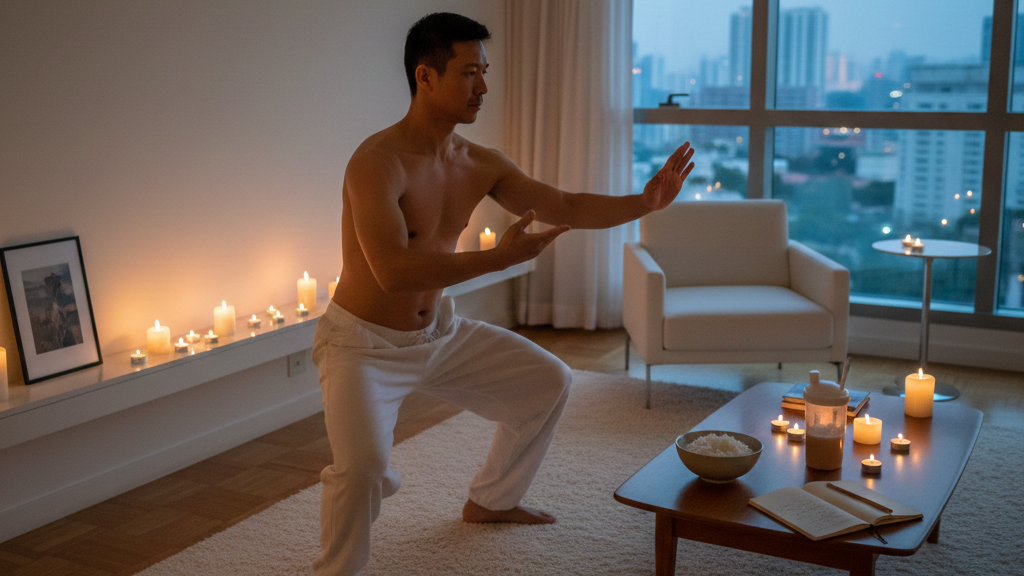
“Monk Mode” sounds like an escape to a mountain monastery, but in Asia’s most developed cities it usually unfolds in cramped apartments, co-working spaces and 24-hour gyms. Across Singapore, Seoul, Tokyo and Hong Kong, a growing number of men are publicly committing to periods of extreme discipline and self-restriction: deleting social media, quitting alcohol, avoiding dating and nightlife, waking up before dawn, exercising daily, meditating, journaling, and working in long, uninterrupted blocks. The promise is seductive and highly searchable: Monk Mode equals focus, productivity, and control in an era of endless distraction.
The motivations behind Monk Mode are tightly linked to life in advanced Asian economies. These are societies marked by intense competition, long working hours, soaring living costs and constant digital comparison. For many men, Monk Mode is framed as a response to burnout and fragmentation rather than spiritual yearning. Asian Media describes it as a deliberate attempt to “cut out noise” and regain mastery over time and attention, often for a fixed period such as 21, 30 or 90 days. It appeals especially to young professionals and freelancers who feel that social media, dating apps and constant messaging are eroding their ability to concentrate and achieve concrete goals.
Despite the name, Monk Mode has little to do with actual monastic traditions. Instead, it borrows selectively from ideas of asceticism and discipline, repackaged through modern self-help and productivity culture. Typical techniques include “dopamine fasting” (avoiding short-term pleasures like scrolling, gaming or pornography), strict routines, time-blocking, minimalist diets, daily workouts and meditation practices inspired by mindfulness rather than religion. The language is often quasi-scientific, referencing “focus,” “neurochemistry” and “habit stacking,” which makes the practice feel rational and optimisable rather than mystical.
Geographically, Monk Mode is most visible in highly urbanised Asian settings where digital saturation is high and private space is limited. In Singapore, where productivity and self-management are civic virtues, local media note that Monk Mode resonates with men seeking structure in fast-paced corporate environments. In South Korea and Japan, it circulates through fitness influencers, start-up culture and men’s self-development forums, intersecting with long-standing anxieties about overwork and social withdrawal. In Hong Kong, where housing constraints and work pressure compress daily life, Monk Mode is often framed as a way to reclaim mental territory when physical space is scarce.
Social media is not just the vehicle of diffusion; it is also the paradox at the heart of Monk Mode. The trend spreads primarily through TikTok, Instagram, YouTube and Reddit, where men document their routines, before-and-after transformations and daily rules under hashtags like #MonkMode. Influencers promote personal “protocols,” productivity challenges and aestheticised images of solitude: dark rooms, notebooks, dumbbells, black coffee. The very platforms being renounced are essential to broadcasting the renunciation. Visibility, validation and virality coexist with claims of withdrawal.
This online framing also shapes the tone of the movement. Monk Mode content often emphasises masculinity coded as control, endurance and self-sufficiency. Critics quoted in Asian media warn that, for some men, it can slide into emotional avoidance or social isolation, especially when framed as a cure-all for dissatisfaction rather than a temporary reset. Yet its popularity suggests that many find real relief in structured withdrawal, at least in the short term.
Ultimately, Monk Mode reflects how men in Asia’s most developed societies are negotiating digital overload. It does not reject ambition; it intensifies it by stripping away what practitioners see as unnecessary stimuli. Unlike other Asian responses to pressure that emphasise disengagement or lowered expectations, Monk Mode is about sharpening the self to perform better within the system. Its rise says less about monks than about modern masculinity under strain, seeking clarity, discipline and meaning in a world that never stops pinging.
Spicy Auntie here, mildly entertained, eyebrow gently raised. So welcome, Monk Mode. Truly. If this trend produces a generation of men who sleep on time, stop doom-scrolling, lift their own bodies instead of their egos, and develop a passing familiarity with self-control, Auntie is not going to complain. Discipline is sexy. Consistency is underrated. Silence can be healthy. All good things.
But let’s talk about the comedy in the room. The great vow of withdrawal from social media—dramatically announced on social media. The rejection of external validation—meticulously documented with progress photos, morning routines, gym mirrors, and captions about “locking in.” The modern monk who renounces the digital world but still needs Instagram to know he exists. Auntie has to laugh. If ancient monks had behaved like this, half the sutras would be selfies.
This is not to dismiss the sincerity behind Monk Mode. Many men are clearly exhausted. They are overstimulated, overworked, and emotionally scrambled by a world that pings them every three seconds and measures their worth in likes, matches, and productivity charts. Choosing structure over chaos is understandable. Choosing fewer inputs over constant noise is sensible. Choosing discipline over drifting is, frankly, long overdue.
Still, there’s something very modern—and very male—about turning withdrawal into a performance. Even silence must be announced. Even restraint must be branded. Even solitude must be monetised or at least admired. Auntie suspects that what’s really being chased here is not monkhood but control: control over impulses, over time, over bodies, over narratives. The aesthetic of discipline is comforting in a world that feels ungovernable.
Now here’s where Auntie clears her throat gently. Dear modern men, before you invent another challenge, another “mode,” another rulebook, please look around you. You want lessons in endurance? Talk to a woman balancing work, family expectations, emotional labour, and constant self-surveillance. You want discipline? Watch women ration time, money, energy, and ambition in systems that were never built for them. You want restraint? Observe how many women swallow anger, desire, and exhaustion just to keep the peace.
Women have been practising Monk Mode for centuries—without hashtags, without applause, without the luxury of calling it a “phase.” They didn’t opt out for optimisation; they endured because they had to. So yes, gentlemen, go ahead and lock in. Train. Focus. Meditate. Delete the apps if it helps. Auntie applauds any man who learns to master himself rather than demand the world revolve around him.
Just remember: if you truly want to learn discipline, humility, and resilience, you don’t need to retreat into monkhood. You need to listen to the women already living it.