


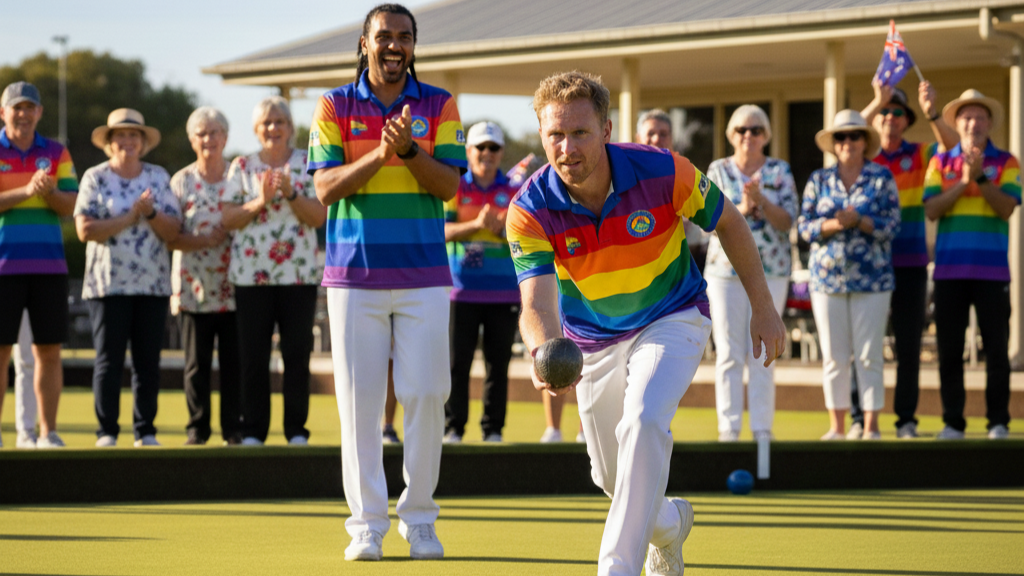
When you think of LGBTQ-friendly community sport in Australia, images of rainbow flags flying over a lawn bowls green might not immediately spring to mind. Yet in the heart of Melbourne’s vibrant suburb of Richmond, a club that once fit the stereotype of a “quiet, conservative” pastime has transformed into a buzzing, inclusive hub where players, allies and community seekers alike gather to roll bowls, raise a pint and celebrate diversity in an atmosphere of joy and acceptance. Richmond Union Bowling Club — now known for its annual Pride Cup and warm welcome to LGBTQ members — is redefining what sport can look like in 2025, with a focus less on competition and more on community, belonging and queer joy.
The Australian broadcaster ABC cites the story of American transplant Paul Cunningham. When he first wandered onto the Richmond green, he expected something austere and unwelcoming. Instead, he found laughter, camaraderie and an invitation to join the club’s committee with a new mandate: make this space truly inclusive. Richmond Union was the first lawn bowls club in the world to host a Pride Cup, a colourful, celebratory tournament that now draws hundreds of participants and spectators each year. What started as a “leap of faith” by club president Robert Hutton has become a model for how a traditional sport can evolve. Rather than keeping to the old image of serious groups of retirees in white uniforms, the club welcomes people of all ages, genders and sexualities, fostering an atmosphere where someone can be themselves — whether they came for the game or the community.
Behind the giggles and colourful polos (often emblazoned with rainbow stripes), there’s a serious recognition of why such spaces matter. Many LGBTQ Australians disengage from organised sport early in life due to negative or discriminatory experiences. For them, finding a welcoming environment later in life can be transformative. Clubs like Richmond Union play a role not just in promoting physical activity, but in rebuilding confidence and connection. Research and community voices across the country have highlighted that feeling unsafe or unwelcome keeps countless queer people away from sports they once loved or wanted to try.
Richmond Union’s story is part of a broader cultural shift across Australia. Organisations such as Proud 2 Play advocate for LGBTQ inclusion across all levels of sport, working with community clubs to dismantle barriers and educate about safe, affirming participation. Bowls Australia itself has embraced these changes, with affiliated clubs hosting Pride tournaments and adopting inclusive policies, recognising that sport should be accessible and enjoyable for everyone, regardless of gender identity or sexual orientation.
But Richmond isn’t alone in fostering LGBTQ-friendly sporting communities. Across cities like Melbourne and Sydney, groups such as Melbourne Frontrunners have grown into large, welcoming running clubs where people come together each week for fitness, friendship and support. Others, like Queer Sporting Alliance (QSA), weave together diverse activities — from basketball and futsal to rollerskating — prioritising fun and inclusivity over elite competition. These spaces often become social lifelines, especially for those who felt marginalised in their school years or traditional clubs.
There’s also an emerging culture of queer outdoor and adventure sports, where clubs like ClimbingQTs and its offshoot TransQTs run climbing sessions and excursions that celebrate strength, resilience and community. In a society where anti-trans rhetoric and exclusionary attitudes still bubble under the surface, the importance of such initiatives can’t be underestimated. They offer a joyful, liberating alternative to the isolating stereotypes that too often keep LGBTQI+ people on the sidelines.
Back at Richmond Union, the greens hum with laughter and the clatter of bowls, but also the deeper rhythms of community — people who might never have stepped onto a sport field feeling accepted now find themselves returning week after week, not just for the love of the game, but for the sense of belonging it brings. In a world where sport has too often excluded some of the very people who most need its joys, this Melbourne club and others like it are proving that inclusion isn’t just a policy — it’s a celebration, and that sometimes the simplest games can build the richest communities.
Spicy Auntie has a confession to make. When someone first told me, with a straight face, that lawn bowls was becoming a queer safe space, I nearly spat out my gin. Lawn bowls? The sport I associated with blinding white shoes, polite claps, and the kind of silence normally reserved for funerals and awkward family dinners? And yet, here we are. Richmond. Rainbow flags. Pride Cups. Drag queens rolling bowls straighter than some of the men I’ve dated. Life is full of surprises.
But the more I think about it, the more it makes perfect sense. Queer people have always been experts at repurposing spaces that weren’t built for us. Bars that became sanctuaries. Dance floors that turned into therapy. Kitchens that doubled as political headquarters. So why not a bowling green? If there’s one thing LGBTQI+ folks know how to do, it’s take something dusty, conservative, and rigid—and soften it with laughter, colour, and chosen family.
What I love about these inclusive bowls clubs and other minor sports isn’t the sport itself. Let’s be honest: most people aren’t there dreaming of trophies. They’re there because traditional sport has failed them before. Many of us grew up learning very early that locker rooms could be cruel places. That PE classes were arenas of humiliation. That “boys’ sports” and “girls’ sports” left no room for anyone in between. You don’t forget that kind of exclusion. It settles into your muscles.
So when I hear about clubs that say, explicitly, “Come as you are. Partner optional. Gender irrelevant. Masc allowed but not required,” my heart does a little queer somersault. These are not high-performance factories. They’re repair shops. Places where people relearn how to move their bodies without shame, how to compete without being crushed, how to belong without pretending.
And notice something important: it’s often the so-called minor sports leading the way. Not rugby, not football, not the testosterone-heavy temples of national identity. It’s bowls, running clubs, climbing groups, dance collectives. The sports where winning isn’t everything, and masculinity isn’t policed like a border crossing. The sports that quietly ask a radical question: what if sport was actually about joy?
Of course, Auntie is not naïve. Rainbow logos don’t magically erase homophobia or transphobia. Inclusion takes work, awkward conversations, policy changes, and the courage to upset the grumpy old regulars at the bar. But when clubs commit to it—not as a marketing stunt, but as a value—the impact is profound.
So here’s my toast, darling. To the queer bowlers, the lesbian runners, the trans climbers, the allies who listened instead of panicking. To all the small sports doing the big emotional labour that major institutions still avoid. Roll on, I say. Roll on.