


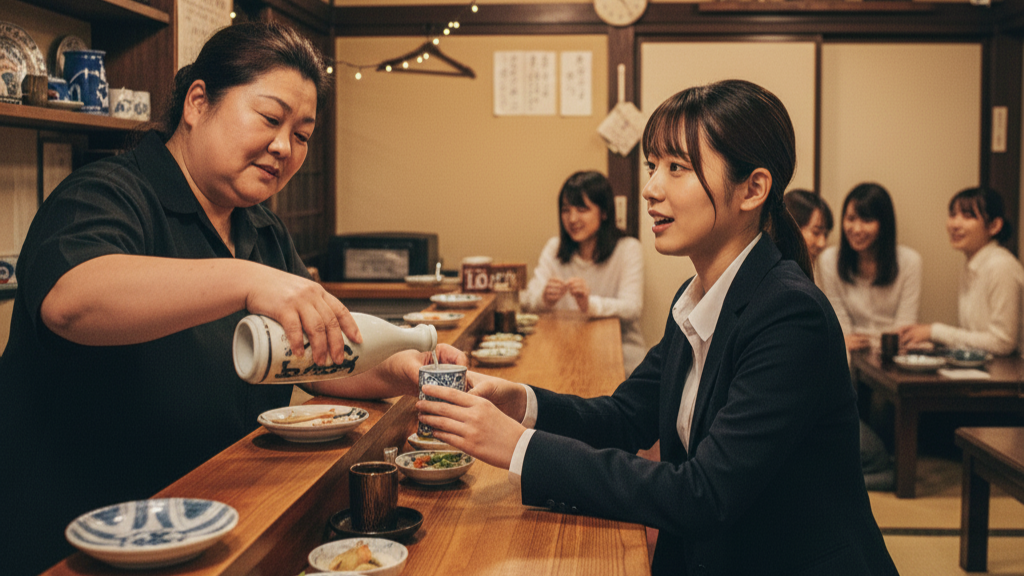
In Japan, the word ‘snack bar’ rarely means what outsiders expect. Far from vending machines or casual food counters, sunakku (スナック) are intimate, neighborhood bars where alcohol is almost incidental to the real offering: conversation, emotional release, and human connection. When these snack bars are run by women—or consciously shaped as spaces for women—they become something more specific and quietly radical: informal sanctuaries where psychological pressure is eased through listening, memory, and care rather than spectacle or seduction.
One of the best-known examples of the classic women-run snack bar is Kuriyakko, tucked into the after-work streets of the Shimbashi district in Tokyo. Run by a veteran Mama-san, the bar is small, warmly lit, and deliberately unpretentious. Regulars return not for novelty but for continuity. Mama remembers who changed jobs, who is caring for an aging parent, who recently divorced. Patrons—many of them women in their forties and fifties—describe Kuriyakko less as a bar than as a “fixed emotional address,” a place where their story does not need to be retold from scratch each time.
In Tokyo, newer snack bars are also redefining the genre. Aeru, run by a woman known as Urara Mama, blends traditional snack bar hospitality with gentle matchmaking and fortune-telling. Tarot cards and casual introductions are used not as gimmicks but as conversational tools, allowing patrons—especially women navigating loneliness or post-marriage life—to speak about desire, fear, or uncertainty without embarrassment. The psychological motivation here is not romance itself, but reassurance: the feeling of being seen as a whole person rather than a problem to be fixed.
Another notable case is Snack Suichu, run by Chisato Sakane, who consciously repositioned her bar as an inclusive, women-friendly space. Younger women, creatives, freelancers, and people uncomfortable with traditional male-dominated nightlife find Suichu approachable precisely because nothing is demanded of them. There is no pressure to drink fast, flirt, or entertain. Mama-san’s main service is ma o mamoru (間を守る, protecting the emotional space): ensuring conversations do not turn aggressive, invasive, or performative. For many female patrons, this gentle boundary-keeping is the real luxury.
Outside Tokyo, the social role of women-run snack bars becomes even clearer. In Fukuoka’s Nakasu district, Hirusuna Nakasu operates during the day and was founded by a social worker. Its philosophy—“it’s okay to be useless”—openly rejects Japan’s productivity obsession. Women come in after night shifts, hospital visits, or emotional breakdowns, not to escape reality but to breathe inside it. Here, Mama-san’s role edges close to informal counseling, though without diagnosis, fees, or hierarchy. Listening itself is the service.
Across these examples, the psychological motivations of patrons are strikingly consistent. Women come to snack bars when other spaces feel too loud, too judgmental, or too goal-oriented. They seek ibasho (居場所), a place where silence is acceptable and feelings do not need to be optimized. Many patrons describe the relief of being able to complain without advice, cry without drama, or laugh without explanation. In a society where emotional labor is expected of women but rarely returned to them, the snack bar quietly reverses the flow.
What a Mama-san offers goes far beyond snacks and drinks. She curates emotional safety, mediates conflicts, remembers anniversaries and losses, and sometimes delivers blunt truths with the authority of lived experience. Her power lies not in flirtation but in recognition. In women-run snack bars, care itself becomes the product—and for many Japanese women navigating isolation, exhaustion, or transition, that care is not a luxury, but a lifeline.
I love these places. Truly. Give Auntie a plastic stool, a dim light, a Mama-san who pours weak whiskey and listens properly, and I’m home. Forget glossy cocktail bars with their performative cool and overpriced ice cubes. Give me a sunakku where nobody is trying to impress anyone and everyone is just trying to survive another day in this beautifully exhausting country.
Let’s be clear: women-run snack bars are not about alcohol. Alcohol is just the excuse. What these places really sell is relief. Permission. A pause button. You walk in with your shoulders up to your ears, your face frozen in polite neutrality, your heart carrying things you haven’t dared say out loud—not to your husband, not to your colleagues, not even to your closest friends. And Mama-san sees it immediately. No interrogation. No “how are you?” trap. Just a glass, a nod, a space.
I’ve watched women come in silent and leave lighter. I’ve watched others cry without apologizing for it. I’ve watched Mama-san shut down a conversation that was getting too macho, too loud, too invasive—because this is her house and emotional safety is non-negotiable. That’s power, sisters. Quiet, practiced, earned power.
What fascinates me most is how these bars operate as unofficial emotional infrastructure. Therapy without invoices. Sisterhood without slogans. Care without hashtags. In a society obsessed with endurance, productivity, and not making trouble, snack bars offer something radical: you don’t have to be useful here. You don’t have to optimize yourself. You don’t even have to talk, if you don’t want to. Sitting there, breathing, is enough.
And yes, let’s say it plainly: many women trust Mama-san more than institutions. More than HR. More than doctors. Sometimes more than family. Because Mama-san doesn’t diagnose, doesn’t judge, doesn’t rush you toward solutions. She remembers. She holds context. She lets you unfold at your own speed. That kind of listening is rare. And it is profoundly political, whether anyone intends it or not.
So no, these bars won’t save the world. They won’t smash patriarchy in one karaoke song. But they keep women going. They catch them before they crack. They offer dignity in small doses, night after night. And honestly? In a system that runs on women’s silence and endurance, that’s already a quiet revolution.
Auntie raises her glass to Mama-san. Keep the lights low. Keep the listening sharp. We need you more than you know.