


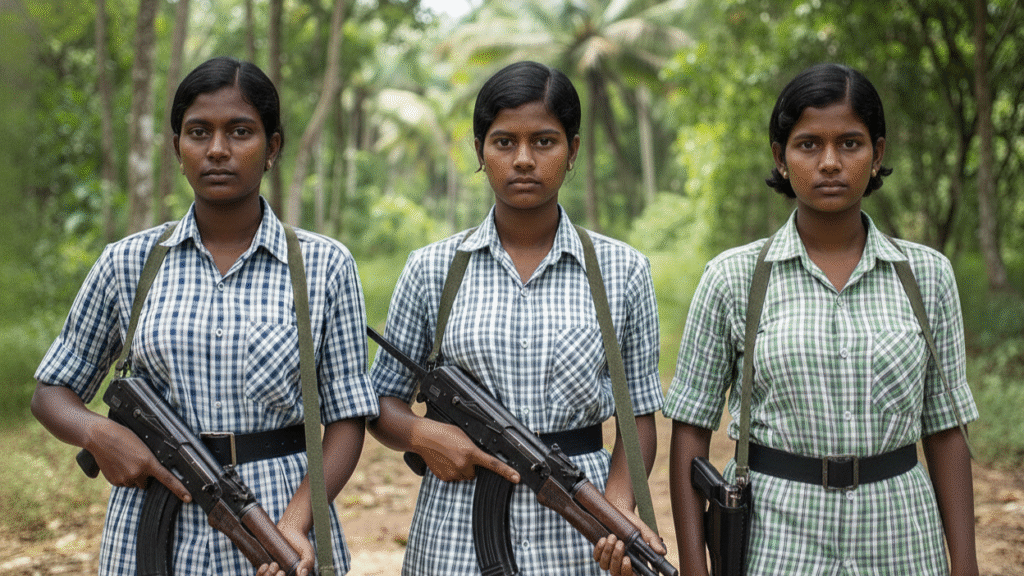
For decades, images of Sri Lanka’s civil war have been dominated by men with rifles in jungle fatigues, but one of the most striking and unsettling features of the Tamil armed struggle was the scale and visibility of women inside the Liberation Tigers of Tamil Eelam (LTTE). From the late 1980s until the movement’s military defeat in 2009, thousands of Tamil women stepped far outside prescribed gender roles to become fighters, unit commanders, intelligence operatives, propagandists, and symbols of a radical promise: that national liberation could also mean women’s liberation.
To grasp how disruptive this was, it helps to start with the cultural world many of these women came from. In a conventional Tamil family, especially in rural northern Sri Lanka, the ideal woman was shaped by karpu (chastity and moral purity), obedience to parents and later to a husband, and quiet endurance of hardship. A daughter, or ponnu, was expected to safeguard the family’s maanam (honour), limit her public presence, and move seamlessly from girlhood to marriage and motherhood. Strength was admired, but only when expressed through sacrifice and silence. War shattered this moral universe. Displacement, militarisation, sexual violence, and the constant presence of death destabilised family authority, pushing many young women toward choices that would have been unthinkable a generation earlier.
The LTTE began systematically recruiting women in the late 1980s, presenting armed struggle as both patriotic duty and personal emancipation. Women were not confined to cooking, nursing, or clerical work. Entire female combat formations were created, trained, and deployed. The first and most symbolically important was the Sothiya Brigade, named after Sothiya, widely described as the commander of the LTTE’s first women’s fighting unit formed in 1989. Sothiya’s death in combat in 1990 was mythologised as proof that women could fight and die on equal terms with men.
Even more iconic was the Malathi Brigade, named after Maalathy, often portrayed as the first female LTTE cadre killed in battle in 1987 during clashes involving the Indian Peace Keeping Force. Malathi’s story, including her reported use of a cyanide capsule to avoid capture, became foundational mythology. LTTE publications, posters, and commemorations elevated her into a symbol of fearless female sacrifice, a martyr whose death sanctified women’s participation in violence.
These brigades were not symbolic. Women trained in weapons handling, jungle warfare, and discipline, and fought in major battles throughout the conflict, including the brutal final years of the war. Female cadres also served in intelligence units, political sections, and administrative departments that governed LTTE-controlled areas. Some rose to command positions within women’s units, supervising training and operations, though ultimate strategic power remained concentrated in male hands.
Among the most famous female LTTE operatives was Thenmozhi Rajaratnam, also known as Dhanu. In 1991, she carried out the suicide assassination of former Indian Prime Minister Rajiv Gandhi, an act that permanently inscribed women’s militancy into regional and global consciousness. Within the LTTE’s own narrative, Dhanu was celebrated as the ultimate embodiment of devotion to viduthalai (liberation), her gender transformed from perceived weakness into tactical advantage.
Ideologically, women’s militancy was framed as social revolution. Figures such as Adele Balasingham, closely associated with the LTTE leadership, argued that armed struggle liberated Tamil women from oppressive customs, caste hierarchies, and domestic confinement. Inside the movement, women often experienced unprecedented autonomy: freedom from early marriage, escape from abusive homes, and a sense of collective purpose unavailable in civilian life. For many, the LTTE offered not only a weapon but an identity beyond daughter or wife.
Yet this emancipation was tightly bounded. Women’s bodies remained sites of intense discipline. Sexual relationships were restricted, pregnancy discouraged, and femininity deliberately erased through uniforms, cropped hair, and strict codes of conduct. The ideal female fighter was desexualised, obedient, and self-sacrificing. Liberation was real, but conditional, granted insofar as it served the nationalist project. In this sense, older expectations of women’s sacrifice were not abolished but repurposed. Thyagam (sacrifice) replaced chastity as the supreme virtue.
When the war ended in 2009 with the military destruction of the LTTE, the women’s wing disappeared almost overnight. Former female fighters were detained, sent through “rehabilitation” programmes, or returned to communities that no longer knew how to place them. Many faced suspicion, stigma, and difficulty marrying or finding work. The movement that had promised transformation was gone, and the society they returned to often preferred silence over recognition.
Still, the legacy of LTTE women endures. For a generation of Tamil women, the war irrevocably expanded the boundaries of what was imaginable. The ponnu of the household had become a soldier, a commander, a political actor. Even in defeat, that memory remains uncomfortable and powerful, a reminder that liberation struggles can simultaneously challenge patriarchy and reproduce it, offering women agency with one hand while demanding everything with the other.
I met them in Kilinochchi, back when it was still called the capital of an ephemeral dream named Tamil Eelam. Not on posters, not in slogans, but in the dust, the heat, the camps. I saw their training grounds: brutal, repetitive, unforgiving. Bodies pushed to exhaustion, minds drilled into obedience. I remember tough women officers, voices sharp, eyes hardened by responsibility, and behind them rows of much younger girls, some determined, some visibly frightened, trying to look brave because fear had no place there.
I remember the details that never make it into heroic narratives. The cyanide capsules hanging from their necklaces like dark talismans, bouncing against their chests as they ran. The haircuts, almost aggressively masculine, meant to erase softness, femininity, individuality. The uniforms that flattened bodies into symbols. Liberation, yes, but only a very specific kind, tightly supervised, heavily policed.
And I also saw the other side, the one the movement never liked to talk about. Forced recruitment. Parents crying, clinging to daughters who were told they were needed “for the cause.” Families terrified of refusing. Mothers who knew exactly what those camps meant, who understood that sending a daughter away was often a one-way journey. In Tamil society, daughters are meant to carry honour and continuity. Here, they were also carrying guns, and sometimes bombs.
Let’s not romanticise too much. The leadership was almost entirely macho Tamil men, men fluent in revolutionary language but deeply comfortable with hierarchy and control. Patriarchy is stubborn like that. Even in movements that promise liberation, it adapts, it survives, it rebrands itself in khaki and ideology. Women were celebrated as martyrs, as symbols, as proof of modernity, but rarely trusted with real power at the top.
And then came the end. Many of those girls and women I met never made it out. They were killed in the final months of the war, slaughtered in lagoons, bunkers, so-called “no fire zones,” their bodies swallowed by a war that had long stopped pretending to care about civilians. History files them away as collateral damage or faceless cadres. I remember faces.
When I go back to Sri Lanka now, I sometimes meet the survivors. Middle-aged women with lowered voices and careful words. “Reintegrated,” they call it. Married, working, silent. Dreams amputated, memories locked away because remembering is dangerous. The fire is gone, replaced by caution. The revolution didn’t just die on the battlefield; it was buried inside them.
So yes, those women were brave. Some were empowered. Many were used. All paid a price. If you want to talk about women in war, don’t just praise their courage. Ask who decided their fate, who survived, and who got to tell the story afterward. Spicy Auntie remembers.