


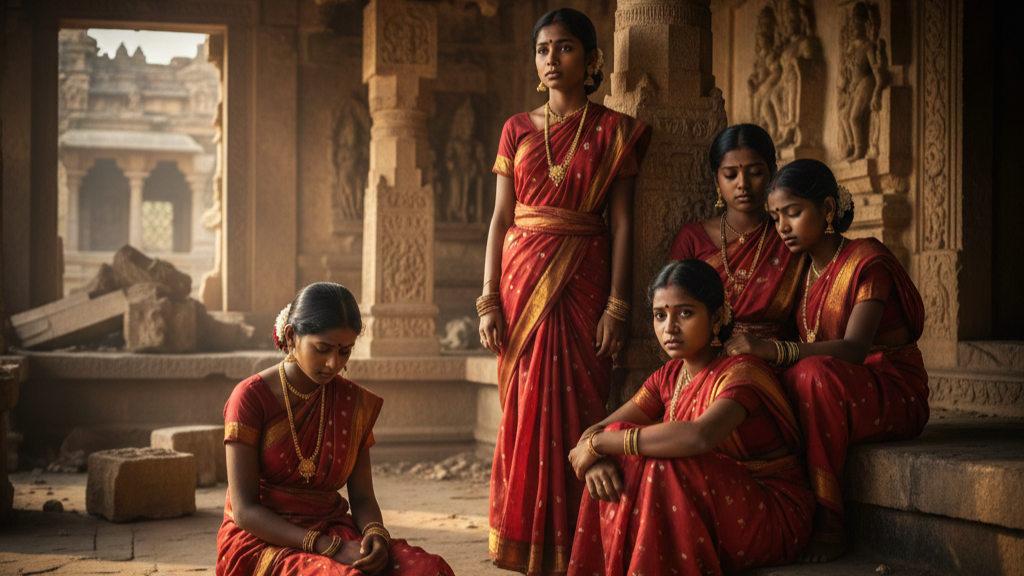
In India’s long and layered history, few institutions sit as uncomfortably at the crossroads of culture, faith, caste and gender as the Devadasi system. Often mistranslated as “temple prostitution” and just as often romanticized as a lost artistic golden age, the reality of Devadasi women is far more complex—and far more brutal in its modern afterlife.
The word Devadasi comes from Sanskrit: deva (god) and dāsi (servant). For centuries, Devadasis were women ritually dedicated to a deity and attached to temples across what are now Karnataka, Tamil Nadu, Andhra Pradesh, Telangana and parts of Maharashtra. In early medieval India, especially between the 6th and 13th centuries, Devadasis were not marginal figures. They were trained dancers, musicians, poets and ritual specialists, performing during temple ceremonies and royal festivals. Many were literate, financially supported by land grants, and socially autonomous in ways that married women rarely were. They were symbolically “married” to the deity and therefore outside the control of husbands or in-laws, an unusual position in deeply patriarchal societies.
This status, however, depended on stable temple economies and royal patronage. When those systems collapsed—through political change, colonial intervention and economic decline—the Devadasi institution hollowed out. By the 19th century, British colonial authorities and Indian social reformers increasingly viewed Devadasis through a Victorian moral lens, labeling them immoral and corrupt. Temples lost income, stipends disappeared, and the women who had once been artists and ritual custodians were left economically exposed.
It was at this point that caste and poverty reshaped the system into something far more exploitative. Dedication began to target girls from Dalit and other marginalized communities, often very young, sometimes barely in their teens. What remained of the “marriage to the deity” increasingly functioned as a religious cover for sexual access by powerful men. In some regions, dedicated girls were expected to become lifelong sexual partners of upper-caste patrons, with no right to marry and little protection from violence or abandonment.
One of the most persistent contemporary manifestations is linked to the worship of Yellamma Temple, where dedication ceremonies have continued for decades despite legal bans. Known locally by terms such as Devadasi, Jogini, Basavi or Mathamma, the practice varies in ritual detail but shares a common pattern: religious obligation, social pressure, and gendered coercion wrapped in the language of tradition.
India outlawed the Devadasi system through a series of laws beginning in the late 1940s, followed by state-level bans in Karnataka, Andhra Pradesh and Tamil Nadu. On paper, dedication is illegal. In practice, it has simply gone underground. Ceremonies are performed discreetly, without temple records, often framed as vows or symbolic rituals rather than formal dedications. The women involved remain trapped by stigma, lack of education, and economic exclusion. Many survive through informal labor or sex work, while their children face heightened risks of discrimination, trafficking and poverty.
The modern debate around Devadasis is deeply polarized. Some cultural revivalists emphasize the historical role of Devadasis as artists and guardians of classical dance traditions like Bharatanatyam, pointing out—correctly—that much of what is now celebrated as “high culture” was preserved by these women. Feminist scholars and activists respond just as forcefully that cultural contribution cannot excuse coercion, especially when dedication involves minors and entrenches caste-based exploitation.
What is often missing from public discussion is the continuity between past and present. Today’s Devadasi women are not relics of an ancient system; they are living evidence of how religion, patriarchy and poverty intersect to control women’s bodies. The tragedy is not only that Devadasis were exploited, but that their artistry was stripped of dignity, their labor erased, and their suffering reframed as tradition.
To understand the Devadasi system honestly means holding two truths at once: that these women were once respected cultural bearers, and that the system as it survives today is a human rights violation. Anything less risks turning lived exploitation into folklore—and leaving the women themselves invisible once again.
Oh, Devadasis. Every time someone starts whispering about “ancient traditions” and “sacred art,” Auntie reaches for her blood-pressure pills.
Let me be very clear, sisters and brothers: tradition does not excuse coercion. Not now, not ever. You don’t get to dress up exploitation in incense smoke and Sanskrit words and pretend it’s culture. That trick is older than patriarchy itself.
Yes, I know the history. Devadasis were once artists, intellectuals, keepers of music and dance. They were admired, educated, even powerful in their own limited ways. And yes, Indian classical dance owes them a massive debt that polite society conveniently forgot once upper-caste women decided to “sanitize” those art forms and claim them as respectable. Funny how culture is only holy when it’s performed by the right bodies.
But let’s stop pretending we’re talking about the past. Today’s Devadasi system is not about dance. It is about poor girls, mostly Dalit girls, being trapped by religion, caste and poverty. Dedicated as children. Denied marriage. Marked for sexual access. Abandoned when they are no longer useful. And then blamed for their own stigma. Classic patriarchy move.
What really enrages Auntie is the hypocrisy. The laws exist. The bans are there. Everyone officially agrees the practice is illegal. And yet ceremonies continue quietly, discreetly, with a wink and a nod. Police “don’t see.” Politicians “don’t know.” Temple authorities suddenly become blind, deaf, and spiritually confused. Meanwhile, the women carry the consequences on their bodies and in their bank accounts.
And don’t get me started on the men. The same society that clutches its pearls about “morality” somehow finds endless excuses for men who exploit Devadasi women. Funny how shame is always gendered. Funny how religion never seems to restrain male desire, only female freedom.
Some people say, “But these women choose it.” Auntie laughs bitterly. Choice without education, without income, without alternatives, without the right to say no — that’s not choice, darling. That’s coercion with better PR.
If you really care about culture, here’s a radical idea: protect the women, not the myth. Fund education. Guarantee housing. Offer real livelihoods. Listen to survivors instead of scholars who romanticize suffering from a safe distance. And stop using gods as alibis for human cruelty.
The Devadasi system doesn’t survive because it is ancient. It survives because it is convenient. For men. For caste hierarchies. For a society that still believes women’s bodies are community property.
Auntie is not impressed by your “heritage” if it requires sacrificing girls. Tradition that cannot survive without oppression deserves to end. Full stop.