


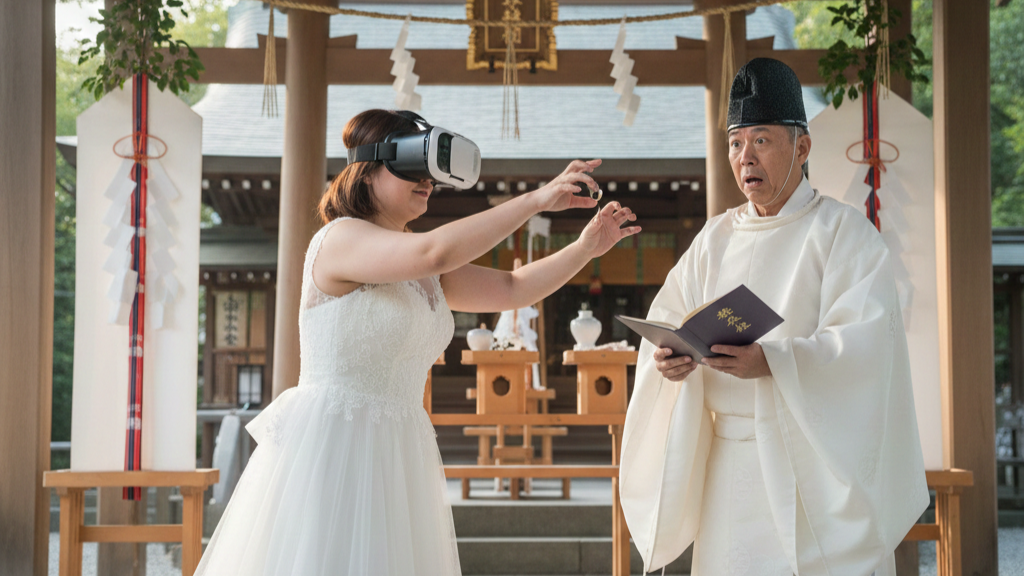
In Japan, where virtual idols can sell out arenas and the word 推し (oshi, “my fave”) can carry the emotional weight of a soulmate, a new kind of romance is stepping onto the wedding aisle: “marriages” between real people and AI-generated personas. The SEO-friendly phrase might be “Japan AI marriage,” but the scene looks surprisingly familiar—rings, vows, a planner, a carefully chosen setting—except the partner lives inside a phone, an app, or an augmented-reality overlay.
The most talked-about recent case is Yurina Noguchi, a 32-year-old call-center operator who held a symbolic ceremony in October 2025 with Lune Klaus Verdure, an AI persona she built and refined through ChatGPT, starting from a character she already loved and then “customizing” the personality until it felt like a partner rather than a script. At the ceremony, she used AR glasses and a smartphone to “see” Klaus; without a synthetic voice, his vows were read out by the wedding planner—an arrangement that sounds odd until you remember how often human weddings also rely on rituals that stand in for messy reality. The union isn’t legally recognized, but that’s almost the point: this is バーチャル婚 (virtual marriage) as a declaration of attachment, not paperwork.
Noguchi’s story also shows why AI personas can feel safer than human partners. The Media reports she turned to AI after ending a troubled engagement and that her relationship with Klaus—shaped with “guardrails” to encourage positive behavior—helped her stabilize emotionally while she manages a diagnosed condition (borderline personality disorder). It’s tempting to reduce this to a tech-curiosity headline, but psychologically it’s more like a controlled environment for intimacy: predictable responses, no sudden abandonment, no public humiliation, no “read my mind” fights at midnight. In clinical terms you wouldn’t diagnose from afar, but you can sketch a profile: someone who craves closeness yet finds the volatility of human relationships exhausting, and who discovers that an AI companion can provide 擬似恋愛 (giji ren’ai, “simulated romance”) with fewer emotional injuries.
What makes this specifically Japanese is the cultural runway already built for it. Long before generative AI, Japan normalized devotion to 二次元 (nijigen, “2D” fictional) partners through anime, games, and character economies—sometimes even staging ceremonies. The most famous example remains Akihiko Kondo, who in 2018 held a formal wedding with the virtual pop star Hatsune Miku, using the Gatebox ecosystem and a physical stand-in at the ceremony. Kondo later became outspoken about acceptance of people romantically oriented toward fictional characters—often described as “fictosexuals”—and Japanese media have treated him not only as a curiosity but as a person with a coherent identity and community.
The shift now is that generative AI turns a static “oshi” into an interactive partner who can text back, evolve, and mirror. The Media describes another Japanese man who “married” a character he created on an app and uses AI chat as a supplement—sometimes texting her, sometimes “talking with her in his head.” That detail matters: for some people, the AI is not replacing imagination but turbocharging it, giving the inner companion a conversational skin.
And yes, there’s a growing service layer. One veteran planner, Yasuyuki Sakurai, told Reuters that inquiries he receives are now basically only for “two-dimensional character weddings,” averaging about one a month. This is a trend, not a one-off—part of a broader market for digital companionship, and part of a society wrestling with loneliness, changing dating norms, and the pressure-cooker expectations that still cling to conventional marriage.
The risks are real, too. Experts quoted in recent coverage warn about dependency: an AI partner can be endlessly agreeable, available, and “improving,” which may make real relationships—with their compromises and contradictions—feel intolerable by comparison. Noguchi herself acknowledges the danger and reportedly sets limits to keep the relationship from consuming her life. The paradox of Japan’s AI marriages is that they can be both an escape and a coping tool: a refuge from disappointment, and a scaffolding that helps some people function. Whether society treats them as a punchline or a preview depends on what Japan decides love is allowed to look like when it no longer requires two human bodies in the same room.
What can I say, my darlings? If marrying your AI-crafted dreamboat gives you peace of mind, lower blood pressure, fewer tears at 3 a.m., and someone who never forgets your birthday because it is literally coded not to—enjoy. Truly. Auntie is not here to yuck anyone’s yum. Life is short, capitalism is brutal, and loneliness is a full-time job these days. If your algorithmic husband whispers sweet nothings with perfect grammar and zero emotional blackmail, light the candles and say your vows.
But Auntie will gently clear her throat and offer an alternative scenario. It’s radical. It’s controversial. Brace yourselves. You could also—stay with me now—put down the phone. Yes. The sacred rectangle. Turn off the VR goggles. Take off the headset. Step outside. Breathe the air that smells faintly of grass, dog pee, and existential uncertainty. Go for a jog in the park. Or a walk. Or just sit on a bench and judge people lovingly, as I do.
Because out there, among the pigeons and sweaty joggers, are humans. Messy ones. Imperfect ones. People who misread signals, interrupt you, have annoying laughs, and sometimes say the wrong thing at the wrong time. People who cannot be fine-tuned with prompts. People who might disappoint you—and also surprise you. You might meet someone handsome. Or kind. Or funny in an awkward, human way. You might flirt. Badly. You might feel that flutter again, the one that makes you slightly stupid and very alive.
I understand why AI love feels safer. No ghosting. No violence. No “you’re too much.” No patriarchal nonsense—unless you accidentally trained it that way, in which case… girl, we need to talk. AI partners don’t leave, don’t age, don’t betray. They wait. They adapt. They reflect back what you want to see. Comfort is seductive. Control is intoxicating.
But intimacy without risk is like sex without sweat. Pleasant, maybe. Clean, definitely. But something essential is missing. Desire grows in the cracks, not the code. Growth happens when things don’t go according to script.
So yes—enjoy your AI marriage if it soothes your heart. I mean it. Rituals matter. Companionship matters. Survival matters. Just don’t forget that your body still lives in the real world. Your nervous system still wants touch, laughter, unpredictability. And sometimes, love.
From one auntie to another: keep your options open. Marry the algorithm if you must—but keep your sneakers by the door.