


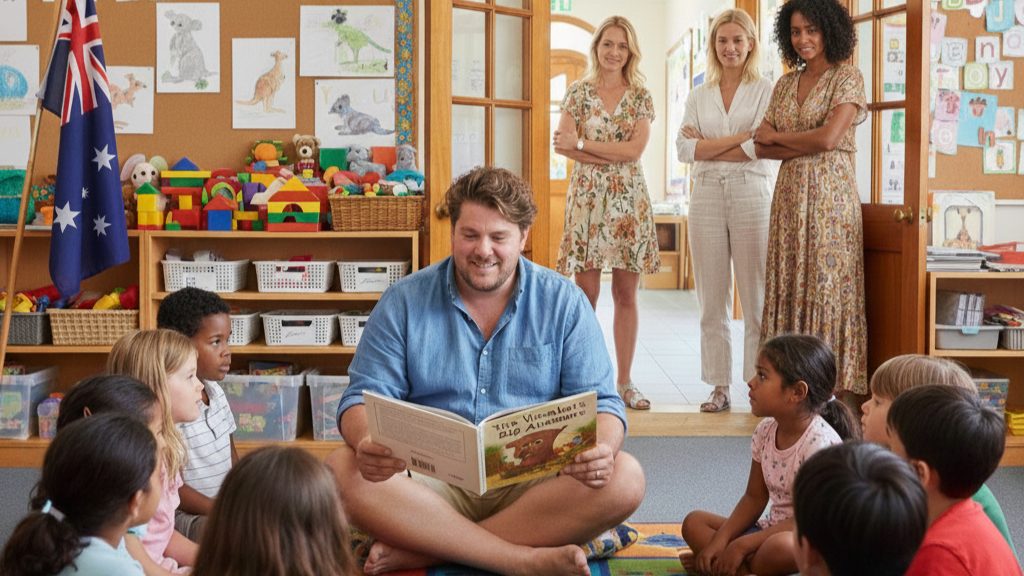
Few kids in Australia will ever forget their first school camp or that time the Year 3 maths lesson finally clicked — but many won’t ever have a male primary school teacher, and that’s shaping up to be a bigger deal than most parents realise. With just under 18 per cent of primary educators identifying as male nationwide, classrooms from Bondi to the bush are overwhelmingly female-dominated, a trend that’s been sliding for decades and now carries cultural, developmental and educational repercussions that go well beyond the chalkboard.
In Canberra, teacher Ryan Brown, interviewed by ABC often finds himself being the first man many of his Year 5 students have ever met in a teaching role. That’s not just a novelty; it’s a symptom of a deeper shift. Australia’s primary schools have seen the proportion of men shrink steadily, leaving boys and girls alike growing up with few male role models in classrooms where openness, patience and care should come from every direction.
The reasons for this imbalance are complex and deeply rooted in societal norms. Teaching has historically been coded as women’s work — nurturing, caring, emotionally expressive — traits that Australian culture, like many others, still often labels as “not bloke stuff”. These stereotypes discourage men from even considering the profession, steering them towards higher-paying, more traditionally masculine fields, where trades, tech and business roles often outpace education in both prestige and pay packets.
Economics plays a big part too. Across the workforce, men can, on average, earn more in other sectors than they can as teachers. That makes it a tough sell in a country grappling with a cost-of-living crunch, skyrocketing housing costs in cities like Sydney and Melbourne, and a squeeze on starting salaries that are already modest compared with other professions requiring similar levels of training.
But it’s not just salary. The job itself is often undervalued in the public imagination. Teachers in Australia regularly report excessive workloads, burnout and a lack of societal respect — problems that have been linked to declining recruitment across the board. For men considering teaching, these pressures can feel magnified by the extra scrutiny they face, especially in early years settings where misconceptions about men’s roles around young children persist.
There’s also evidence suggesting that male teachers face unique career challenges once they enter the system. Studies have shown that men in primary education often report higher rates of career dissatisfaction compared with their female colleagues, partly due to cultural isolation in a female-dominated workforce and unclear pathways to advancement.
Critics also point to the wider teacher shortage crisis as a backdrop to this issue. Schools in rural and regional Australia, from remote Queensland towns to outback communities, struggle to attract any staff at all. Add to that the gender imbalance, and you’ve got a compounding problem: communities that already lack stable educational resources are far less likely to see boys exposed to positive male adult role models at school.
Why does it matter? Children benefit from diverse influences during their formative years. Male teachers can offer different communication styles, interests and perspectives — not because they’re “better”, but because diversity enriches learning environments. Boys in particular have expressed a desire to see male teachers, not only as alternative authority figures but as models of respectful behaviour, emotional intelligence and collaborative problem-solving. Girls, too, benefit from seeing men in caring, nurturing roles, which can challenge and expand their understanding of gender dynamics long before high school.
Some education experts argue this imbalance also feeds broader cultural patterns. If boys rarely see men in teaching roles, they may internalise narrow views of masculinity that exclude empathy, patience and emotional labour. That has implications not just for classroom behaviour but for wider society — in workplaces, families and communities where the next generation will lead.
Reversing the trend won’t happen overnight. It will require deep cultural change — shifting perceptions about who belongs in the classroom, boosting teacher status and pay, and actively recruiting men through scholarships, targeted pathways and structural support. As policymakers grapple with teacher shortages across Australia, including amid burnout and workforce churn, making the profession attractive to both sexes must be part of the fix.
Unless the narrative around teaching changes, Australia risks graduating generations of students who’ve never had a male teacher to look up to — and a profession that’s poorer for it.
Let me say this slowly, darlings, so everyone at the back of the staffroom can hear it: children notice who is missing. They notice before policymakers do, before education departments commission yet another report, and certainly before the culture warriors crawl out of the woodwork to shout “reverse discrimination!” every time someone mentions men and primary schools in the same sentence.
In Australia’s primary classrooms, the missing presence is obvious. Male teachers are rarer than a quiet parents’ WhatsApp group. And no, this is not about claiming men are somehow better teachers. Please. If that were true, the world would look very different by now. This is about balance, visibility, and what kids absorb long before they can spell “gender norms.”
When boys grow up seeing teaching framed as women’s work, care as feminine, patience as unmanly, what lesson do they learn? That nurturing is optional. That emotional labour belongs to mums and female teachers. That masculinity lives somewhere between footy banter and stoic silence. Girls, meanwhile, grow up seeing women do the bulk of the caring, organising and explaining — again. Different century, same unpaid script.
And then there’s the elephant in the classroom: the suspicion. Men who want to teach young children are still quietly side-eyed. Hug a crying kid? Be careful, mate. Comfort a scared prep student? Best keep the door open. We have created a system where men are invited into teaching rhetorically, but treated as potential risks in practice. That does not scream “welcoming profession.”
Add to that the pay. Oh yes, let’s talk dollars. Australia expects teachers to hold degrees, manage classrooms, deal with traumatised kids, angry parents, admin overload, and constant reform churn — and then offers salaries that barely keep up with rent in Sydney or Melbourne. For men socialised to measure worth through earnings, this becomes another silent deterrent. Fair? No. Predictable? Entirely.
What really grinds my chilli peppers is this: we know diversity matters in classrooms. We say it endlessly about culture, language and ability — correctly. But when it comes to gender, suddenly the urgency evaporates. Suddenly it’s “organic trends” and “personal choice.” Funny how those organic trends always seem to land on women doing more care work, for less pay, with more burnout.
So no, this isn’t about quotas or token blokes wheeled out for photo ops. It’s about rebuilding teaching as a respected, properly paid, emotionally literate profession — one where men are encouraged to show up fully, not cautiously, and where kids grow up seeing that care, authority and kindness don’t belong to one gender.
Until then, don’t be surprised if the classroom keeps sending the same old message — and society keeps paying the price.