


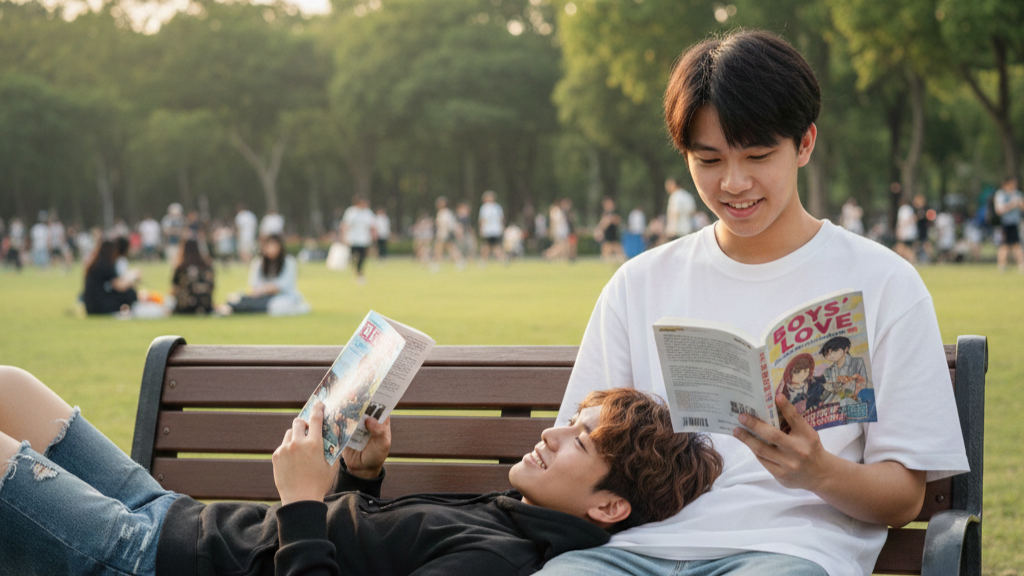
When fans of Taiwan’s Boys’ Love (BL) comics search for stories that feel like xiaoquexing (小確幸, “small yet definite happiness”), they’re no longer hunting for melodramatic conflict or cultural taboo—they’re turning the page for tender slices of everyday romance that reflect a society where love blossoms without apology. Taiwanese BL comic books have quietly become a cultural phenomenon, blending cosy storytelling with vibrant art and capturing hearts both at home and abroad in a way that’s distinct from their Japanese and Korean counterparts.
In Taiwan, BL comics aren’t just a genre—they’re a mirror of social progress and cultural nuance. After Taiwan became the first place in Asia to legalise same-sex marriage in 2019, creators found themselves free to depict male-male relationships that didn’t hinge on struggle against discrimination or painful self-discovery but instead celebrated intimacy, routine, and connection. This shift gives Taiwanese BL a unique flavour: protagonists don’t have to defend their identities to the world, they simply live, love, and grow together.
Take Day Off by Dailygreens, a BL comic that began on CCC Webcomics in 2020 and has since been translated into more than ten languages. On the surface, it’s the gentle story of a supervisor and their subordinate navigating office life and romance, but its appeal lies in its gentle rhythms, soft colours, and the way it captures inflection points in ordinary life—going beyond grand gestures to celebrate everyday moments of laughter, hunger over bubble tea, and shared glances.
This depiction of daily life is a hallmark of Taiwanese storytelling. As local artists note, scenes of street food, bubble milk tea in hand, or phone calls on scooter rides evoke a cultural authenticity that feels uniquely Taiwanese, grounding romantic fantasy in familiar settings. It’s this blend of the universal and the local that helps Taiwanese BL resonate across borders, finding fans in markets as diverse as Thailand, France, and beyond.
Even though BL comics originated in Japan—where the literary genre blossomed from yaoi and tanbi traditions and was primarily consumed by women eager to explore romantic narratives outside heteronormative constraints—Taiwan has indigenised the form in compelling ways. BL in Taiwan still draws on its manga heritage, but increasingly it reimagines love narratives through a lens that’s culturally specific and socially progressive, showing characters who are at ease with their identities and whose stories teem with warmth rather than conflict.
This localization is evident in the breadth of Taiwanese BL titles gaining traction today. Works like My Online-Celebrity Boyfriend and the Rainbow Splendour Land series weave relationships into narratives about life stages and careers, depicting couples who are YouTubers, theatre workers, mid-career professionals, or longtime partners navigating everyday challenges. These comics reflect not only the diversity of love but also the layers of modern Taiwanese identity—where romance coexists comfortably with career dreams, generational expectations, and social connectivity.
The creative ecosystem supporting these stories has matured alongside the genre itself. Taiwan’s Golden Comic Awards and platforms like WEBTOON, Mojoin, and CxC foster a vibrant community of creators and readers, and institutions such as the National Taiwan Museum of Comics and the Taiwan Comic Base exhibition spaces celebrate the art form’s cultural significance. BL comics, once niche and primarily fan-created, have now secured a place in Taiwan’s official comic landscape and pop culture calendar.
For international audiences, Taiwanese BL offers a refreshing contrast to traditional tropes: its characters fall in love, argue about trivial things, text, kiss, and eat together without the narrative weight of societal rejection. This isn’t to say conflict doesn’t exist—relationships, after all, are complex—but it is to say that in Taiwanese BL, love isn’t a battleground; it’s part of the tapestry of daily life. As readers turn page after page, what they encounter isn’t just romance, but a reflection of a progressive society where affection and acceptance walk hand in hand.
In the world of Taiwanese BL comics, love doesn’t have to be grand or tragic to be meaningful; it simply has to be true. And perhaps that’s why these stories have won hearts around the world—because in their simplicity and sweetness, they capture something universally human: that the ordinary moments we share with someone special are often the ones we remember the most.
Let me tell you something, darlings. When I read Taiwanese BL comics, my first reaction isn’t “oh, how daring” or “how subversive.” It’s much simpler: finally, love that’s allowed to breathe. No hysteria, no punishment, no endless suffering as proof of legitimacy. Just two men falling into routines, habits, petty arguments, shared meals, shared beds, shared lives. And honestly? That’s revolutionary.
For decades, queer love in Asian storytelling had to earn its existence through tragedy. Someone had to die, disappear, go mad, or marry a woman out of filial duty. You could have passion, sure, but only if it came with guilt. Taiwanese BL quietly flips the table. Here, being gay isn’t the plot twist. It’s the background. The real drama is who forgot to buy toilet paper or who’s sulking because the other worked late. That’s not boring. That’s zhen de ai (真的愛, real love).
What I adore about Taiwanese BL is its devotion to shenghuo gan (生活感, the feeling of everyday life). The bubble tea cups sweating on a desk. The scooter rides through humid evenings. The casual “chi fan le mei?” (吃飯了沒?, have you eaten?) that in Asia is basically foreplay and emotional care rolled into one. These stories understand that intimacy isn’t built in bedrooms alone. It’s built in kitchens, offices, convenience stores at midnight.
And yes, let’s say it clearly: this didn’t happen by magic. Legalising same-sex marriage didn’t just change laws; it changed imagination. When society stops treating queer love as a scandal, artists stop writing like they’re asking for permission. Taiwanese BL doesn’t scream. It doesn’t beg. It simply exists. That confidence is sexy.
I also want to whisper something to the international fandom: stop projecting trauma where there isn’t any. Not every queer story needs to be a battlefield. Sometimes the radical act is pingfan (平凡, ordinariness). Seeing two men argue over air-conditioning settings or silently make up over breakfast is political in a world that still denies queer people the right to be dull, domestic, and content.
So no, Taiwanese BL isn’t “soft” because it’s weak. It’s soft because it trusts love to survive without theatrics. It tells readers—queer and straight alike—that happiness doesn’t have to shout to be valid. And as a woman who has lived long enough to know that peace is rarer than passion, I’ll say this: these comics aren’t escapism. They’re a glimpse of what the future should look like.
Now pass the bubble tea. I’m rereading.