


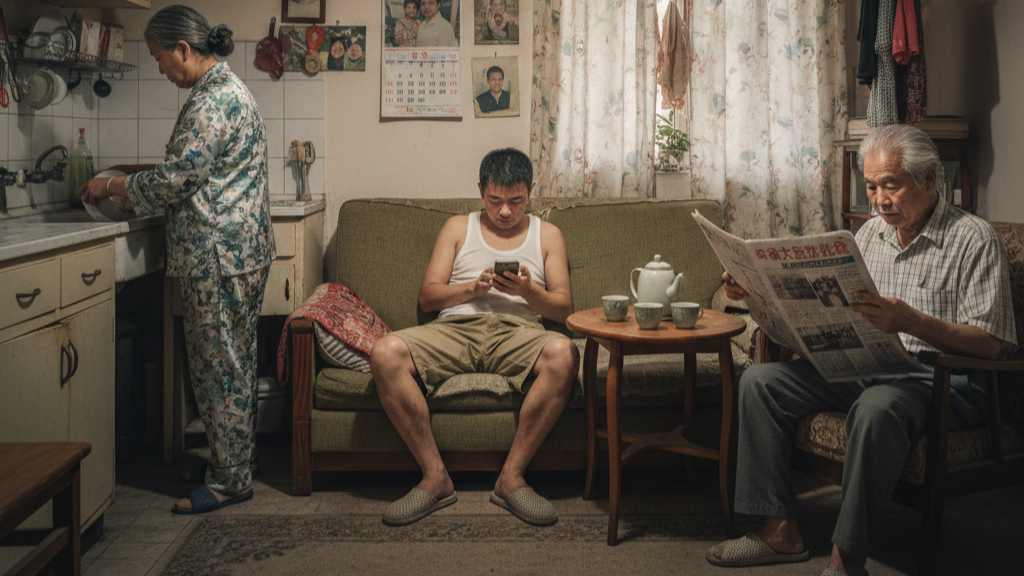
In China’s megacities, the figure of the adult child who never quite leaves home has become a symbol of a generation caught between expectation and exhaustion. Western media might call them “nesters,” but in China the debate comes wrapped in sharper language, heavier moral judgment, and a rapidly changing social reality. Over the past few years, adult children living with their parents have moved from being an unremarkable life stage to a national talking point that reveals deep fractures in China’s economy, family model, and promise of upward mobility.
The most striking new term is “全职儿女” (quánzhí érnǚ), or “full-time children.” First popularised on social media platforms such as Weibo and Xiaohongshu, it describes young adults—often university graduates—who move back into the parental home and contribute through domestic work, caregiving, errands, and emotional support, while relying on their parents for financial security. Supporters insist this is not idleness but unpaid labour within the family, a practical arrangement during a time of economic uncertainty. Critics see it as a euphemism for dependency. The speed with which the term spread reflects how many families quietly recognise themselves in it.
This debate sits uneasily alongside an older, far more judgmental label: “啃老族” (kěn lǎo zú), literally “those who gnaw on the elderly.” For years, it was used to shame adults who relied on their parents rather than achieving independence. What has changed is that younger Chinese increasingly reject the moral framing. They argue that the system has changed faster than expectations, and that independence is no longer a realistic benchmark for many.
Housing is the most obvious pressure point. In cities like Beijing, Shanghai, Shenzhen, and Guangzhou, property prices are among the highest in the world relative to income. Homeownership remains closely tied to adulthood and marriage, particularly for men, yet purchasing a flat without parental wealth is nearly impossible. Renting, once seen as a stepping stone, has become unstable and expensive, with short leases and frequent relocations. For many young adults, living independently offers little security and no clear future, while returning home at least provides stability.
Employment adds another layer. Since 2022, youth unemployment has remained stubbornly high, and graduate underemployment widespread. Many young people cycle through short-term contracts, gig work, or jobs far below their qualifications. Others retreat temporarily to prepare for state-sector exams, such as the fiercely competitive civil service route known as “考公” (kǎo gōng). Moving back home reduces costs and buys time, even as it fuels anxiety about falling behind.
Marriage, once the decisive moment for leaving home, is also being postponed or rejected. Marriage ages are rising, and a growing minority—especially women—are opting out entirely. For unmarried adults, staying with parents remains socially acceptable, even expected. This overlaps with broader youth attitudes captured in buzzwords like “躺平” (tǎng píng, lying flat) and “摆烂” (bǎi làn, giving up the grind), which reflect fatigue with relentless competition rather than a lack of ambition.
Gender shapes the experience in uneven ways. Daughters often face less public stigma for staying at home, but greater expectations of emotional labour and caregiving. At the same time, some young women describe returning home as a form of protection—from unsafe rentals, exploitative workplaces, or intense pressure to marry quickly. Feminist commentators note that nesting can function as a quiet refusal of an increasingly punitive marriage market.
Parents themselves are ambivalent. Many worry about social judgment and their children’s future independence. Yet China’s rapidly aging population and limited public care systems make intergenerational living practical, even necessary. Adult children help with care, technology, and companionship, while parents provide housing and financial cushioning. In this sense, the family has become China’s most reliable welfare institution.
Official responses remain conflicted. State media periodically criticise “full-time children” for lacking drive, while policy rhetoric continues to promote employment, marriage, and childbirth. Yet without meaningful reform on housing, labour insecurity, or care provision, families are left to absorb the strain alone.
In today’s China, the parental home is no longer simply a nest to escape. For many young adults, it is the last functioning safety net in a system where independence has become prohibitively expensive and adulthood increasingly deferred.
Spicy Auntie here, waving from the kitchen table where three generations are negotiating who used the last soy milk. Let’s talk about China’s “nesters,” or as the internet now politely calls them, full-time children, without clutching pearls or sharpening knives.
First, my position is boringly clear: young sisters and brothers should fly free. Independence matters. Privacy matters. Learning how to survive on instant noodles and bad landlords matters. Every woman and man deserves the chance to build a life that is not supervised by their parents’ rice cooker. Freedom is not a Western import; it is a human need.
But. And this is a big Auntie but.
If staying at home is the only realistic, temporary solution, then no stigma. None. Zero. Shame is cheap; housing in Shanghai is not. Jobs that pay dignity-level wages are not raining from the sky. Pretending that everyone can simply “try harder” is intellectual laziness disguised as morality.
What I do insist on is this: consent and boundaries. Living with your parents as an adult is not a right—it is a negotiated arrangement. Your parents are not a free hostel with emotional room service. They also deserve freedom, privacy, romance, boredom, silence, and lives that do not revolve entirely around your career anxiety or existential crisis.
If you are a “full-time child,” then be exactly that: full-time present. Contribute. Clean. Care. Pay what you can. Take responsibility for the emotional climate of the home. Do not turn your mother into your unpaid therapist or your father into your personal ATM. And for the love of everyone’s sanity, have an exit plan—even if it’s vague, even if it takes time.
To parents, Auntie has words too. Support does not mean control. Helping your adult children survive does not give you lifelong rights over their bodies, choices, or marital status. You cannot demand grandchildren as rent. You cannot monitor dating apps as a household chore. If you want your children to grow wings, stop clipping them with guilt.
What I see in this whole panic about nesters is not moral decay, but system failure pushed back onto families. When the state retreats, the family absorbs the shock. When jobs disappear, kitchens fill up again. That is not decadence; that is survival.
So yes—fly free, my young sisters and brothers. And if you can’t yet, rest without shame. Just remember: the nest is a shelter, not a cage. And the birds who built it are allowed to want their sky back too.