


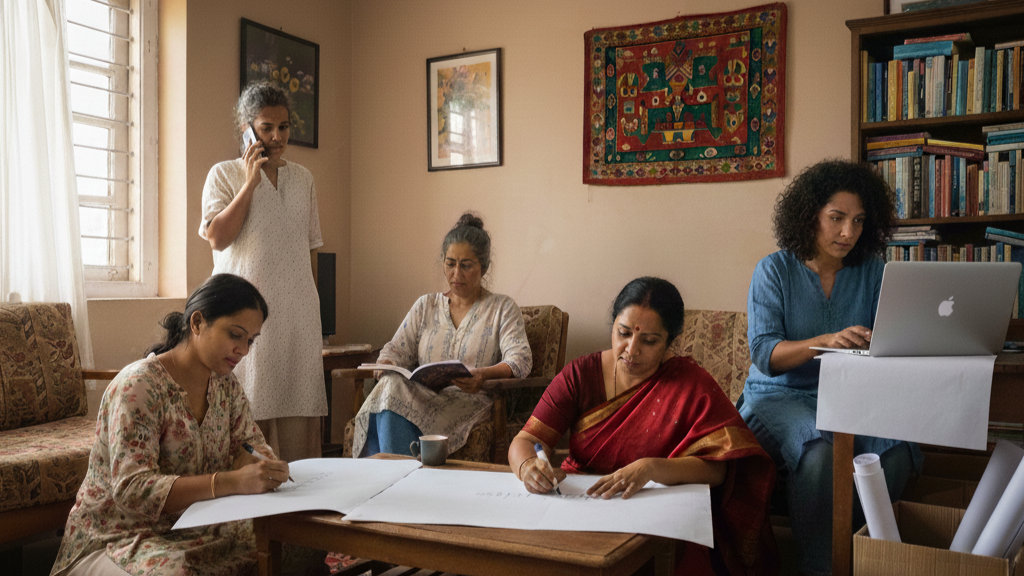
In a country where headlines about sexual violence, caste atrocities, and everyday misogyny appear with grim regularity, the latest WEAVE Report in India lands with both urgency and quiet defiance. Released in late 2025, the report offers a rare, ground-up portrait of how women’s movements across the country are confronting violence—not only as isolated acts, but as a deeply embedded system shaped by patriarchy, caste hierarchies, religion, and the shrinking space for dissent. Drawing on testimonies, movement histories, and feminist organising practices, the WEAVE India Report places women not as passive victims of violence, but as political actors reshaping resistance in extraordinarily hostile conditions.
WEAVE—short for Women’s Empowerment and Violence Elimination—focuses less on crime statistics and more on what Indian feminists have long argued: that violence is structural, normalized, and sustained by silence. The report documents how women’s collectives, especially at the grassroots level, understand hinsa (हिंसा, violence) not only as physical assault but also as economic deprivation, digital abuse, state repression, and social exclusion. From Dalit women resisting caste-based sexual violence in rural belts to Muslim women confronting surveillance and stigma under majoritarian politics, the report shows how violence is experienced intersectionally, or as Indian feminists often phrase it, through sangharsh (संघर्ष, struggle).
One of the report’s most striking insights is how feminist movements are adapting in an increasingly authoritarian environment. With laws restricting foreign funding, intensified scrutiny of NGOs, and the routine criminalisation of protest, many women’s groups are forced to operate under the radar. The WEAVE Report highlights how this pressure has shifted strategies—from mass street protests to community-based networks, legal literacy circles, survivor-led collectives, and digital mobilisation that avoids overt visibility. Resistance, the report suggests, has become quieter but no less radical.
Caste remains central to the analysis. The report is unflinching in describing how Dalit and Adivasi women face layered violence, where sexual assault is used as a tool of social control and punishment. For these communities, justice is often obstructed by police inaction, political interference, and social boycotts. Yet the report also documents how Dalit feminist groups have reframed nyay (न्याय, justice) beyond courts and convictions, emphasising collective dignity, economic autonomy, and community accountability. This broader understanding of justice challenges the narrow, carceral approach that dominates mainstream debates on gender-based violence in India.
The WEAVE Report also pays close attention to the emotional and bodily toll of activism. Burnout, fear, and grief are recurring themes, particularly among frontline defenders who work with survivors while facing threats themselves. In response, many movements are consciously building practices of care—what the report describes as a feminist politics of sahara (सहारा, support). Healing circles, peer counselling, and shared leadership models are not treated as “soft” interventions but as essential tools for sustaining resistance over the long term.
Digital spaces emerge as both battleground and refuge. While online harassment, doxxing, and threats have become routine for women activists, especially journalists and students, the report shows how digital platforms are also used to document violence, mobilise solidarity, and bypass hostile mainstream media. This duality reflects a broader tension in contemporary India, where technology amplifies both surveillance and subversion.
Placed against the backdrop of recent news—from protests against the release of convicted rapists to debates over marital rape, communal violence, and the policing of interfaith relationships—the WEAVE Report feels acutely timely. It reminds readers that women’s movements in India are not monolithic, urban, or elite, but deeply rooted in local realities and historical memory. Many draw inspiration from earlier feminist waves, invoking yaadein (यादें, memories) of resistance from the anti-dowry campaigns of the 1980s to the mass mobilisations after the 2012 Delhi gang rape, while also recognising the limits of symbolic outrage without structural change.
Ultimately, the WEAVE India Report does not offer easy solutions or celebratory narratives. Instead, it insists on complexity, patience, and political honesty. Violence against women, it argues, will not be ended by harsher laws alone, but by dismantling the social and economic systems that make such violence possible—and profitable. In doing so, the report stands as both documentation and declaration: a testament to the everyday courage of Indian women who continue to organise, resist, and imagine freedom in the face of relentless odds.
Full support, my Indian sisters. Full, loud, unapologetic support—from this Auntie who has seen enough cycles of outrage, denial, repression, and “reforms” that go nowhere to know exactly what you are up against.
I read the WEAVE India Report and nodded so hard my chili necklace nearly snapped. Not because it told me anything shocking—violence against women in India is not new, not hidden, not misunderstood—but because it finally tells the story from where it actually matters: from the ground, from the collectives, from the women who adapt because the system refuses to change. When the state shrinks your space, you shrink your footprint and sharpen your tools. That is not weakness. That is strategy.
Let’s be clear: Indian women are not failing to resist. They are resisting in conditions that would break many movements elsewhere. Surveillance, funding chokeholds, police hostility, courts that move slower than patriarchy itself, and social norms that still whisper “log kya kahenge?” (what will people say?) as if shame were a moral compass. And yet—and yet—the organising continues. Quieter, sometimes. Less photogenic. More dangerous. More effective.
What WEAVE captures beautifully is something the media almost never understands: survival is political. Care is political. Refusing burnout is political. When Dalit women redefine justice beyond conviction rates, when Muslim women organise knowing visibility can mean targeting, when rural collectives build solidarity instead of waiting for institutions that have never served them—that is not compromise. That is resistance evolved.
To the critics who say, “Why aren’t women protesting more?”—Auntie has a message: come back when protest doesn’t cost your freedom, your funding, or your life. Until then, sit down. Movements are not performance art. They are long games played with real bodies.
And to my sisters inside these movements: adapt, yes—but never internalise the lie that adaptation equals surrender. Patriarchy loves exhausted women. It thrives on fragmentation. It waits you out. Your job is not to be heroic every day. Your job is to last. To build sahara (support) when institutions collapse. To remember that sangharsh (struggle) is not linear, and neither is victory.
India’s feminist future will not come from one law, one verdict, or one viral moment. It will come from this stubborn, collective refusal to disappear. From women who refuse to be reduced to victims or symbols. From organisers who understand that dignity is as important as justice, and sometimes harder to secure.
So yes, WEAVE matters. Not because it tells a neat story, but because it tells the true one. You are not alone. You are not failing. You are not invisible—even when the system pretends you are.
Keep adapting. Keep resisting. And never, ever give up.
With love, rage, and absolute solidarity,
Spicy Auntie