


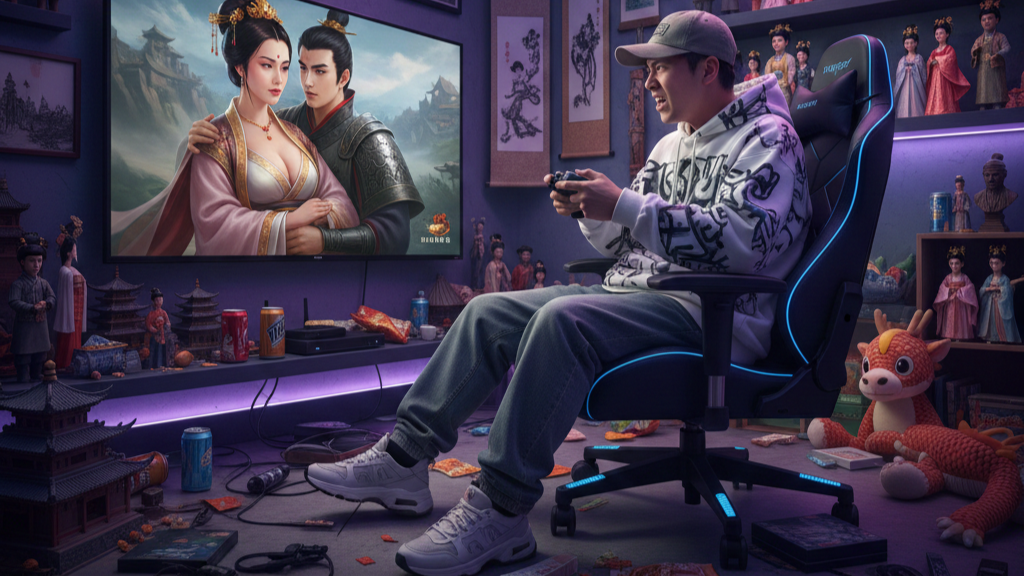
Sexism in gaming in China has become one of the industry’s most uncomfortable open secrets: hugely profitable, loudly denied, quietly defended, and increasingly difficult to hide as Chinese games conquer global markets. From mobile “harem-building” simulations to blockbuster console releases, gender politics sit just beneath the surface of gameplay, character design, studio culture and online fandom, shaping not only how games look but how power, desire and identity are imagined in one of the world’s largest gaming ecosystems.
For years, some of the most commercially successful Chinese mobile games have relied on mechanics that turn women into systems rather than characters. In imperial court and officialdom simulations, female figures appear as wives, concubines or lovers whose primary functions are fertility, loyalty and political leverage. These games draw on familiar tropes from historical dramas and web novels, but critics argue that they repackage patriarchy as entertainment, embedding sexism directly into reward loops. Progress is often tied to acquiring, managing and upgrading women, reinforcing a worldview where female agency is secondary to male ambition. The language used to describe such titles is revealing: women are “collected,” “raised,” or “unlocked,” echoing the logic of commodities rather than people.
Even outside these overt examples, sexism permeates character design across genres. Female characters are frequently hyper-sexualised or infantilised, presented as obedient, cute or visually exaggerated in ways male characters rarely are. This aesthetic is often defended as “market demand” or “style,” but it reflects deeper assumptions about who games are for. Despite the fact that women now make up nearly half of China’s gamers, many studios still design with an imagined male player at the centre, treating women as decorations, rewards or narrative support. The contradiction is stark in a country where female-targeted games, from romance narratives to fashion RPGs, generate massive revenues, yet remain segregated and dismissed as niche.
Behind the screen, the industry itself mirrors these imbalances. Chinese game studios remain overwhelmingly male, especially in leadership and technical roles. Women are more visible in art, community management and marketing, positions that are often undervalued and precarious. Accounts from former employees describe a workplace culture where casual misogyny is normalised, women’s ideas are sidelined, and hiring discrimination against women of childbearing age is quietly accepted. Speaking out is risky. Unlike in some other markets, there is no robust protection for whistleblowers, and accusations of sexism can quickly turn into defamation cases or coordinated online harassment.
Player culture amplifies the problem. On platforms like Bilibili and Weibo, anti-feminist rhetoric has become a form of performance, a way of signalling belonging within gamer communities. Feminism is frequently framed as foreign interference or Western “political correctness” imposed on Chinese creativity. Terms like 女权 (nüquan, women’s rights) are weaponised as insults, while critics are accused of wanting censorship or of being anti-Chinese. For women gamers, streamers and reviewers, harassment is routine. Many adopt gender-neutral usernames or avoid voice chat altogether to escape sexualised abuse and constant demands to prove their competence.
Recent controversies have pushed these dynamics into the international spotlight. The global success of major Chinese titles has drawn scrutiny to studio cultures that once operated largely out of view. Allegations of sexist internal environments and dismissive attitudes toward gender equality have begun to affect reviews, partnerships and public perception abroad. What was once tolerated or ignored domestically now risks becoming a reputational liability in global markets increasingly sensitive to inclusion and representation.
Regulation offers little help. Chinese authorities are strict when it comes to explicit sexual content, nudity and “vulgarity,” yet largely silent on misogyny or gender stereotyping. Cleavage may be censored, but power fantasies built on female submission remain untouched. This creates a paradox in which superficial desexualisation occurs without any challenge to deeper sexist structures. The result is an industry that polices bodies but not attitudes.
Sexism in Chinese gaming persists not because it is invisible, but because it has long been profitable, culturally normalised and politically inconvenient to address. As Chinese games continue to expand globally, that calculation is beginning to change. The question is no longer whether sexism exists in China’s gaming industry, but how long it can remain an open secret before it starts costing more than it earns.
Spicy Auntie here, adjusting her chili-pepper necklace and picking up the controller with one eyebrow already raised. Let’s talk about sexism in gaming in China, because apparently nobody else at the table wants to spill this particular tea.
China has the biggest gaming market on Earth. Bigger than Hollywood, bigger than K-pop fandoms, bigger than your nephew’s esports dreams. And yet, somehow, many Chinese games still behave as if women are a decorative side quest. Concubines to collect. Waifus to upgrade. Cute assistants who giggle, obey, and exist mainly to make the hero feel powerful. Auntie has seen this movie before. It was called feudal patriarchy, and trust me, it did not age well.
What really amuses me—darkly—is the constant excuse that “this is just history” or “this is just culture.” Oh please. History didn’t force anyone to code women as fertility stats or loyalty meters. That was a design choice. Culture didn’t demand that female characters speak like obedient toddlers while male characters deliver philosophical monologues. That was marketing. Let’s stop pretending sexism is a neutral tradition, like tea ceremonies or dumplings.
Then there’s the gamer backlash. The moment anyone whispers 女权 (nüquan, women’s rights), a thousand keyboards ignite. Feminism, we’re told, is Western poison, foreign propaganda, an attack on Chinese creativity. Funny how sexism never counts as foreign, even when it looks suspiciously like every other global boys’ club. Auntie has lived long enough to know that when men say “keep politics out of games,” what they really mean is “stop questioning our comfort.”
And regulators? Don’t get me started. China will pixelate a cleavage faster than you can say “moral hygiene,” but misogyny strolls right through customs, no passport required. Bodies are policed; power fantasies are not. You can’t show a nipple, but you can build entire game systems around female submission. Priorities, darling.
What’s especially ironic is that women now make up nearly half of China’s gamers. Half. That’s not a niche; that’s a revolution waiting for better writing. Women are playing, paying, streaming, reviewing—and still being told they’re not the “real” audience. Imagine ignoring half your market and still calling yourself a genius. Only tech bros and game studios get away with that level of confidence.
Here’s Auntie’s prediction: China’s gaming sexism problem won’t be solved by enlightenment or hashtags. It will be solved by embarrassment and money. As Chinese games go global, the old tricks start to smell. Reviews mention it. Streamers notice it. Players abroad ask uncomfortable questions. Suddenly, what was once “normal” becomes a liability.
And that, my friends, is when change usually begins—not when men grow consciences, but when sexism stops selling.