


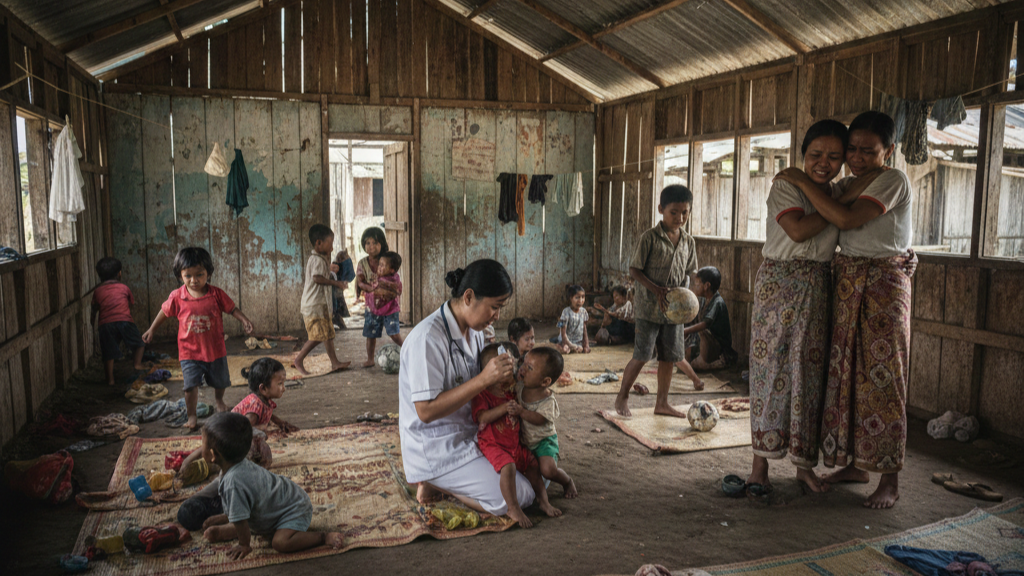
Growing up HIV-positive in Indonesia today is a daily journey through social stigma, medical uncertainty and, often, life on the margins of a health system that struggles to meet the basic needs of its most vulnerable citizens. For children living with HIV-AIDS in Indonesia, the reality is that survival isn’t just a matter of biology — it’s also about finding a place where they are not shunned, where they can get lifesaving treatment, and where someone, somewhere, cares enough to help them thrive. In converted school buildings in Solo, Central Java, dozens of these children — some born with HIV, others orphaned after losing parents to AIDS — live under the care of volunteers whose devotion fills the gap left by a fragmented state response.
Inside one shelter near the Bengawan Solo river, bunk beds now line former classrooms; blackboards have given way to shelves holding medicines and scattered toys. Here, 36 HIV-positive children share cramped space and uncertain futures, relying on the dedication of just a handful of volunteers. These caretakers, known affectionately to the kids as ayah (father) and ibu (mother), manage day-to-day life — feeding, comforting, and distributing antiretroviral (ARV) drugs that are essential to prolonging life. Yet this fragile ecosystem depends almost entirely on private donations, small businesses run by the volunteers, and occasional celebrity support — most notably from Indonesian badminton star Jonatan Christie — because government support is inconsistent and insufficient.
The numbers tell a broader story of struggle and possibility. Indonesia’s Ministry of Health estimates around 564,000 people in the country are living with HIV, and roughly 255,000 of them are receiving ARV treatment that, in theory, is provided free at public health centers. But fewer than half of Indonesia’s health facilities actually dispense these lifesaving drugs, leaving many children — particularly in remote or rural areas — without reliable access to treatment.
Even where treatment is available, maintaining strict adherence is a challenge, especially for young children. Side effects like nausea and fatigue can discourage consistent use, and the emotional burden of taking daily medication can be heavy for those who don’t understand why they must take it when they “feel fine.” One teen in the Solo shelter, Siti Safia (not her real name), tragically died after secretly hiding and discarding her medication, a stark reminder that medical availability is only part of the equation.
Cultural stigma deepens these struggles. In many Indonesian communities, misconceptions about HIV persist despite decades of awareness campaigns. Fear of discrimination leads families to hide diagnoses, children to be excluded from schools and social activities, and health facilities to turn away those they are meant to serve. In the Solo shelters, volunteers sometimes place children in schools without telling classmates or parents about their HIV status to protect them from rejection.
Non-governmental organizations like Lentera Anak Pelangi (Rainbow Children’s Lantern) step into this void, offering psychosocial support, nutritional guidance, and life skills education to HIV-positive children and their families so they can build resilience and reclaim hope. LAP’s programs aim to reduce mortality and improve quality of life, equipping young people not just to survive—but to pursue education, form friendships, and look forward to a future beyond their diagnosis.
Yet stigma isn’t confined to shelters or schools; it pervades healthcare and employment as well. Training and awareness initiatives targeting health workers have shown promise in dismantling harmful myths about HIV transmission and treatment, but such efforts must be scaled up to reach every province and village if the cycle of discrimination is to be broken.
Globally, children still bear a disproportionate burden of the HIV epidemic, with recent estimates indicating that hundreds of thousands of young lives are lost annually due to gaps in prevention, care and treatment access. In Indonesia, the journey toward ending new HIV infections among children will require not only stronger health systems, but also a cultural shift that embraces compassion over fear and inclusion over ignorance. Until then, the courage of children who wake up every day with HIV—and of the volunteers, caregivers, and advocates who stand beside them—continues to be a testament to human resilience in the face of adversity.
My heart is bleeding. My mind is raging. And honestly, I am tired of pretending this is complicated.
Children living with HIV in Indonesia are not statistics, not “cases,” not moral lessons. They are children. Full stop. They did not choose this virus, they did not “misbehave,” they did not sin, they did not fail at anything except being born into a society that still prefers fear over facts and silence over responsibility. And every time I read about them being hidden, excluded, whispered about, or quietly shuffled into shelters because schools and neighbors can’t cope, something in me snaps.
Let’s be very clear, darling: HIV does not spread through classrooms, shared toilets, hugs, laughter, or friendship. We have known this for decades. Decades. The science is boringly settled. What hasn’t moved fast enough is the mindset — the mental malas (lazy thinking) that lets adults dump their fear onto the smallest shoulders imaginable.
And where is the state in all this? Too often, absent. Or worse: technically present, but emotionally missing. Yes, ARVs exist. Yes, they are “free” on paper. But what good is a pill if a child is too scared, too ashamed, or too unsupported to take it every day? What good is a policy if the burden of care is pushed onto volunteers, exhausted caregivers, and underfunded NGOs who are basically holding the system together with duct tape and love?
I admire these volunteers fiercely. They are doing what governments should be doing: showing up, staying, caring, explaining, comforting, fighting stigma one conversation at a time. But let’s not romanticize this as “community resilience.” That’s a polite way of saying abandonment. Children should not have to rely on charity to access dignity.
And don’t even get me started on the moral panic. The way HIV still gets wrapped in shame, sexuality, and punishment in a country that prides itself on gotong royong (mutual care). Funny how that solidarity evaporates when the child is labeled “different.” Funny how quickly compassion turns conditional.
Here’s my rage, loud and clear: if you exclude an HIV-positive child from school, you are the problem. If you refuse care, you are the risk. If you whisper instead of educating, you are spreading harm faster than any virus ever could.
My heart bleeds for these kids. My mind rages at the adults who should know better. And my message is simple: stop failing them. Give them medicine, yes — but also safety, honesty, education, and a future that doesn’t come with an asterisk.
Children deserve childhood. Even with HIV. Especially with HIV.