


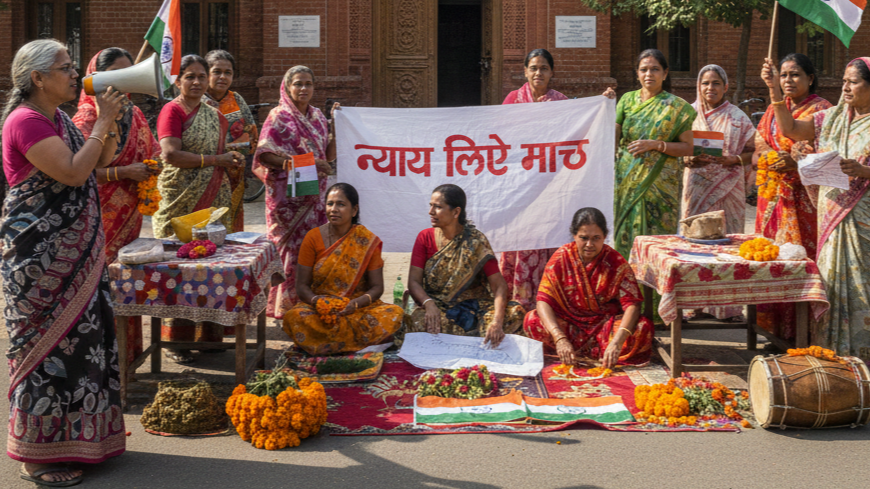
For more than four decades, the women of Bhopal have stood at the very frontlines of the fight for justice for the Bhopal gas tragedy, refusing to let the world forget one of the worst industrial disasters in history and demanding accountability, rehabilitation, and rights for survivors. What happened on the night of December 2–3, 1984, when a leak of toxic methyl isocyanate (MIC) gas from a Union Carbide pesticide plant exposed more than half a million people, killing thousands outright and leaving countless others with lifelong injuries, is not just a grim chapter in history — it is a living wound that continues to shape lives, livelihoods, and movements.
At the heart of this relentless struggle – the feminist Indian website BehanBox reports – are the women of Bhopal — Rasheeda Bee, Nasreen, Leela Bai, Savitri Devi, Reena Devi, and many others — whose voices have turned grief into unyielding political action. “Hum Bhopal ki naari hain, phool nahin chingari hain (we, Bhopal’s women, are not flowers but sparks of fire),” has become a rallying cry for survivors demanding insaaf (justice), not merely commemorations or broken promises.
These women were everyday homemakers and workers before the disaster — their lives defined by families, kitchens, and local communities. But the sudden rupture of that night thrust them into the public sphere as advocates, organizers, caregivers, and tactical strategists. From grassroots unions like the Bhopal Gas Peedit Mahila Udyog Sangathan to collective actions crossing borders, women have spearheaded an often under-recognized movement that balances labour rights, environmental justice, and corporate accountability.
Among the most luminous figures in this struggle are Champa Devi Shukla and Rashida Bee, both survivors whose lives — marked by personal loss and ongoing health struggles — became symbols of an international movement for justice. Through class action suits, hunger strikes, global demonstrations, and legal battles, they brought the Bhopal cause onto the global stage. In 2004, they were awarded the prestigious Goldman Environmental Prize, not as a consolation, but as recognition that survivors’ voices could cut through layers of governmental indifference and corporate protectionism.
But the fight has been anything but linear. More than four decades later, survivors and advocacy groups continue to allege systemic resistance from political powers, including accusations that successive governments have diluted criminal charges, weakened rehabilitation measures, and protected corporate interests — claims highlighted in recently released survivor “chargesheets” targeting political leadership. The tragedy’s legacy of polluted soil and contaminated water has ensured that the disaster never truly ended, with toxic exposure affecting generations of children born long after the gas first spread.
This ongoing crisis has shaped the activism of newer generations too. Rachna Dhingra, who swapped a career in business consulting for full-time social advocacy, represents how the struggle for justice has evolved — from local protests to transnational pressure campaigns and legal advocacy in Indian courts. Her work exemplifies how Bhopal’s women have continued to adapt their strategies in the face of changing political and corporate landscapes.
Even as interfaith prayer meetings and official tributes mark the anniversary each year, the women activists insist that remembrance is not enough without tangible change — clean water, comprehensive healthcare, fair compensation, and environmental remediation. They press not just for recognition of past harms but for structural transformation that prevents future industrial tragedies and honours the rights of those whose lives were forever altered by corporate negligence.
In the alleys and bastis of Bhopal today, the movement is sustained through shared histories, collective care, and unwavering determination. Women meticulously gather data on contamination, march with chants of insaaf, sit-ins and hunger strikes, and bring their demands to legislative corridors and international forums. Their resistance is not only about recompense for the past but a demand for dignity in the present — a testament to how women, often the most marginalized in society, have become the most resolute custodians of justice in Bhopal’s long, unfinished story.
Forty-one years on, as the world reflects on this industrial calamity, it is the women of Bhopal who insist the story continues — not as tragedy alone, but as an enduring struggle for recognition, reparations, and rights that defies silence and insists on accountability.
Bhopal sisters, this Auntie has your back. Always has. Always will. And not just yours, but the backs of every woman who wakes up one day as a worker, a mother, a caregiver — and is forced by injustice to become a fighter.
Forty-one years after the gas crept into your homes, lungs, wombs, and bloodlines, the world still treats Bhopal emphasised like a closed case, a tragic footnote, an old disaster wrapped up with a cheap settlement and polite condolences. But you never accepted that lie. You understood something powerful and dangerous: survival is not justice.
You buried your dead, nursed the sick, raised children with damaged bodies and poisoned water, and then — when the men in suits told you to move on — you refused. You learned new words: insaaf (justice), zimmedari (responsibility), hisab (accountability). You learned how courts work, how ministries dodge, how corporations vanish behind mergers and rebranding. You learned how power hides. And then you chased it.
Let’s be very clear: what you did was not “activism” as a hobby. It was frontline human rights defense. It was labour rights — because your bodies were treated as expendable inputs. It was environmental justice — because your land and water were sacrificed for profit. It was women’s rights — because caregiving, illness, and long-term survival fell overwhelmingly on women’s shoulders. And it was global justice — because Bhopal was never just about India; it was about how multinational capital behaves when it thinks brown lives are cheap.
This Auntie sees the pattern because she has seen it everywhere. In garment factories after fires. In mining towns after spills. In export zones after “accidents.” The faces change. The language changes. The playbook does not. Delay. Deny. Dilute. Distract. Let women do the unpaid work of survival, then call them emotional when they demand accountability.
But you didn’t stay quiet. You organised. You marched. You crossed borders. You embarrassed governments. You taught the world that justice does not expire and trauma does not have a statute of limitations. You showed younger defenders — climate activists, union women, land rights organisers — what stamina looks like.
So to the Bhopal sisters: you are not alone, even when power pretends you are. Your fight belongs to every woman standing between a community and a bulldozer, between a worker and a toxic workplace, between a river and corporate waste. You are part of a global sisterhood of women who refuse to trade silence for survival.
This Auntie salutes you. Stands with you. Learns from you. And says this loudly, for the record: there will be no more Bhopals only if women like you keep fighting — and if the rest of us keep backing you, without conditions, without fatigue, without forgetting.