


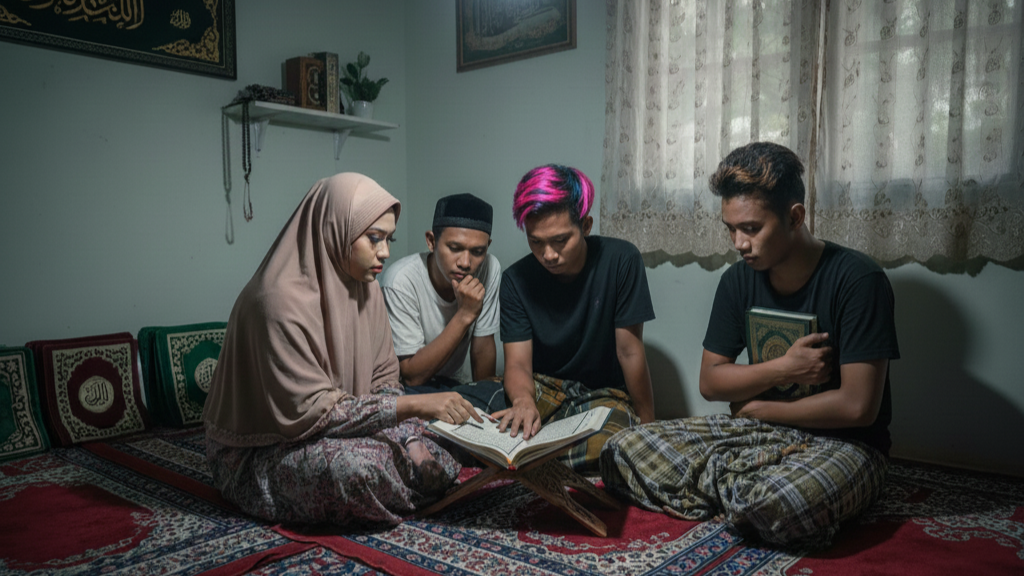
In Indonesia, the world’s largest Muslim-majority country, questions of sexuality and faith are often framed as irreconcilable. Yet for many queer Indonesians who identify as Muslim, daily life is not lived in slogans or absolutes but in quiet negotiations—between prayer and privacy, family expectations and personal truth, fear and devotion. Their stories rarely fit the dramatic binaries of media debate. Instead, they unfold in small rooms, WhatsApp groups, modest mosques, and rented houses where faith is practiced without spectacle.
For these individuals, being Muslim is not a costume that can be taken off when sexual or gender identity comes into focus. Islam is woven into childhood memories, family rituals, and ethical vocabularies. Many continue to pray (shalat), fast during Ramadan (puasa), and speak of God as Allah with intimacy rather than distance. What changes is not belief itself but the way belief is inhabited. One gay Muslim in Yogyakarta describes his faith as something he “carries inside,” even when public expressions feel unsafe. Another speaks of iman (faith) as elastic—strained, yes, but not broken.
Language matters here. Rather than global labels, some Indonesians prefer local terms like waria, a long-standing word for transfeminine people that blends wanita (woman) and pria (man). The term carries cultural histories that predate today’s polarized debates. In some contexts it is embraced; in others, rejected. What remains consistent is the desire for dignity. For waria who are Muslim, religious exclusion can cut deeply, not because doctrine is debated at length, but because access to communal worship is denied through mockery or quiet refusal.
One of the most cited examples of queer Muslim religiosity in Java emerged in Yogyakarta, where a small Islamic boarding space for waria once operated under the name Pondok Pesantren Waria Al-Fatah. It was never large or flashy—just a place to study basic religious texts, pray together, and talk openly about how to live ethically. Its founders spoke not of theological rupture but of rahmatan lil’alamin (“mercy to all creation”), a phrase often used to emphasize Islam’s compassionate core. Over time, pressure from conservative groups forced the community to disperse, but its symbolic impact endures.
Beyond such visible examples, much of the work happens quietly through civil-society networks, especially on the island of Java. Organisations like GAYa NUSANTARA, based in Surabaya, have for decades provided health information, community support, and documentation of queer lives, including those of queer Muslims. In Jakarta, groups such as Arus Pelangi focus on advocacy, legal awareness, and emergency support, while also serving as informal reference points for people navigating family rejection or police scrutiny. Smaller collectives, often informal and rotating, operate in cities like Yogyakarta and Bandung, where queer Muslims may encounter discussion circles or counseling framed around personal wellbeing rather than identity politics.
Dialogue-oriented initiatives also play a role. The Youth Interfaith Forum on Sexuality (YIFoS), which has roots in Java’s academic and NGO circles, has organised closed camps and workshops bringing together young people from different religious backgrounds, including Muslims, to talk about sexuality, belief, and ethics. Participants often describe these spaces as rare moments where they can speak without being corrected. The emphasis is not on winning theological arguments but on acknowledging lived experience and moral complexity.
These careful spaces exist against a harsher backdrop. In Aceh, where regional regulations enforce a version of Islamic law, same-sex acts can be punished by public caning, an image that circulates widely in national media and fuels fear far beyond the province. Elsewhere in Java, police raids framed as morality enforcement and statements by religious authorities contribute to a climate in which discretion becomes a survival skill. Many queer Muslims learn to separate worlds: family, mosque, work, friends. Disclosure is selective, calculated.
What is striking in conversations with queer Indonesian Muslims is how rarely they speak in the language of rebellion. Instead, they talk about balance (keseimbangan), patience (sabar), and intention (niat). Some reinterpret Qur’anic stories privately; others accept unresolved tension as part of their spiritual journey. A lesbian Muslim in Jakarta puts it simply: “I don’t ask to be celebrated. I ask not to be erased.”
In a country where both Islam and queerness are often discussed in abstract terms, these lived experiences tell a quieter story. Reconciliation, here, is not a declaration. It is a practice—fragile, adaptive, and deeply human.
I want to speak quietly for once. Not because I am afraid, but because some stories deserve a softer voice.
To those trying to reconcile faith and queerness in Indonesia—and elsewhere—I see you. Not as a headline, not as a controversy, not as a “problem to be solved,” but as people doing one of the hardest kinds of work there is: holding together parts of yourselves that others insist must tear apart.
There is a particular cruelty in being told that the God who watched you grow up, who heard your childhood prayers, who shaped your moral compass, suddenly has no room for you. That your love disqualifies your devotion. That your body cancels your soul. Many of you were never trying to provoke anyone. You were just trying to pray without flinching.
What strikes me, again and again, is how little drama there is in your actual lives compared to the noise around you. No grand declarations. No burning bridges. Just careful choices: which mosque feels safest, which words to use with family, which truths to carry alone. You learn restraint not as submission, but as survival. You learn patience (sabar) because impatience can cost you everything.
Some of you keep your faith private, like a photograph folded into a wallet. Others reshape it, question it, wrestle with it at night. Some step back from ritual but not from ethics. Some cling to prayer precisely because the world has grown harsh. None of this is hypocrisy. It is humanity.
I am especially moved by those who refuse the false choice they are offered. You are told: leave Islam or erase yourself. But many of you answer, calmly, “No.” You stay. You reinterpret. You endure the discomfort of unresolved tension. You accept that iman—faith—is not always certainty, sometimes it is persistence.
To the waria praying together despite mockery. To the gay son fasting quietly so his mother won’t worry. To the lesbian woman who still whispers “Bismillah” before difficult conversations. To the trans believer who knows the verses by heart even when others say they are not meant for you. You are not naïve. You know the risks. And yet you choose meaning over bitterness.
This Auntie does not ask you to be louder. I do not ask you to be symbols. I simply want you to know that your way of believing—careful, bruised, stubborn, sincere—is not a failure of faith. It is faith under pressure.
And that, my dears, is something sacred.