


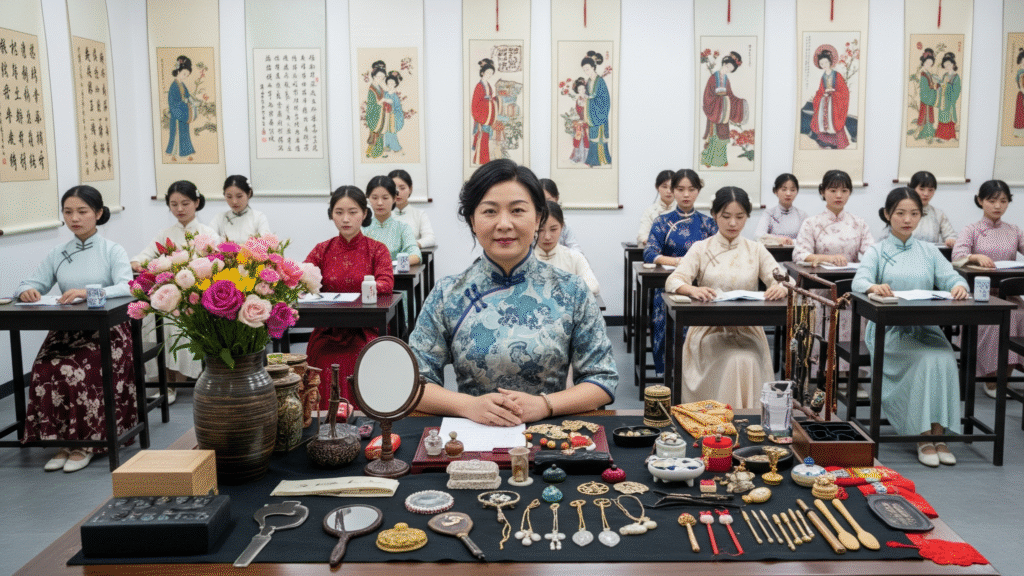
Female students scrubbing floors at dawn, wives told not to fight back if their husbands beat them, teenage girls warned that short skirts invite rape: images and slogans from China’s so-called “female virtue classes” (女德班 nǚ débān) have circulated online for years, sparking outrage at home and abroad. Behind the soft language of “traditional culture” (传统文化 chuántǒng wénhuà) is a hard politics of gender: a push to remake women as obedient daughters, wives and mothers at a time when many of them are better educated, more urban and more independent than ever before.
The most notorious example was a “morality school” in Fushun, Liaoning, exposed in 2017 for forcing women to wake at 4:30 a.m., scrub floors and listen to lectures telling them to “shut up and do more housework” and never resist domestic violence. After furious debate on Chinese social media, local authorities shut it down for violating “socialist core values.” Similar “feminine virtues” camps in other provinces were later ordered to close after teaching that disobedient children would get cancer and that “revealing” clothes would cause rape.
On paper, the state’s stance seems clear. The Ministry of Education has since banned teaching explicitly drawn from the old Confucian code of “Three Obediences and Four Virtues” (三从四德 sāncóng sìdé), and state media have criticised extreme women’s morality classes as harmful “feudal dregs” (封建糟粕 fēngjiàn zāopò) that endanger children. Yet feminist scholars point to the deeper tension: the same government also urges women to shoulder a “unique role” in reviving the nation’s family virtues (家风 jiāfēng) and boosting births in the face of demographic crisis. In a 2023 speech to the All-China Women’s Federation, Xi Jinping called on women to promote “traditional virtues” and support “a new culture of marriage and childbearing,” language echoed in crackdowns on what officials see as “deviant” gender and sexual expression, from effeminate male idols to danmei homoerotic fiction written by young women.
That contradiction is at the heart of Chinese feminist critiques. On one level, they argue, 女德班 are a backlash business. Private “traditional culture” associations and training outfits sell short courses promising to turn women into the perfect “good wife and wise mother” (贤妻良母 xiánqī liángmǔ), monetising parental panic about daughters not marrying, not having children or getting divorced. Research on the contemporary “Women’s Virtue Movement” shows that these courses attract not only conservative grassroots families but also some local officials and entrepreneurs who see them as tools for “family harmony” (家庭和谐 jiātíng héxié) and corporate discipline.
On another level, feminists see 女德班 as part of a broader ideological project. Under Xi, gender debates are increasingly framed as a front in the struggle for cultural security: anti-feminist campaigns online often blend misogyny with hyper-patriotism, denouncing feminist voices as “Western puppets” and insisting that “real Chinese women” should sacrifice for the family and the nation. In this climate, lecturers like Ding Xuan—who has toured campuses and training centres telling women that obedience is their core value and that victims of sexual assault are to blame for dressing “improperly”—can present themselves as defenders of national tradition rather than promoters of gender inequality.
Chinese feminists push back on several fronts. They call out 女德班 as a form of “moral blackmail” (道德绑架 dàodé bǎngjià) that dumps responsibility for social problems—divorce, low fertility, workplace stress—onto women’s individual behaviour instead of housing prices, lack of childcare or weak protections against domestic violence. They also challenge the narrative that patriarchy is inevitable, pointing out that Confucian classics have always been selectively interpreted, and that modern appeals to “tradition” often erase the radical promise of earlier socialist slogans like “women hold up half the sky.” Recent scholarship on gender and education in Xi’s China shows how state campaigns to standardise “proper masculinity” and “femininity” in schools, and to police online culture, narrow the space for young people to imagine alternative roles.
At the same time, the story is not only one of repression. Feminist lawyers, journalists and ordinary netizens have helped expose and shut down some of the worst virtue schools, and they continue to test the limits of censorship with essays, podcasts and social-media posts that re-read Confucianism, insist on consent and condemn domestic violence. The fact that authorities feel compelled to publicly distance themselves from the ugliest 女德班, even as they promote motherhood and family values, suggests that outright endorsement of submissive womanhood is still politically risky.
In that sense, female virtue classes are less an exotic throwback than a mirror of contemporary China’s gender contradictions. They sit at the intersection of commercialised anxiety, conservative nationalism and unfinished feminist struggles. Whether the future belongs to the obedient “virtuous wife” of the classroom slogans or to the many women who denounce those slogans online remains an open question—but for China’s feminists, the stakes are nothing less than who gets to define virtue in the first place.
Let me tell you, darlings: every time I read about another 女德班 popping up somewhere in China, promising to turn women into obedient angels of the household, my inner chili pepper bursts into flames. These classes wrap themselves in “traditional culture” (传统文化), but what they actually teach is the oldest scam in the patriarchal handbook: control the woman, and you control the family; control the family, and you control the society. And of course, all this “virtue” conveniently applies only to women. The men? Free-range roosters doing whatever they please.
What fascinates me is how these schools operate like wellness retreats from hell. Wake up at 4:30 a.m., scrub floors, practice silence, apologise for simply existing. I swear, if they could, they’d make women sign a pledge never to have an opinion again. Meanwhile, the so-called “lecturers”—often women themselves—deliver sermons about obedience with the zeal of someone who has never met a happy, autonomous adult woman in her life. Some tell girls that short skirts cause rape. Others preach that wives should “never resist” domestic violence. My sisters, this isn’t education. This is psychological domestication.
And here’s the twist: the state swoops in to shut these schools down when public outrage gets too loud, all in the name of “socialist core values.” Cute. Because at the same time, those same authorities promote “family virtues,” “good wife and wise mother” ideals, and birth-boosting campaigns that quietly nudge women back into the kitchen. It’s like banning cigarettes while handing out free lighters.
Chinese feminists, bless their fierce hearts, see straight through this. They’ve been calling out 女德班 for years as 道德绑架—moral blackmail disguised as national pride. They know perfectly well that these courses flourish because anxiety sells. Worried your daughter might not marry? Send her to virtue boot camp. Scared your wife might want independence? Enrol her in obedience training. It’s patriarchy with a price tag, marketed with soft lighting and Confucian quotes.
But here’s the thing the patriarchs always underestimate: women talk. Women organise. Women expose nonsense faster than a Beijing influencer posting her breakfast. Every shutdown, every online backlash, every leaked video is a reminder that women are not quietly slipping back into submissive roles. They are watching, laughing, resisting—and rewriting the script.
So let the virtue peddlers keep chanting about the glory of obedience. Meanwhile, Spicy Auntie will be over here raising a toast to the unruly, loud, unrepentantly modern women of China. May your virtue be whatever you decide it is—and may your chili always burn hot.