


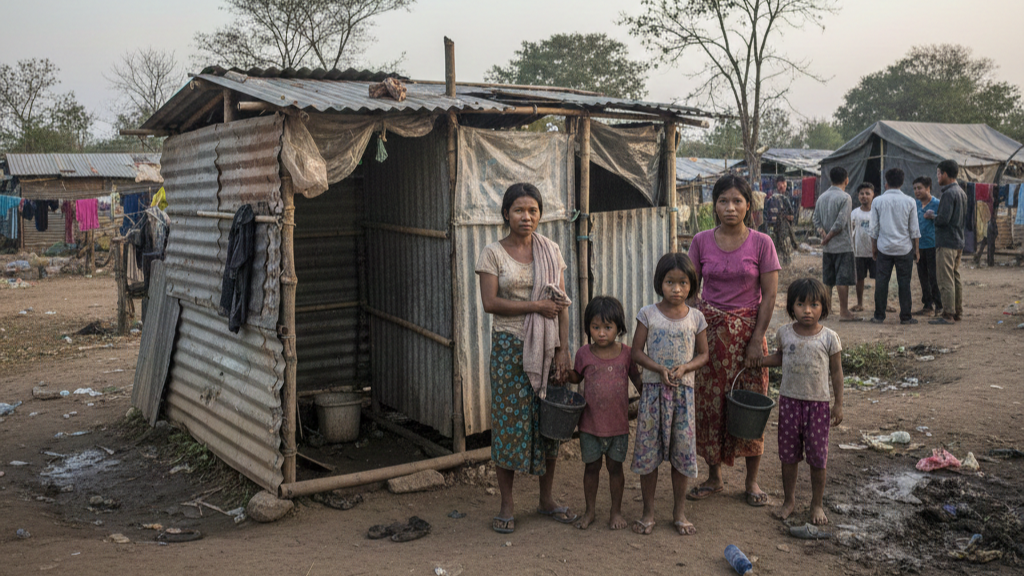
When guns thunder near the frontier and villages empty overnight, the danger for women and girls doesn’t end at the last sound of shelling — it shifts, often invisibly, into the crowded shelters where displaced families seek refuge. Over the past months, with conflict flaring again along the Cambodia–Thailand border, more than a hundred thousand Cambodians have been uprooted from their homes — and many of them women and girls now face new, chilling threats in displacement camps.
Since May 2025, recurrent clashes — including artillery fire and airstrikes — have forced tens of thousands to flee their homes, leading to a large-scale humanitarian crisis. Among the hardest-hit regions is Preah Vihear province, where the war displaced entire villages, and survivors were hastily relocated to pagodas, makeshift shelters and camp sites.
But for many women and young girls, safety remains elusive even behind tent walls. In one of the largest shelters — the 5,000 Bodhi Trees Pagoda displacement camp in Kulen district — mothers began to notice their daughters trembling at bath time. A woman named “Sophy” (name changed) described how, soon after arriving in the camp, her daughters and niece refused to bathe: they would sit and cry instead. When she secretly followed them, she saw men spying on the girls bathing, stripping down to underpants, and rinsing off perilously close to their tents.
Interviews conducted in early September 2025 with four girls and young women aged between 14 and 21 revealed repeated incidents of sexual harassment — and a terrifying normalization of abuse. The families explained that the camp’s wash-rooms offered no privacy: the “toilets” consisted of unisex blocks with 10 cubicles, all sharing a single water pipe; doors had gaps at the top and bottom, and there were no bamboo fences screening off the baths. One 15-year-old, “Pisey,” said she dreaded using the toilet or bathing because men would stare at her, sometimes even bathe next to her while she washed.
This kind of gender-based violence isn’t a side-effect — it’s a structural hazard. That hazard is compounded by the lack of “WASH” (water, sanitation, hygiene) infrastructure, cramped living conditions and deeply inadequate privacy. According to a recent assessment, one in four displaced people still lack access to safe drinking water or private spaces for hygiene — a situation that disproportionately endangers women and girls.
Beyond the immediate trauma and humiliation, these conditions carry deeper cultural weight. In Khmer society, notions of “sampheak” (honour, dignity) and “chivery” (shame) are deeply intertwined with a woman’s — and especially a young girl’s — reputation. When personal dignity is so easily violated, many families fear more than just physical harm: there is the dread of long-term social stigma, or worse, forced silence.
Meanwhile, humanitarian agencies such as UNICEF and Plan International Cambodia have sounded the alarm. UNICEF has confirmed that displaced children — many of them girls — now live in makeshift shelters and face elevated risks of abuse, exploitation, and gender-based violence. As a response, “dignity kits”, sanitary pads, and gender-sensitive privacy tents have been distributed to help women and girls manage menstrual hygiene with some privacy and dignity — but aid is still far from adequate.
The risks do not end with shelter conditions. The broader backdrop of displacement — broken schools, empty clinics, failed livelihoods, and acute psychological stress — leaves families desperately vulnerable, ready prey for exploitation, trafficking, or other forms of violence. Reports that young Cambodian migrant workers in Thailand have been subjected to rape and forced labour make the danger more visceral.
In a region scarred by decades of old border disputes — including the legacy of past tragedies like the Dangrek genocide — this new crisis should serve as a wake-up call. Those who fled war to find refuge now face terror of another kind. In Khmer homes, mothers gently remind daughters to cover their bodies, to guard their modesty — but in crowded camps with broken doors and unisex latrines, such modesty becomes dangerously exposed.
Until shelters are redesigned with gender-sensitive infrastructure, until WASH facilities offer dignity and safety, until the displaced are seen not just as “refugees” but as human beings with rights to private, safe spaces — the youngest, the most vulnerable will continue living in fear. And as long as that fear festers, peace will be more than just the absence of bullets. It will be the presence of dignity, agency, and protection — for every woman and girl forced to flee.
Let me say this slowly, loudly, and without apology: when the generals are men, and the camp planners are men, girls and women become collateral damage. Not accidentally. Structurally.
I’ve been to too many conflict zones, refugee camps, evacuation sites — call them whatever euphemism you like — to pretend this is surprising. Men plan war. Men plan camps. Men design “security”. And somehow, every single time, women are told to be patient, to adapt, to cover up, to endure. As if sexual harassment were a natural disaster instead of a predictable outcome of male-only decision-making.
Look at the Cambodian border shelters and tell me this wasn’t inevitable. Unisex toilets. Bathing areas without walls or fencing. No lighting. No female guards. No consultation with women before thousands of people were herded into pagodas and makeshift camps. And then — shock, horror — young girls are stared at, followed, harassed while bathing. Mothers watch their daughters cry and refuse to wash. And the response? Silence, shame, shrugging shoulders.
This is not “chaos of war”. This is negligence layered on patriarchy.
Khmer society talks endlessly about sampheak (honour) and chivery (shame). Funny how shame always lands on girls’ shoulders, never on the men who leer, follow, expose themselves, or abuse. Funny how honour is invoked to keep girls quiet, not to hold perpetrators accountable. In war, modesty becomes another weapon used against women: stay invisible, don’t complain, don’t provoke. As if simply existing in a female body were provocation.
And let’s be honest about power. These camps are not neutral spaces. They are militarised environments, overseen by male officials, male monks, male security, male local authorities. Even aid logistics are often run by men who have never had to think about bathing at night, menstruating without privacy, or escorting a terrified teenage girl to a latrine.
Women are not asking for luxury. They are asking not to be watched while naked. They are asking not to feel hunted. They are asking for doors that close, light that works, spaces that separate safety from threat. This is not radical feminism. This is basic human design.
Every war produces refugees. But only patriarchal systems consistently produce camps that retraumatise women. If planners included women from day one — mothers, adolescent girls, widows — these failures wouldn’t happen. The fact that they do tells you everything.
So yes, Auntie will say it plainly: when men monopolise power, women pay the price with their bodies, their fear, and their silence. And until women are at the planning table — not as tokens but as decision-makers — these camps will remain what they really are: unsafe zones disguised as protection.
Peace without dignity is not peace. And protection that ignores women is not protection at all.