


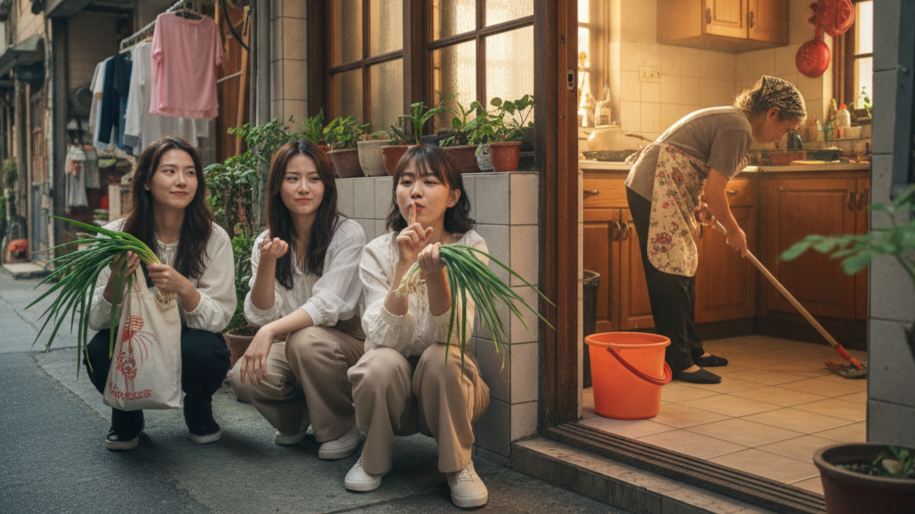
Under the full autumn moon of Taiwan’s Mid-Autumn Festival, while urban families barbecue on balconies and children clutch mooncakes, an older, earthier ritual once unfolded quietly in the countryside: women slipping into neighbours’ vegetable patches to “steal” spring onions. The practice sounds mischievous, even illicit, and that is precisely why it has fascinated folklorists, journalists, and cultural historians. Rooted in ancient ideas about fertility, marriage, and lunar power, this curious custom reveals a forgotten side of Zhongqiu Jie (中秋節, Mid-Autumn Festival) that goes far beyond lanterns and moon-gazing.
In traditional rural Taiwan, especially in Hoklo- and Hakka-speaking areas of central and southern parts of the island, Mid-Autumn Festival marked more than a harvest milestone. It was a liminal moment, when the full moon was believed to amplify luck,生命力 (shēngmìng lì, life force), and reproductive power. Women—particularly newly married ones, childless wives, or unmarried women of marriageable age—would venture out at night to take spring onions, cōng (蔥), from neighbouring fields. The act was often playful and collective, accompanied by laughter, teasing, and mock secrecy.
Spring onions were chosen for their symbolic potency. In Chinese folk belief, cōng (蔥) is closely associated through sound and symbolism with 聰 (cōng, cleverness or vitality). Their long white stalks and fast growth linked them to masculine energy and fecundity, making them a vegetal stand-in for reproductive strength. Cooking or eating “borrowed” onions after the theft was believed to help a woman conceive quickly, ensure an easy pregnancy, or secure harmony between husband and wife.
Despite appearances, this was not theft in the moral sense. The fields were often left deliberately accessible, and the “victims” were typically households known for prosperity, many sons, or good fortune—好命 (hǎo mìng). Having one’s onions taken was less a loss than a compliment, a public acknowledgment that the household possessed enviable fertility and luck. During festivals like Mid-Autumn, customary law temporarily suspended normal rules of property, allowing symbolic acts that transferred fortune rather than wealth.
Anthropologists have long noted how such practices offered women a rare outlet in otherwise patriarchal agrarian societies. The nighttime excursions allowed female mobility, collective action, and open engagement with sexuality and reproduction—topics usually constrained by propriety. For one evening, women could laugh loudly, trespass playfully, and express desires linked to their own bodies and futures, all under the protective glow of the moon and the sanction of tradition.
Taiwan’s custom did not exist in isolation. Similar practices were recorded in parts of Fujian, Guangdong, and other southern Chinese regions, where Mid-Autumn rituals blended agriculture, fertility magic, and lunar worship. In some villages, men joined the practice to boost virility, while in others couples cooked the onions together as a symbolic act of unity. These rites were often connected to worship of Chang’e (嫦娥), the Moon Goddess, whose association with femininity and renewal made her a natural guardian of reproductive hopes.
As Taiwan urbanised rapidly in the second half of the twentieth century, such customs faded or were reshaped. Today, onion-stealing survives mostly as folklore, reenacted during cultural festivals or recounted with humour and nostalgia. Few modern Taiwanese genuinely believe that sneaking into a neighbour’s patch will guarantee pregnancy. Yet the persistence of the story speaks to something deeper: how festivals once structured intimate aspects of life, from marriage expectations to bodily hopes.
Behind the laughter and rustic charm, the tradition also exposes the heavy social pressure historically placed on women to marry and bear children. Fertility rituals were empowering in their collective joy, but they also reinforced the idea that a woman’s worth was bound to reproduction. Seen today, the custom feels both liberating and constraining—an ambivalence that mirrors ongoing debates in Taiwan and across East Asia about family, choice, and gender roles.
In the end, the image of women stealing spring onions under a Mid-Autumn moon is less about vegetables than about the ways societies ritualise desire, luck, and continuity. It is a reminder that beneath today’s sanitized festival imagery lies a rich, earthy past where moonlight, soil, and human longing were deeply entangled.
Oh, I absolutely adore this tradition. Picture it: moonlight soft as silk, the countryside hushed, and women slipping out at night, giggling, skirts lifted, feet muddy, hearts light, rummaging through the neighbours’ vegetable patches for spring onions. For a few precious hours during Zhongqiu Jie (中秋節, Mid-Autumn Festival), they were not just wives, daughters-in-law, or future mothers. They were conspirators. Adventurers. Women on the move. Honestly, that alone makes the ritual worth loving.
In societies where female mobility was tightly controlled, especially after dark, this mattered. Night belonged to men. Fields belonged to men. Property belonged to men. Yet here was a sanctioned moment when women could break all three rules at once—with laughter, not punishment. Under the full moon, boundaries softened. The theft was symbolic, yes, but the freedom was real. Running through cabbage rows, pretending not to be seen, deliberately being seen—this was joy, rebellion, and sisterhood rolled into one.
And yet, Auntie sighs. Because wrapped in this delicious mischief is the familiar old story: women’s bodies as vessels of expectation. Those stolen spring onions—cōng (蔥), with all their clever wordplay and virile symbolism—were not about pleasure for pleasure’s sake. They were about fertility, pregnancy, producing heirs, and keeping lineages alive. Even fun had a reproductive deadline. Enjoy your laughter, dear, but don’t forget why you’re here.
This is the double edge of so many “charming” traditions. They grant women space, but only within a narrow purpose. They loosen the leash, but never remove it. Ancient societies rarely asked what women wanted—only what families, husbands, and ancestors required of them. The moonlight gave permission, but the destination was still the womb.
Now fast forward to today. Taiwan has changed. Urban, noisy, independent, complicated Taiwan. Women are delaying marriage, skipping it altogether, having one child, no children, or deciding that plants and dogs are perfectly sufficient company. Fertility rates are plunging, and suddenly governments look nostalgic for old moonlit tricks. Auntie is not amused. No ritual—ancient or modern—should tell women what they are “meant” to do with their bodies.
So let’s keep what deserves to survive: the laughter, the night air, the camaraderie, the unapologetic female joy. Let’s drop the reproductive expectations. These days, instead of sneaking into fields, I suggest we buy our spring onions with our own money and toss them generously into a pot of hot Taiwanese soup. Beef noodle soup, vegetarian broth, oyster omelette garnish—your choice. Cōng for flavour, not fate.
Mooncakes on the table, soup on the stove, choices firmly in our own hands. That, my friends, is real progress.