


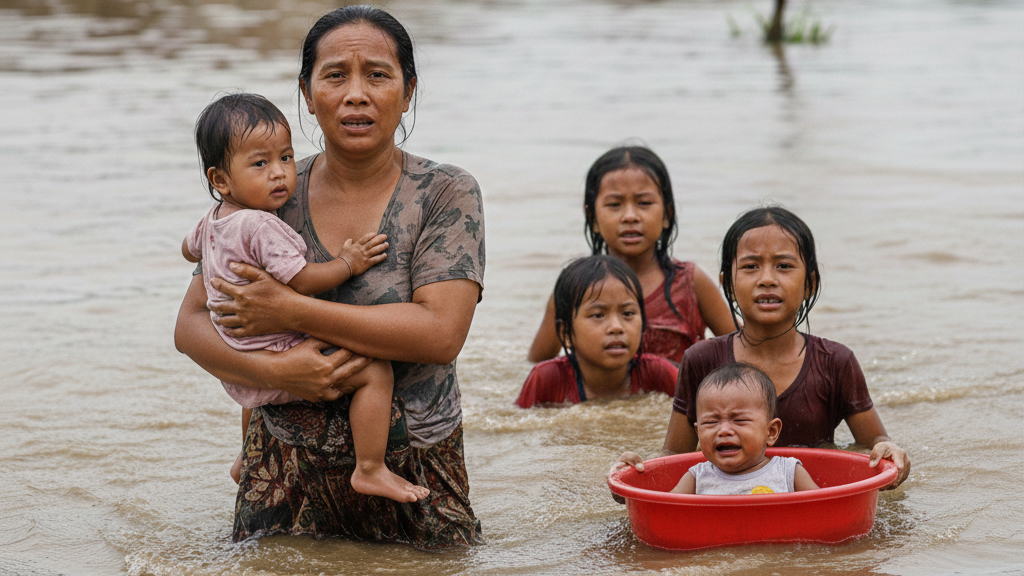
The floods sweeping across Southeast Asia have laid bare an often-overlooked crisis: the disproportionate burden borne by women and girls when disaster strikes. As monsoons and cyclones ravage Indonesia, Thailand, the Philippines and neighboring countries, the collapse of roads and homes is only the first layer — the hidden emergency is within evacuation camps, relief queues and makeshift shelters, where the risk to women and girls is higher, and where much depends on whether authorities respond with gender-sensitive care.
In Indonesia, where the disaster has hit hardest, officials are at least trying to steer relief toward inclusivity. Arifah Fauzi, the Minister for Women’s Empowerment and Child Protection, recently visited a flood evacuation center in Padang, West Sumatra, to personally monitor conditions for women, children, the elderly, and people with disabilities. Her ministry has coordinated with regional governments to assess shelter conditions and pin down priority needs. Hygiene kits, maternal and infant supplies, basic medicines, and even nutritional support like baby-milk are being distributed — actions meant to prevent the invisible tragedies that so often follow natural disasters.
Psychosocial support has also been rolled out in some locations, as authorities recognize that trauma from losing homes, loved ones, or livelihoods can hit women and children especially hard. The government has pledged to protect vulnerable people, and to maintain this support through both emergency and recovery phases.
That said, the magnitude of the disaster throws into doubt whether these efforts will be enough. The scale is staggering: recent estimates place fatalities in Indonesia at over 600, with more than 28,000 homes destroyed and 1.5 million people affected. Across the region, floods have displaced over a million people.
Aid organizations have underscored the urgency of making relief operations gender-sensitive. Plan International Indonesia, for example, has mobilized rapid-response teams in Aceh, North Sumatra and West Sumatra — and emphasized that women’s and children’s specific needs must be central to any disaster response. Their relief packages include hygiene kits (including menstrual hygiene supplies), blankets, sleeping mats — basic but critical items for women and girls in crowded shelters. In their own words, without inclusive approaches “disasters not only cause immediate harm but also worsen inequality.”
Yet even as some relief agencies push for inclusivity, other parts of the response continue to struggle with sheer scale, logistical obstacles, and coordination breakdowns. Authorities in Thailand, and Malaysia are scrambling to assist millions affected by the region’s worst floods in decades. In the Thai south, flooded provinces and battered transport links have forced evacuees into overcrowded shelters — raising fears that women and adolescent girls may face additional vulnerability, from lack of privacy to increased risk of gender-based violence.
Beyond immediate shelter needs, families displaced by floods face long-term social fallout. Schools — often safe harbors for children — have shuttered or become temporary shelters themselves. According to recent reporting, across Southeast Asia the number of displaced and out-of-school children has surged. When education stalls, girls are at particular risk of falling out of the system altogether. As argued by humanitarian groups, this disruption not only affects their academic future but deepens existing inequalities by cutting off one of the more reliable pathways out of poverty.
In addition, the environmental and historical context must be reckoned with. Experts say that the floods’ unprecedented severity was amplified by deforestation, illegal logging, and other forms of environmental damage — which stripped the landscape of natural buffers and turned torrential rains into deadly flash floods and landslides. That same environmental degradation tends to hit marginalized communities hardest, including rural families struggling to make ends meet, where women — often already responsible for water, food and childcare — now must navigate multiplied burdens.
In short, while officials and humanitarian agencies across Southeast Asia are beginning to integrate gender-sensitive measures into disaster relief — offering hygiene kits, infant supplies, psychological support and nutritional aid — the scale of displacement and destruction threatens to overwhelm those efforts. For women and girls, the fallout is not only physical and immediate, but systemic and enduring: lost education, greater inequality, increased exposure to exploitation or violence, and prolonged disruption of support networks.
If there is hope, it lies in sustained, inclusive response — from governments that commit to gender-aware planning, to aid groups that put women and girls at the center from day one, to communities that rebuild with equity in mind. The floods have exposed deep vulnerabilities; how leaders choose to respond now will define the long-term cost for half the region’s population.
Auntie has been there, my dears. Too many times. In the mud, in the stench, under the leaking tarpaulin roofs of those so-called “temporary” IDP camps that somehow become permanent features of our landscape. Southeast Asia’s postcard-pretty beaches and rice fields hide another truth: every year, climate disasters sweep through our region like a cruel lottery, and the poorest — especially women and girls — never seem to have the winning ticket.
Floods, typhoons, landslides… climate change and human stupidity have merged into one endless, miserable season.
And what does Auntie see, again and again? Camps thrown together with zero planning. Privacy? Ha! A word known only in government press releases. Safety? A luxury. Sanitation? A negotiation with fate. Women queuing for hours for toilets that don’t lock. Mothers trying to breastfeed in front of a hundred strangers. Teenage girls whispering to Auntie that they have no pads, no clean clothes, no protection.
And don’t get me started on the “safe zones” promised by local authorities — sometimes nothing more than a corner behind a plastic sheet. When a camp is not designed with women’s dignity in mind, it becomes a warehouse of suffering.
Auntie remembers one camp where women told me they slept sitting up, holding their daughters, to stay alert. Another where teenage girls stopped drinking water after 6 p.m. because the latrines were too far and too dark. Another where a pregnant woman walked three kilometers barefoot to find someone — anyone — with basic medical skills. These are not exceptions. They are patterns.
Aid? Oh yes, bags of rice and instant noodles dropped from trucks. But gender-sensitive support? Menstrual hygiene kits? Safe reporting channels for harassment? Psychosocial counseling? Only if you are lucky enough to be in a camp managed by NGOs that actually know what they are doing. Too often, the front line is staffed by people who have big hearts but zero training — and sometimes by officials whose main goal is taking photos for social media before disappearing back to their air-conditioned command posts.
And the most bitter truth? None of this is new. Climate change may be accelerating the disasters, but the incompetence is decades old. Auntie has watched governments talk endlessly about “preparedness” while failing to build evacuation centers that can actually protect the vulnerable. They know floods will come. They know storms will hit. Yet every year, we repeat the same tragic plays, just with higher water levels and more traumatized children.
Women and girls are always the silent majority in these crises. They carry the weight — holding families together, queuing for aid, keeping children alive, swallowing their own fear — and yet their needs are treated like optional extras.
Auntie says enough. In our region, disasters are no longer exceptions; they are the norm. So gender-sensitive response must also become the norm. Not tomorrow. Not after the next storm. Now. Because resilience is not a slogan — it is a lifeline, and our sisters deserve it.