


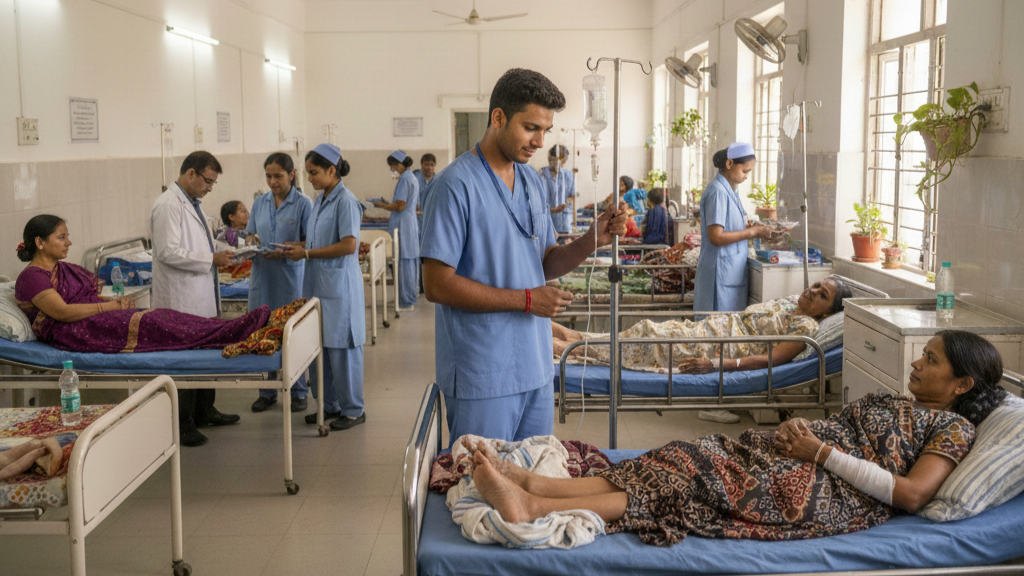
Male nurses are quietly but steadily reshaping India’s hospital wards — yet their footsteps echo with stigma. As the country grapples with a deepening nursing shortage, the rising presence of men in scrubs promises to relieve overburdened systems, especially in emergency departments and intensive-care units. But for many of them, being paid more than female colleagues offers only partial compensation for the persistent social and cultural resistance they confront.
It may surprise some to learn that, according to a 2025 study cited by The New Indian Express, male nurses earn on average 24 percent more than their female peers. This pay gap exists despite women constituting the overwhelming majority of the global—and Indian—nursing workforce. In a profession historically viewed as sādhāraṇ rūp se “feminine” (conventionally female), many men find themselves navigating a world that questions their motives, dismisses their compassion as anomalous, or treats them as “heavy-lifters” rather than caregivers.
Social attitudes play a major role. A fresh qualitative study from Odisha highlighted how male nursing officers experience “gender bias, occupational injustice, and social stigma” simply because their choice of career does not conform to entrenched expectations. What these men do — offering kindness, care, medical attention — is often discounted or considered suspect by patients, families, and even colleagues. In wards where intimate care is needed — bathing or dressing wounds — even patient discomfort is cited as a reason to channel men away from specialties such as obstetrics or paediatrics.
Yet male nurses are fast becoming essential to meeting India’s looming health-care demand. With an ageing population, rising chronic illnesses, and glaring deficits in the nurse-to-population ratio — currently around one nurse per 670 people, well below the recommended 1:300 established by the World Health Organization (WHO) — swinging open the doors wider to male nurses is not optional, but urgent. Across the country, new nursing colleges are being approved, and intake of male students is gradually increasing, especially in states like Punjab, Maharashtra, Karnataka, and Rajasthan.
Part of the hesitancy to welcome male nurses springs from the legacy of how nursing evolved globally. Since the era of Florence Nightingale, nursing has been cast as a woman’s calling — nurturing, gentle, maternal. Over time, this generated a stereotype so powerful that most nursing textbooks now omit or ignore the contributions of male caregivers from earlier eras. As a result, many male nurses report feeling socially isolated, professionally sidelined, or uncertain about long-term career growth — particularly in areas where “care” is conflated with femininity.
But the numbers make a compelling case: including more men in nursing isn’t just about gender justice or personal careers. It’s about saving lives. Men are often more likely to join emergency, critical-care, or physically demanding units — the very places where India’s shortage is most acute. Their participation helps stretch thin healthcare staff, reduce overwork and burnout among women, and bring gender balance to a profession that sustains the entire medical ecosystem.
It’s time for a paradigm shift. Klinīk aur aspataal (clinics and hospitals) must actively recruit men into nursing, supported by public-awareness campaigns that present nursing not as “women’s work” but as seva (service), competence and compassion. Institutional policies—like balanced recruitment quotas, scholarships for male students, and transparent career-progression tracks — could help dismantle norms that currently discourage men.
As India marches toward universal health coverage, the call is clear: more male nurses, less stigma — more care, less prejudice. For the health of the nation, and the dignity of those who care.
Ah, stigma — that stubborn ghost that keeps haunting our bright, modern corridors like an outdated hospital chart nobody has bothered to update. Prejudice and discrimination are its loyal sidekicks, always ready to whisper nonsense in people’s ears. And here we are in 2025, still treating these three like chronic conditions instead of eradicating them the way we once wiped out smallpox. Honestly, darlings, how much longer before we administer the cure of common sense?
Take the case of male nurses. These brothers in care walk into hospitals with steady hands and open hearts, ready to soothe, stitch, lift, comfort, and save. Yet some people still react as though compassion has a gender, as though tending to a patient is somehow “not masculine enough.” I want to grab these skeptics by their starched collars and ask: have you ever seen a trauma ward at midnight? You think fragile egos survive there? It’s courage, skill, calm, and kindness that keep those rooms breathing — qualities that don’t belong exclusively to any sex.
And the irony! While female nurses have held the system together for decades with grit and grace, male nurses often end up earning more. That alone should spark a national conversation, not about who is “fit” for the job but about why our health system rewards gender before competence. When discrimination flips direction, it doesn’t become justice — it simply proves the whole structure needs rewiring.
Meanwhile, hospitals and ministries cling to old habits like creaky wooden doors resisting the monsoon wind. If only they would push them open. Imagine a truly inclusive system, where a young man from Bihar or Kerala studying nursing doesn’t have to defend his career choice at every family dinner. Where patients understand that a professional is a professional, whether they wear a sari or a shirt. Where we stop snickering when a man changes a dressing or holds a newborn in the NICU. Where respect flows freely, like saline through an IV line.
To my dear brothers dreaming of a place in the ward: don’t give up. Your work is noble, your path necessary. Our region needs every capable pair of hands we can get. And to the rest of us: unclench those old prejudices. Let’s open our minds and hearts — the way these good men would, if the institutions guarding our health would finally open their ancient doors and let the future in.