


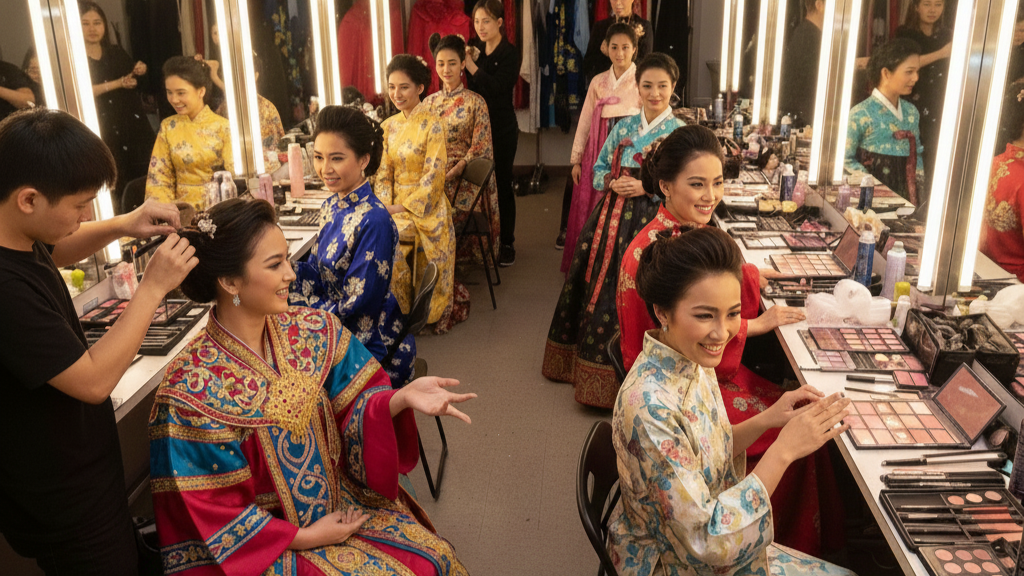
Bangkok’s neon nights have seen their share of glitter, gossip and grand entrances, but the latest Miss Universe contest in the Thai capital brought an unusually cinematic dose of drama, turning Asia’s already fervent passion for beauty pageants into a global talking point. The controversy over scoring irregularities, backstage clashes, and allegations of national favoritism rippled across social media faster than a crown can tilt off a trembling head. And, as always, millions across Asia tuned in—not only for the gowns and the glamour, but because beauty pageants in this region are woven into culture, aspiration, economics, and identity. From Manila to Mumbai, Bangkok to Busan, Asia’s relationship with beauty pageants remains as dazzling and complicated as a sequined sash.
The enthusiasm is rooted in history. Pageants first arrived in Asia as colonial-era curiosities, later repurposed into platforms for modern nation-building. In the Philippines, arguably the beating heart of global pageant fandom, victories by queens such as Pia Wurtzbach and Catriona Gray turned bayanihan (community spirit) into a glitter-coated national campaign. Filipinos treat pageants like international sport—training camps, TV marathons, and public send-offs included. Indonesia’s Puteri Indonesia and Thailand’s Miss Universe Thailand follow similar patterns, with contestants training for months in fitness, elocution, cultural advocacy, and that famously elusive art of “walking like a queen”—known among Thai fans as เดินสวย (beautiful stride).
But beneath the rhinestones, the regional industry is a serious economic engine. Pageants draw sponsorships from cosmetics giants, tourism boards, plastic-surgery clinics, fashion schools, skincare start-ups, and even fintech companies desperate to ride the attention wave. Bangkok’s hosting of Miss Universe this year alone generated tens of millions of dollars in hotel bookings, media production, advertising, and influencer partnerships. In South Korea and Japan, smaller national contests feed a lucrative talent pipeline for the entertainment industry. Even Nepal—never historically known as a pageant powerhouse—has seen a boom: the recent crowning of Luna Luitel as Miss Nepal World 2025 came with record-breaking sponsorships from beauty brands seeking Himalayan freshness for their global campaigns.
The stage also amplifies geopolitics, sometimes unintentionally. Miss Cambodia stirred cross-border tempests this year when she publicly backed Phnom Penh’s position in the long-simmering territorial dispute with Thailand. Her comments, framed as patriotic pride, ignited fierce online debate, with fans accusing her of politicizing a supposedly apolitical event while supporters praised her khsae khloun (personal integrity). It was a reminder that even a glittering runway cannot fully escape the gravitational pull of regional history.
Yet the industry is never free from scandal. Thailand—Asia’s unofficial stage for high-octane pageant drama—recently saw a local beauty queen stripped of her title after an X-rated video surfaced. Her defense, that the clip was part of personal content leaked without consent, sparked a national debate on morality, digital privacy, and double standards applied to women in public life. The case, covered by Thai and regional media, highlighted the collision between conservative expectations and the reality of online economies, where OnlyFans creators and beauty queens sometimes occupy overlapping digital universes. Whether she faces legal consequences remains to be seen, but the scandal exposed the fragile pedestal upon which many Asian contestants stand.
Across the South China Sea, Vietnam has been rewriting pageant history in bolder colors. The recent participation of a transgender woman—Nguyễn Hà Thảo Linh—as Vietnam’s representative in the Miss Universe contest marked a watershed moment for both the country and the region. Her presence triggered a tsunami of praise and predictable pockets of backlash. Vietnamese media framed the event as a triumph of bình đẳng (equality), while critics accused pageants of losing their “traditional identity.” Yet for many young Vietnamese, her inclusion was a proud sign that the national imagination is expanding.
Other countries are navigating their own pageant reckonings. In conservative parts of South Asia, pageants remain contested terrain, seen by some as platforms for women’s empowerment, and by others as Western-influenced spectacles. India’s industry, though still robust, faces questions about elitism and colorism. Meanwhile, Singaporean media recently asked whether beauty pageants still matter, hinting at declining participation and shifting public attitudes. The debate mirrors a broader regional inquiry: can pageants survive in an era increasingly uncomfortable with the measurement of women by appearance, even when wrapped in a language of advocacy?
And yet Asia’s fascination persists—part nostalgia, part aspiration, part commercial juggernaut. Pageants here are more than contests; they are national narratives draped in satin. They are young women turning personal ambition into global platforms. They are countries projecting soft power with a smile, a wai, or a perfectly choreographed sampa.
Whether celebrated or criticized, beauty pageants in Asia remain arenas where gender, culture, commerce, and modernity collide. And as the Bangkok drama showed once again, they will continue to command attention—because in Asia, the crown is never just a crown. It is a mirror reflecting who societies believe they are, and who they dream of becoming.
Let’s get one thing straight, my dazzling darlings: beauty pageants in Asia are both empowerment and commodification, tangled together like sequins stitched onto cheap satin. Anyone who pretends it’s purely one or the other is either naïve or selling something. Yes, more and more Asian girls with brains, ambition, and big dreams are stepping onto those global stages—and that, to me, is a sign of progress. These young women are articulate, educated, politically aware, and often far more clued-in than the men interviewing them. They bring advocacy, personal stories, and a refreshing refusal to be treated like decorative plants. That deserves applause.
But let’s not ignore the elephant in the dressing room: the business of beauty pageants is still firmly in the hands of men. Men with money, men with microphones, men with egos so inflated they need their own green rooms. And they are not always smart, nor respectful. The recent Miss Universe fiasco in Bangkok was proof—rumors, drama, questionable decisions, backstage powerplays, egos clashing like badly choreographed dancers. A global stage that should uplift women turned into a playground for grown men behaving like territorial roosters. Embarrassing, honestly.
And yet… here I am. Here we all are—millions of Asian sisters (and brothers, and aunties, and your cousin’s neighbor) glued to the TV, live-streaming gown parades while cooking dinner, debating scores in group chats, and shouting “She was robbed!” at the screen like true sports fans. What can I say? It’s spectacle. And spectacle is delicious.
But empowerment? True empowerment? That doesn’t come from crowns or sashes. It comes from rights, education, autonomy, safety, choice. It comes from having a voice even when the microphone is not offered.
Still, let me tell you the moment that made me pump my fist in the air: Vietnam’s trans candidate stepping confidently onto the Miss Universe stage. She didn’t make it to the top 20—no surprise, these “modern” pageants can still be as rigid as a plastic tiara—but her courage was radiant. And, for once, kudos to the Vietnamese authorities for allowing her to represent the nation publicly and proudly. That’s a win, not just for her, but for all of us who dream of a more inclusive Asia.
Beauty pageants? I’ll keep watching, teasing, critiquing, and celebrating. But let’s not pretend a crown liberates women. Women liberate women. The rest is glitter.