


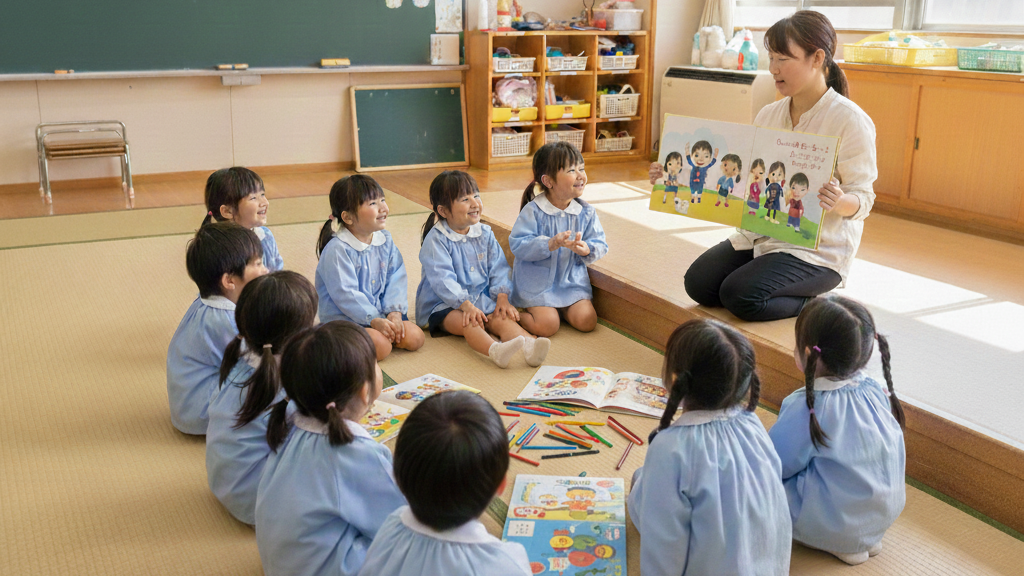
In Japan, where conversations about sexuality have long hovered in the shadows, a quiet revolution is taking place in the most unexpected of places: kindergartens. The phrase “Learning about sex is not dirty” is no longer taboo—it’s becoming a mission. In the city of Kunisaki in Oita Prefecture a workshop for children aged 4–6 tackled the topic of private parts with animated books and candid discussion—an indication of how early childhood education in Japan is evolving.
Such classroom moments mark a shifting tide in Japan’s approach to sex education (性教育, sei kyōiku). Traditionally, education about bodies and sexuality has been delayed until later years—typically the junior high (中学校, chū-gakkō) and high school (高等学校, kōtō-gakkō) levels—and content has been cautious, often emphasising biology without deeper engagement with relationships, consent or gender. Researchers note that Japanese curricula fall short of the international benchmarks set out by UNESCO for Comprehensive Sexuality Education (CSE), lacking in topics like sexual diversity and rights.
But educators and local governments are now saying that waiting until adolescence is too late. At the workshop in Kunisaki, children were invited to name body parts using an illustrated book titled Daiji Daiji Dō-koda? (“Where are your special parts?”) and shown images of cameras and smartphones with a clear message: the “special, important parts of your body… don’t take pictures or videos.” The rationale is simple: in an age of ubiquitous screens and increasing reports of sexual violence—even involving preschoolers—children need early tools to say “No,” to recognise their own bodies and to ask questions without shame.
Indeed, the National Police Agency of Japan recorded 33 reported cases of rapes of preschool-age children last year—the highest in 15 years—highlighting the urgency of preventive education. Local governments such as in Saitama Prefecture report a rising number of requests from nurseries and kindergartens for sex-education sessions, delivered by midwives or specialists.
Yet while early childhood lessons are gathering momentum, sex education in upper grades still faces hurdles. In junior high and high schools, content is typically embedded in health and physical education (保健体育, hoken-taiiku) or home economics (家庭科, katei-ka), and focuses on physical development, puberty and still relatively modest discussion of relationships or sexual rights. A 2019 article explained that Japan’s approach lags behind other countries because scientific, gender-diverse or inclusive topics remain rare in textbooks.
Legislative efforts have begun to catch up: in October 2022 a group of Japanese lawmakers proposed that public schools adopt a rights-based, inclusive model of sexuality education, aligned with international guidance. Moreover, the 2023 enactment of the LGBT Understanding Promotion Act obliges schools and government bodies to promote understanding of diverse sexual orientations and gender identities—an important cultural signal.
In the classroom of the future, middle and high school students are increasingly expected to learn not just about cell division and reproductive systems, but also about consent (同意, dōi), respect (尊重, sonchō) and boundaries (境界, kyōkai). However, surveys show uneven progress: one Tokyo high-school study found that while many students expected sex education via schools, actual knowledge about sexually transmitted infections or safe methods was inconsistent, and the Internet remains a powerful yet uncontrolled source of information.
Culture plays a big role in this transformation. Japan’s educational customs have long emphasised modesty and delayed deep discussion of sexuality; older generations often regard sex ed as risky or shameful. But younger educators argue that early education builds the foundation for later learning—how children learn to interact with others, respect bodies and speak up when something feels wrong. As one midwife in Kunisaki put it: “How we learn to interact with others is built on the foundations laid in childhood.”
Of course, this doesn’t mean that every kindergarten in Japan is now running animated books and workshops on private parts. Much depends on local boards of education (教育委員会, kyōiku iinkai), budget, teacher training and community consent. Research shows that best practice involves external lecturers—midwives, gynecologists—and collaboration between education and healthcare sectors.
From the baby steps in nursery classrooms to the still tentative lessons in high schools, Japan is gradually rewriting its script on sex education. For parents, educators and policymakers who have long assumed that young children should be shielded from sexual knowledge, the message is shifting: early, age-appropriate education isn’t about arousing curiosity—it’s about empowering children to respect themselves, understand relationships and stay safe in a world that increasingly demands those skills.
Oh, Japan, you sweet shy lotus flower—look at you finally catching up with what Auntie has been screaming for decades: teach the babies early, and you save them later. This little kindergarten in Oita, boldly telling tiny humans that their bodies are special, private, and worthy of protection, deserves a standing ovation with pom-poms, neon lights, and a giant arigatō banner. Auntie is positively glowing. If I had a fan, I’d be snapping it open dramatically right now.
Because let’s be honest: for too long, the idea of sex education (性教育, sei kyōiku) in Japan has been wrapped in layers of modesty thicker than a winter kotatsu blanket. And meanwhile, predators don’t wait politely for puberty. Digital threats don’t wait until junior high. Shame doesn’t protect children—knowledge does. What this kindergarten is doing? This is the blueprint.
And may this initiative spread across Japan like a positive wildfire—fast, unstoppable, and impossible to smother by the hands of the prudish brigade. In fact, let it jump oceans while it’s at it. Southeast Asia, South Asia, East Asia—come on, sisters and brothers! If Japan can start teaching five-year-olds about boundaries, private parts, and safety, then surely every other Asian country can stop clutching its pearls and follow suit.
What especially makes Auntie want to dance a victory bon odori is the emphasis on consent (同意, dōi). Oh, blessed be the teachers introducing this concept to older students! Consent is not some optional cherry on top of adulthood—it’s basic human interaction. It’s kindergarten-level respect, elementary-level communication, junior-high-level emotional intelligence. It’s the antidote to harassment, coercion, peer pressure, toxic masculinity, and the legion of problems born from silence and confusion.
Teach a child they have the right to say “No,” and you give them a shield. Teach them others have the right to say “No,” and you give them a conscience.
Auntie imagines a Japan where every school—from Hokkaido to Okinawa—embraces early, age-appropriate sex ed. Where high school students finally get comprehensive lessons not just on biology, but on relationships, boundaries, LGBTQ+ respect, and emotional well-being. Where teachers stop fearing conservative backlash and start celebrating empowered, informed youth.
And to the brave educators leading the charge: Auntie sees you, Auntie loves you, Auntie supports you. Keep going. Spread those workshops. Print those illustrated books. Say the anatomically correct words loudly. Normalize what has long been whispered.
Kindergarten today. A safer Japan tomorrow. A model for all of Asia.
Now that is a revolution worth cheering for.