


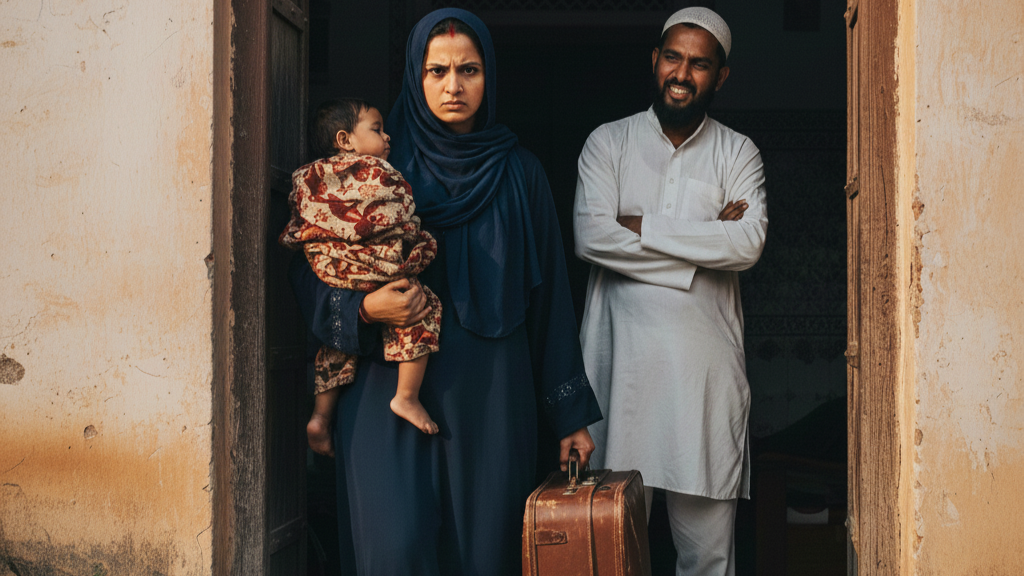
In India’s diverse tapestry of laws, the practice of Talaq‑e‑Hasan (three-step divorce) has quietly become a flashpoint for debates about gender equality and religious liberty. Under this Islamic mechanism, a husband may pronounce “talaq” (divorce) once each month across three lunar cycles, and by the third utterance the marriage ends — a sequence that many critics now argue is anything but even-handed. In India, a country that banned instant “triple talaq” (Talaq‑e‑Biddat) in 2017 and enacted the Muslim Women (Protection of Rights on Marriage) Act, 2019 thereafter, Talaq-e Hasan remains legally valid — but under growing scrutiny.
For many women in India’s Muslim community, the appeal of Talaq-e Hasan lies in its subtle promise of “lengthened” process rather than the abrupt divorce of triple talaq. Yet as columnist Amana Begam Ansari has argued in ThePrint, it remains a deeply one-sided, extra-judicial mechanism whereby the husband alone gets to decide, unilaterally, to end the marriage. Under this regime the wife must endure the uncertainty of the “iddat” (waiting) period; for the very real duration of three months she lives in limbo, while the husband holds the power to dissolve the contract at will. Even the unwelcome delegation of the pronouncement to an agent — for example a lawyer — was recently flagged by the Supreme Court of India, observing that such third-party talaq notices flout both Sharia form-requirements and constitutional norms.
To understand the cultural context we must recall that Islamic jurisprudence (fiqh) traditionally distinguishes between several modes of divorce. Talaq-e Hasan belongs to the category of Talaq‑ul‑Sunnah, which contrasts with the now-banned instant triple talaq. In India, while the latter was found manifestly arbitrary by the Supreme Court, the three-step mechanism escaped immediate regulation. The pain of the process has been particularly acute for marginalised Muslim women in India who lack resources, legal literacy or community backup — living in “suffocation”, as one activist put it, because the system provides little recourse against unilateral repudiation.
How does the Indian scenario compare with other Asian countries with large Muslim majorities or minorities? In Muslim-majority Malaysia, even though the husband retains the talaq-prerogative, jurisprudence and state syariah courts require that the divorce be registered with a kadi (Sharia judge) or registered authority; the unilateral power is constrained by formal procedural safeguards. Indonesia — the world’s largest Muslim-majority country — follows the Islamic principle of talak cerai (husband-initiated divorce) but also allows the wife to initiate gugat cerai (judicial divorce) and mandates court registration; in practice, though, implementation gaps remain, especially for women. These comparisons reveal that while unilateral divorce by husbands exists across jurisdictions, many Southeast Asian legal systems add registration, judiciary supervision or equal-ground access for wives — safeguards that Indian Muslim women invoking Talaq-e Hasan largely do without.
In India the question therefore is not just whether Talaq-e Hasan is “religious” or “traditional”, but whether a democratic society committed to equality can tolerate a gender-skewed regime where only one party holds the exit-door key. For a woman married under this regime, the pronouncement may feel like a ticking timer, rather than a mutual negotiation. As petitions now seek to challenge Talaq-e Hasan’s constitutional validity, the conversation has shifted from tradition to equal rights. The process may last three months, but the imbalance is baked in at day one.
In sum, Talaq-e Hasan in India sits at the intersection of faith, law and gender. It draws on centuries-old jurisprudence of talaq and iddat, but when stripped of procedural protections it becomes a unilateral swift-exit for husbands — with wives left in limbo. When contrasted with jurisdictions like Malaysia and Indonesia, the Indian model reveals a stark absence of safeguards for Muslim women. As reform debates deepen, the challenge now is to preserve religious freedom while ensuring that the marital contract does not become a one-way door.
Auntie is extremely annoyed today — and that’s me trying to be polite. Because honestly, India, darling, you strut around calling yourself the world’s largest democracy, a champion of pluralism, a nation of constitutional rights and modern aspirations… and yet here we are in 2025, still debating whether Muslim women — your own female citizens — deserve equal rights inside marriage and divorce. Are we serious? Are we awake? Is the WiFi on?
Auntie wants to shake this great subcontinental family by the shoulders and ask: What kind of democracy treats women as optional participants in their own marriages? What kind of “modern nation” still allows unilateral repudiation dressed up as tradition? You abolished instant triple talaq — bravo — but then left the door open for a slow-motion version of the same unilateral nonsense, only stretched across lunar cycles like some cosmic joke.
And to the guardians of “culture” who keep defending this as sacred and untouchable — ah yes, the bigots in turbans, the self-appointed clerics of purity who claim to speak for 200 million Indian Muslims — come closer, Auntie has something to whisper gently in your ear: Stop hiding your insecurity behind theology. Women are not your property.
Religion is beautiful when it uplifts. It turns poisonous when it becomes a shield for patriarchy. And you know perfectly well that fiqh, sharia, usul — whatever vocabulary you adorn yourselves with — has always been multi-voiced, interpretative, flexible. It’s not the divine will you’re defending; it’s your monopoly over interpretation. Your fear is not about God. Your fear is women who read, vote, earn, negotiate, leave, and demand equality.
And India — yes, I’m looking straight at you now — why are you letting these men claim an authority you never granted them? Why are you allowing a constitutional democracy to be outsmarted by medieval gatekeeping? If your Muslim sisters cannot walk into a divorce process with the same rights, agency, and dignity as everyone else, then something is fundamentally wrong with your idea of equality.
Auntie’s patience is thinner than a masala dosa today. Because equality is not a buffet where you pick what suits your palate. Either all female citizens have full rights, or you stop bragging about being a modern democracy.
Fix this, India. For your daughters, for your sisters, for the future you pretend to aspire to.
Auntie has spoken.