


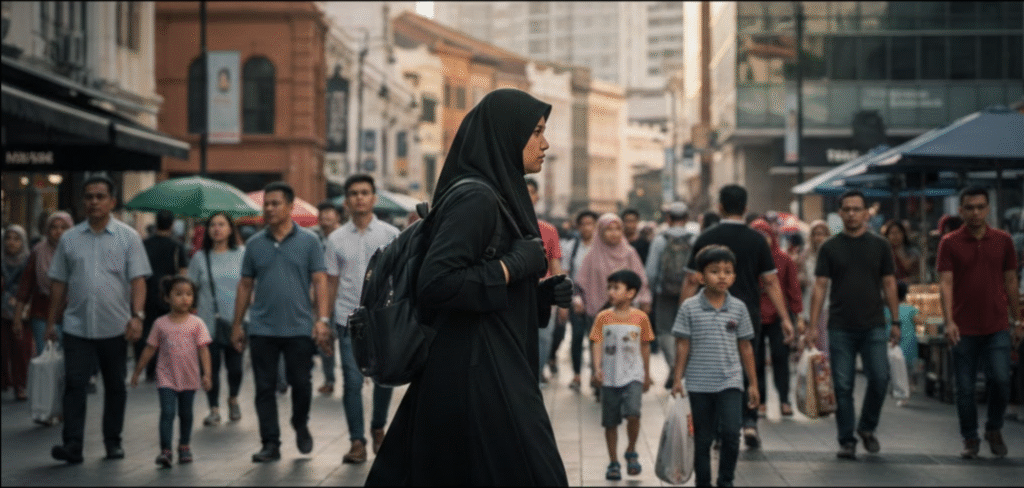
The typical image of a jihadi operative has long been that of a burly man wielding a gun or planting a bomb. But in Malaysia today, a quiet transformation is unfolding—one that is sending shock-waves through the nation’s counter-terrorism (pencegahan keganasan) framework. Women, often sidelined in profiles of militant extremism, are emerging as actors—not just as passive supporters, but as frontline participants, recruiters and even potential bombers. In the Malay language the shift might be framed as “ibu yang bukan hanya pengikut” (mothers who are not just followers). For authorities in Kuala Lumpur and beyond, the question is no longer whether women might be radicalised, but how they can no longer be ignored.
According to a recent piece in Focus Malaysia, Malaysian women and girls—active users of social media and participants in online religious circles—are becoming more visible as targets for extremist narratives. The article notes that Malaysia’s counter-terror apparatus has long been built on the assumption that militant activity is male-driven, leaving gaps in detection and prevention of female radicalisation. The shift matters because it taps into deep cultural codes: the Malay concept of “rumah tangga” (household) and “pengasuh” (care-giver) are being subverted when women who might traditionally be seen as homemakers become extremist operatives—mothers turned “mujahidah” (female warrior) in disguise.
The reality on the ground backs this up. Malaysian law-enforcement has reported that women today are not just collecting funds or marrying militants abroad, as was once more typical; rather, they are participating in radicalisation chains and instigating attacks. While many cases remain undetected, the shift from “supporter” to “instigator” is clear. Moreover, the regional threat is interconnected: in Indonesia, a detailed study shows a rising pattern of female suicide attackers and radicalisation among women that parallels and overlaps with the Malaysian experience. For example, a domestic worker in Taiwan who had worked in Singapore was radicalised online, married her handler via Telegram, and planned a suicidal bombing at Indonesia’s presidential palace—a case documented by Time. This shows how migrant worker networks (rangkaian pekerja migran) and social media intersect in gendered patterns of radicalisation.
In the Philippines, too, the landscape is shifting. The insurgency in Mindanao has featured cases of women linked with extremist networks; while women do not yet appear in equal numbers to men as bombers, they are increasingly part of family cells and support networks for groups such as the Maute Group and other IS-aligned networks operating in the southern islands. The cultural angle is critical: in Southeast Asia, women’s activism often happens in religious and community spaces—halakah (study circles), pengimarahan (preaching), even organizing events at the surau (prayer hall). Extremist recruiters exploit these very spaces and re-imagine them as springboards for radical action, turning traditional roles into instruments of violence. The trap is subtle.
Back in Malaysia, this means that the Teroris Act (Akta Kesalahan Keselamatan) and the rehabilitation efforts (program pemulihan) need to evolve. Detecting a male fighter slipping across borders is one thing; identifying a middleaged woman quietly facilitating recruitment or delivering an explosive inside a bag is quite another. Analysts point out that current systems often overlook women because of gender stereotypes—assuming they are victims, not perpetrators. Culturally, Malaysia’s social fabric emphasises wanita (women) as carers and community anchors; when those roles are reshaped by extremist ideologies, the shock is amplified. The concept of “keluarga inti” (nuclear family) becomes a vector when mothers bring children into radicalised households or women financier become the axis of home-grown cells.
To counter the threat effectively, it is not enough for authorities to treat women as adjuncts to male militants. The strategy must recognise that women may be radicals in their own right, often motivated by emotional appeals, a sense of injustice, ideological conviction and social isolation. The emphasis on “perempuan terpinggir” (marginalised women) may mislead—many are educated, social-media savvy, and deeply embedded in religious networks.
In sum, the emergence of women as key terror actors in Malaysia and across the region signals a paradigm shift: the next frontier of extremism may wear the guise of redundant mother, loving wife or devoted sister. The culture of “ibu penjaga rumah” (mother of the house) is being co-opted by jihadist playbooks. In a world where radicalisation adapts faster than state laws, recognising the gendered dimension—understanding how women are recruited, radicalised (terradikalisasi) and weaponised—is more urgent than ever.
Ah, sisters… this one hurts. It hurts deep, like a bruise under the ribs that refuses to fade. When I read about women—our women—walking down the path of violent extremism, I feel more than fear or anger. I feel a profound, almost maternal pain. Because behind every so-called “jihadist sister” or “mujahidah bride” or whatever melodramatic title these recruiters wrap them in, there is a story of a girl who once dreamed of ordinary things: love, dignity, safety, recognition. And now, somehow, she is carrying a bomb, not a baby; clutching rage instead of hope.
Yes, of course, the men play their roles. The manipulative preachers, the charismatic online recruiters, the husbands who whisper poison disguised as piety. There is always a man behind the curtain—coercing, controlling, seducing young women with promises of heaven or justice or belonging. But let’s not lie to ourselves: something deeper is happening too. Something simmering in the bones of these sisters.
It is rage. Quiet, accumulated, corrosive rage. Rage at systems that treat them as less-than. Rage at corruption that rots institutions. Rage at leaders who preach morality while pocketing public money. Rage at hypocrisy, at injustice, at being told to be patient, obedient, grateful—selalu diam (always silent).
And extremists know how to sniff out rage like wolves scenting vulnerability. They wrap it in sacred language, lace it with a fake sense of empowerment, and sell it as “purpose.” Suddenly the sister who felt invisible becomes “chosen.” Suddenly the system that failed her is recast as the enemy. Suddenly violence seems like clarity, purity, a way out.
But here’s what these sisters don’t see—what breaks my heart every time: hatred is a terrible adviser. Hate does not liberate. It devours. A bomb does not build a new world; it only shatters the bones of the old one. Their “sacrifice” will not cleanse corruption, will not heal injustice, will not restore dignity. It will only create fresh graves and deeper sorrow.
And the saddest part? Their lives, precious and full of unrealised potential, become footnotes in someone else’s war. The men who pushed them forward remain alive, recruiting the next batch. The system they despised remains unchanged. And their families—mothers, children, communities—are left carrying wounds that will never fully heal.
Sisters, we deserve better than martyrdom. We deserve justice, not jihad. And justice is never built with explosives—it is built with courage, compassion, and the refusal to surrender our humanity, no matter how broken the world feels.